Published May 1, 2003 12:00AM
If you buy through our links, we may earn an affiliate commission. This supports our mission to get more people active and outside.Learn about Outside Online's affiliate link policy
This Is Your Life
The Fountain of Youth is a myth. But take heart: Intelligent training and an adventurous spirit will keep you running, kicking, screaming at the peak of your potential for years to come.
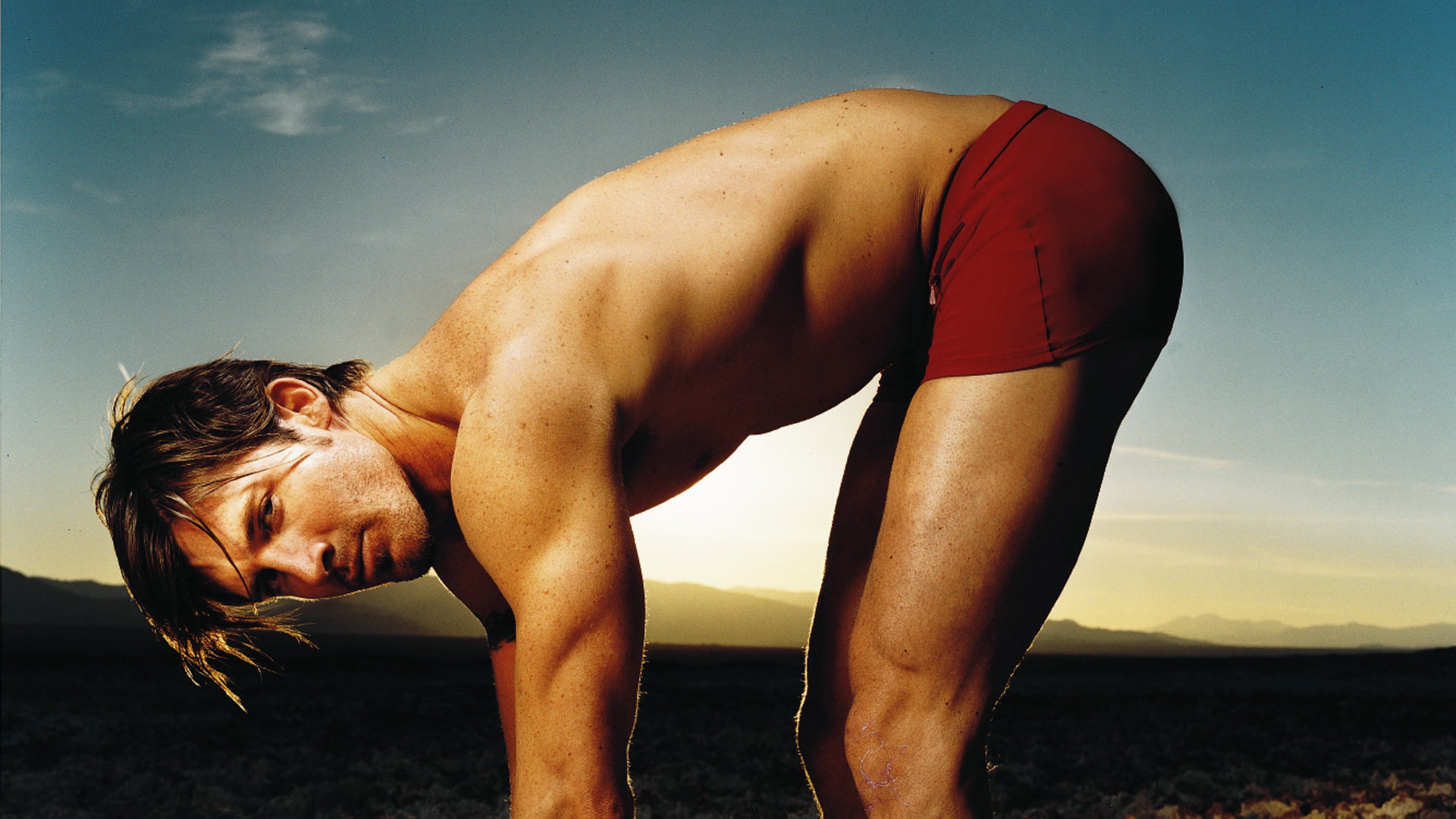
Brett Young, runner, boxer, and rock climber: “Your body is different every day, and you have to work it according to how it feels. Listen to it.” (Photo: Jeff Riedel)
The rest of your life starts now. It's true you can shape your destiny. But it will require choosing one of two paths:
- Muscles turn to flab in your thirties, you get clumsy in your forties, weak in your fifties, and by your sixties you're primed for heart attacks and cancer. At 74, it's sayonara, sucka; you've just hit the average life expectancy for an American male.
- You're Vincent Carnevale, 86, of Glen Ridge, New Jersey, and you just ran your 500th race—your 500th race since turning 70, that is.
The choice is a no-brainer, right? So read on for our strategy to stay young while you're young and for the long run.
Your 20s
Back in 1999, 20-year-old John Grossman, a part-time ski instructor, kayaker, and all-around fun hog from Ketchum, Idaho, decided to take up boardercross, that nutty mix of motocross and snowboarding. But during the Swatch Boardercross at Colorado's Copper Mountain, Grossman fell and badly dislocated his left shoulder. While he endured a couple more seasons of downhill combat, he ultimately came to a rather mature realization. “In some sports, you just hurt yourself,” he says. “It was too dangerous.”
The Bad News
“You have little concern about what life might look like after retirement,” says Christina Geithner, Exercise Science department chair at Gonzaga University, in Spokane, Washington. Grossman's epiphany underscores your biggest liability during this golden decade of athletic prowess: your Superman-like self-image.
But pay attention: Your body's decline has already begun. Cartilage, that Teflon-like material that ensures smooth joint movement, is deteriorating. Flexibility-wise, you're over the hill: Males' biggest natural gains in elasticity come at about 13, whereas in your twenties, collagen, the protein-based connective tissue around your joints, begins to harden and make you stiffer if you don't stay active. Suffer a common injury like a blown knee, torn shoulder, or tweaked back and you hasten physiological decrepitude—often through the likes of arthritis. Alas, recovery from those injuries is rarely 100 percent.
ADVERTISEMENT
The Good News
“It's the charmed decade. You haven't faced your own mortality,” says Geithner. And why should you? VO2 max, the maximum amount of oxygen that your body can process, peaks in your twenties. On average, muscle makes up a whopping 45 percent of a body's lean tissue. (The rest consists of bone, organs, and water.) Double bonus: Sixty percent of the horsepower in that muscle is generated by “fast-twitch” fibers, the ones designed for explosive activities like sprinting and leaping. With your body humming on all cylinders, you're more likely to take on activities—steepcreeking, BASE jumping, all-night Red Bull-and-vodka benders—that throw common sense out the helicopter window. Enjoy yourself.
The Prescription
- Keep your hamstrings and torso flexible by stretching them after every workout to ensure the muscles don't shorten and tighten up.
- “Make every third aerobic workout a cross-training day,” says Lynn Millar, a fellow at the American College of Sports Medicine. “If you're a runner, cycling, swimming, or rowing offers an excellent aerobic workout while giving your hips, knees, and ankles a rest.”
- Swimmers, cyclists, and other low-impact athletes, take note: Since bones develop throughout your twenties, you'll need a steady diet of explosive movements—lifting heavy weights that fatigue muscles in no more than ten reps, trail running, shooting hoops—to buttress bone density and carry you up to and through middle age. Do nothing for your bones and you risk the early onset of osteoporosis.
ADVERTISEMENT
Your 30s
If you exercise as frequently—and intensely—as you did in your twenties, you'll retain almost all of your physical abilities from a decade ago. But that's a big if.
The Bad News
“Physical decline happens in your thirties because you simply give it away,” says Jon Schriner, the medical director of the McLaren Sports Medicine Center, in Flint, Michigan. With each year of sluggish inactivity, you're able to lift 1.5 percent less weight. And goodbye, VO2 max: Your aerobic capacity drops up to 1 percent per year.
The Good News
You can minimize these losses with hard exercise, even if you can do nothing about a diminishing ability to bounce back from grueling workouts. It's a lesson that mountain-bike racer David Roth, 37, from Los Angeles, learned to heed only after falling out of the top ten in race after race. Finally, after watching his bike-racing wife's smashing podium finish (the result of a carefully measured training plan of exercise and recovery), Roth saw the error of his go-till-you-blow training habit, held over from his teens. To stay competitive, Roth needed to learn periodization, a training plan that ebbs and flows throughout the year, with months of increasing intensity followed by a couple weeks of recovery. According to periodization guru Joe Friel, author of Going Long, most thirty-somethings are capable of three physical peaks—be they marathons, bike races, or triathlons—per year. Nowadays, Roth enters only two big races during the season, but the payoff is worth it. Says Roth, “I know I'm a better athlete now than I was when I was 20.”
ADVERTISEMENT
The Prescription
Follow our basic 12-week periodization program to reach peak shape.
- First month: Complete a full-body weight-lifting circuit twice weekly. Do your cardiovascular workouts on three other days at low intensity, going long on one day. Each week, increase the duration of the long day's workout by 10 percent. On the fourth week, cut the workout load by 50 percent.
- Second month: Cut back to lifting once a week and add another day of cardio. The eighth week is for recovery, so cut the volume in half.
- Third month: Stop lifting and use that day for cross-training. Ramp up your speed by completing one of the week's cardio days at race pace. Your long day gets no longer, and for weeks 11 and 12 you halve its duration. Week 12 has you tapering by doing only 50 percent of week 11's work. After you cross the finish line, take a couple of weeks off and then start the 12-week cycle anew.
- Your metabolism has started to ease off by as much as 10 percent, so steer away from the burger and fries and head toward the whole-grains shelf and the organic-produce aisle for your caloric sustenance.
ADVERTISEMENT
Your 40s
Just when you think you've acquired and nailed all the skills necessary for your sport of choice, these ten years introduce serious bugs into the operating system.
The Bad News
The cerebrum—the complex part of your brain that is the center for decision-making, learning, and reasoning—may shrink as much as 20 percent over the rest of your adult life. One study has shown that between 45 and 50, response functions—a combination of reaction speed and movement time—slow about 5 percent, or long enough that you'll swipe at air instead of digging out a rival volleyball player's spike. And simultaneously handling a lot of peripheral information also becomes harder; witness the fact that chess grand masters fade by age 40.
ADVERTISEMENT
As for the flesh, it's not unusual to carry about 17 more pounds of unneeded mass than you did in your twenties. As fast-twitch muscle fibers wither, explosive power recedes from your forearms and calves, diminishing climbing and sprinting performance, respectively. What's more, key mechanisms for proper kidney function diminish by 10 percent, making dehydration a bigger threat. Drink up.
The Good News
“Changing up activities expands your capacities for all physical functions,” says Waneen Spirduso, a professor of kinesiology and the director of the Institute of Gerontology at the University of Texas at Austin.
Colorado-based rock climber Jeff Achey, 44, battled encroaching mental and physical deficits by taking on sport routes way beyond his comfort level. Now falling no longer means failure—it means he's challenging himself in the right way. “Being OK with a 20-foot fall from an overhang is a skill that every good climber needs,” he says. “I know it's made a huge difference in my abilities.”
The Prescription
- You need to keep your internal balance receptors and the nervous system sharp, and you have to strengthen the small muscles that keep the back, hips, knees, and ankle joints in shape, since weakening muscles that cross over your joints result in decreased mobility. Accomplish all the above by balancing on a wobble board for ten minutes, three times a week.
- Your body requires 120 fewer calories per day at age 40 than at age 30, but those remaining calories have to pack more nutrients. Get them from vitamin-heavy fruits and vegetables, not processed foods, and start eating nuts, seeds, olives, fish, and avocados—the healthy fat in them actually puts the brakes on hunger.
ADVERTISEMENT
Your 50s
Duncan howat didn't start rowing until he was 54. But not long after settling into a scull, the 58-year-old general manager of Mt. Baker Ski Area, in Washington, realized a couple of things: He'll never again have a 25-year-old's engine, but someday he could have an Olympian's stroke. “I asked myself, How do I best offset the effects of aging?” recalls Howat. “Emphasize technique to the maximum.”
The Bad News
By your sixth decade of activity, it's time to take an age-related reality check. You'll still be able to play outside plenty hard, but after 50 you need biomechanical efficiency to offset natural physical deterioration. To wit, muscle-mass losses can accelerate to 1 percent annually, and bone density can start slipping at a rate of approximately 0.4 percent per year. You'll increasingly struggle to focus clearly on the newspaper as tissue changes in your eyes, and your cardiovascular system will maintain its slow but steady decline.
The Good News
A weight-training regimen will prevent peak power from falling dramatically until you're past 60. And as Howat proves, you've still got excellent coordination.
ADVERTISEMENT
“Compared with the rate of muscle-mass loss, an athlete's loss of kinesthetic awareness (a sense of where and how your body parts move) is quite slow,” says Spirduso, who conducted a study of masters rowers in 1998 and found that even into their sixties, the oarsmen posted times that were only 17 percent off world-record marks. Spirduso partially attributes the graybeards' amazing performance to their excellent form.
The Prescription
- Lifting three times a week can help you avoid losing as much as 15 pounds of muscle mass. Work the whole body: chest, back, shoulders, stomach, and legs. Studies show that in only two months, you'll gain two and a half pounds of muscle and could lose more than four and a half pounds of fat. “Make sure to vary the weights and reps with each workout to prevent your muscles from adapting to the loads,” advises William Kramer, professor of exercise physiology at the University of Connecticut. One day, lift heavier weights for six reps. The next, lift lighter loads for 15 reps. The next should be a normal day of pushing out ten reps.
- Assuming your body's in good shape, there's no medical evidence that says you need to reduce the frequency and duration of longer aerobic workouts. “But slow down, pay close attention to hydration, and be modest about your training intensity,” says Walter Bortz, marathoner and co-chair of the American Medical Association Task Force on Aging. “Older runners can run marathons, but they still need to do all the training everyone else does.
- “The Institute of Medicine recommends a daily calcium intake of 1,200 milligrams. Pills aside, swallow three daily servings of leafy green vegetables and dairy products to keep those bones strong.
Your 60s
You took a little time off from working out? Maybe a couple of decades? Don't panic, it's not too late. “I lived in Southeast Asia for 18 years, smoking and drinking and carousing and falling out of shape,” says ex-Olympic swimmer Jeff Farrell, 66. Returning to the hyperfit environs of Southern California, however, kicked him back into gear. Within a few years, he was setting new masters swimming records.
“Exercise isn't a bulletproof vest, but it maximizes your potential for a healthy future,” says Wojtek Chodzko-Zajko, professor of kinesiology at the University of Illinois at Urbana-Champaign and president of the International Society on Aging and Physical Activity.
ADVERTISEMENT
The Bad News
Exercise and a healthy lifestyle now represent the difference between life and looming mortality. Between 60 and 79, your chances of getting cancer are one in three. But scientists believe that a full third of cancer-related deaths could be prevented through improved diet and a regular fitness regimen.
For those of you who never retired the gym bag, you've lost 25 percent of your peak power but can still make gains in hamstring flexibility. Your reaction time is 20 percent off its peak of decades ago, but you've got more fast-twitch muscle fiber remaining than was once thought possible. Arthritis affects more than 4.3 million men over 65, but studies indicate that a weight-lifting regimen eases impressive amounts of discomfort—more than 40 percent.
The Good News
Science indicates that a return to training at any age reverses the effects of poor health and brings you back to solid form. In a study begun in 1966, researchers gave a fitness test to five healthy men, all in their twenties. Thirty years later, the men were tested again after participating in a moderate six-month endurance training program. The results showed that the subjects' VO2 maxes reached their levels of 30 years ago.
ADVERTISEMENT
The Prescription
- Build up the muscles around your joints to ward off pain caused by osteoarthritis with squats, step-ups, and leg extensions three times a week.
- Eat foods rich in omega-3 essential fatty acids—such as salmon and albacore tuna, as well as olive oil and flaxseed oil—to reduce tissue inflammation caused by arthritis.
- Cross-train with tai chi to utilize your body's full range of motion and keep your neuromuscular network in tune.
Your 70s+
You already met Vincent Carnevale, the perpetual-motion runner and our poster boy for supercharged seniors. Ask him if the scientists who claim that athletes as old as 70 can increase calf-muscle size by 12 percent are right. He'll probably say, “Of course.”
ADVERTISEMENT
The Bad News
Experts say that mechanical signs of aging accelerate inexorably after 70. Arthritis becomes more prevalent. VO2 max decreases until your body utilizes more than 50 percent of its aerobic capacity to accomplish daily tasks, threatening your independent lifestyle. Studies indicate severe strength drop-offs: Backs, hands, and biceps all get notably weaker.
The Good News
Or do they? In a study that tracked a six-month weight-lifting program for men over 70, the subjects reaped 60 percent increases in peak quadriceps strength. And a separate 12-week training study for participants between 85 and 97 showed 134 percent increases in power.
ADVERTISEMENT
“It's unclear how far these changes in performance are due to a lessening of training with age versus aging itself,” writes exercise physiologist Roy Shephard in his book Aging, Physical Activity, and Health. If you stay active, the medical community might learn a few things from you.
The Prescription
- With clearance from your doctor, train with similar frequency and intensity as the youngsters. In the gym, using relatively heavy loads and performing as little as one set of only eight reps will generate impressive gains.
- The body's thermostat has gone on strike. Sweat glands operate less efficiently, making you more susceptible to heatstroke. Avoid extreme heat. A thinning of the skin layer called the subcutis results in less insulation, which, combined with poorer circulation, makes seniors likelier candidates for hypothermia. Bundle up.
Research has proven that consistent exercise can add two years to your life, and it undoubtedly improves the quality of those years. “People with active lifestyles don't show age-related changes to the same degree as sedentary people,” says Christina Geithner. “Your biological age can be different from your chronological age.” If you're fit, you'll always act younger than you are.
Andrew Tilin (@atilin) is a former Outside senior editor.
