Published February 19, 2026 03:05AM
For One Perfect Day, Apostle Islands Ice Caves Re-Opened After 11 Years
For one extraordinary day, the Apostle Islands Ice Caves were re-opened, the first time in 11 years. Our contributor Stephanie Pearson was among the lucky to witness this fleeting natural wonder.
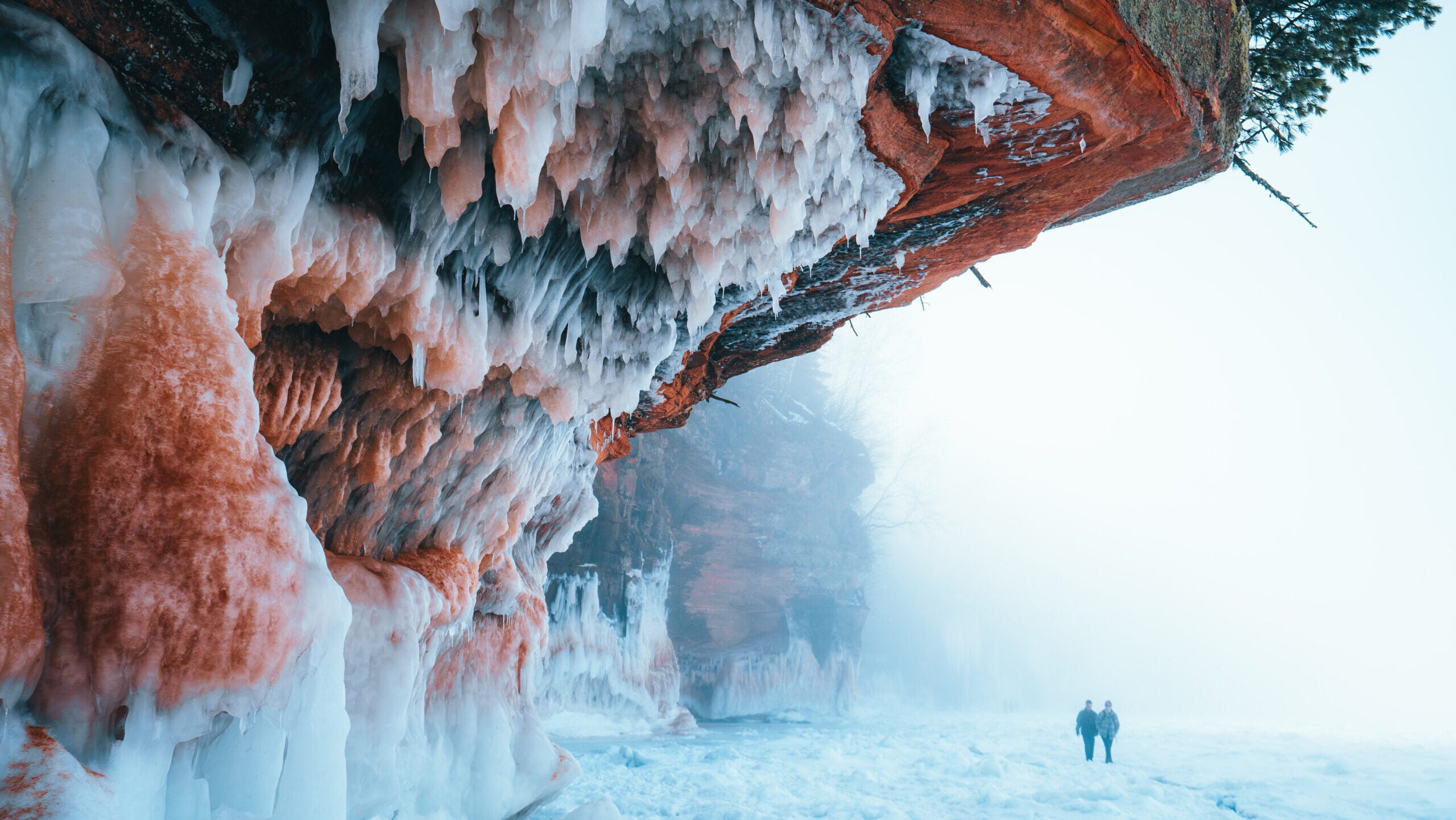
For one perfect February day, the Apostle Islands Ice Caves were re-opened after being closed for a decade. Our contributor Stephanie Pearson was fortunate enough to visit the fleeting wonderland. (Photo: Courtesy of Travel Wisconsin)
Ice is everywhere. It’s hanging above me in a curtain of daggers, with tips so sharp they could cleave a body in half. It spreads out below me on the surface of Lake Superior, frozen in a two-foot-thick mass. It’s growing out of sandstone walls in the form of delicate spine-like needles and caught in frozen, sculpted waves cascading from caves. Some ice is blue, some is stained the color of cinnamon, and some is so clear I can see through it to the cerulean sky. The most exposed ice is melting under a powerful sun.
I’m not alone in this ethereal wonderland. My sister Jen, niece Ellie, and I are walking with hundreds of others, like a line of purposeful ants, from the starting point at Meyers Beach across pack ice for two miles along Wisconsin’s Apostle Islands National Lakeshore. This section of shoreline is lined with cliffs, below which are sea caves, formed over centuries by the relentless pounding of Lake Superior waves. It is devoid of safe havens—like beaches—making the caves unsafe and nearly impossible to reach. Lake Superior is so powerful that an ice shelf can be crushed to pieces within minutes.
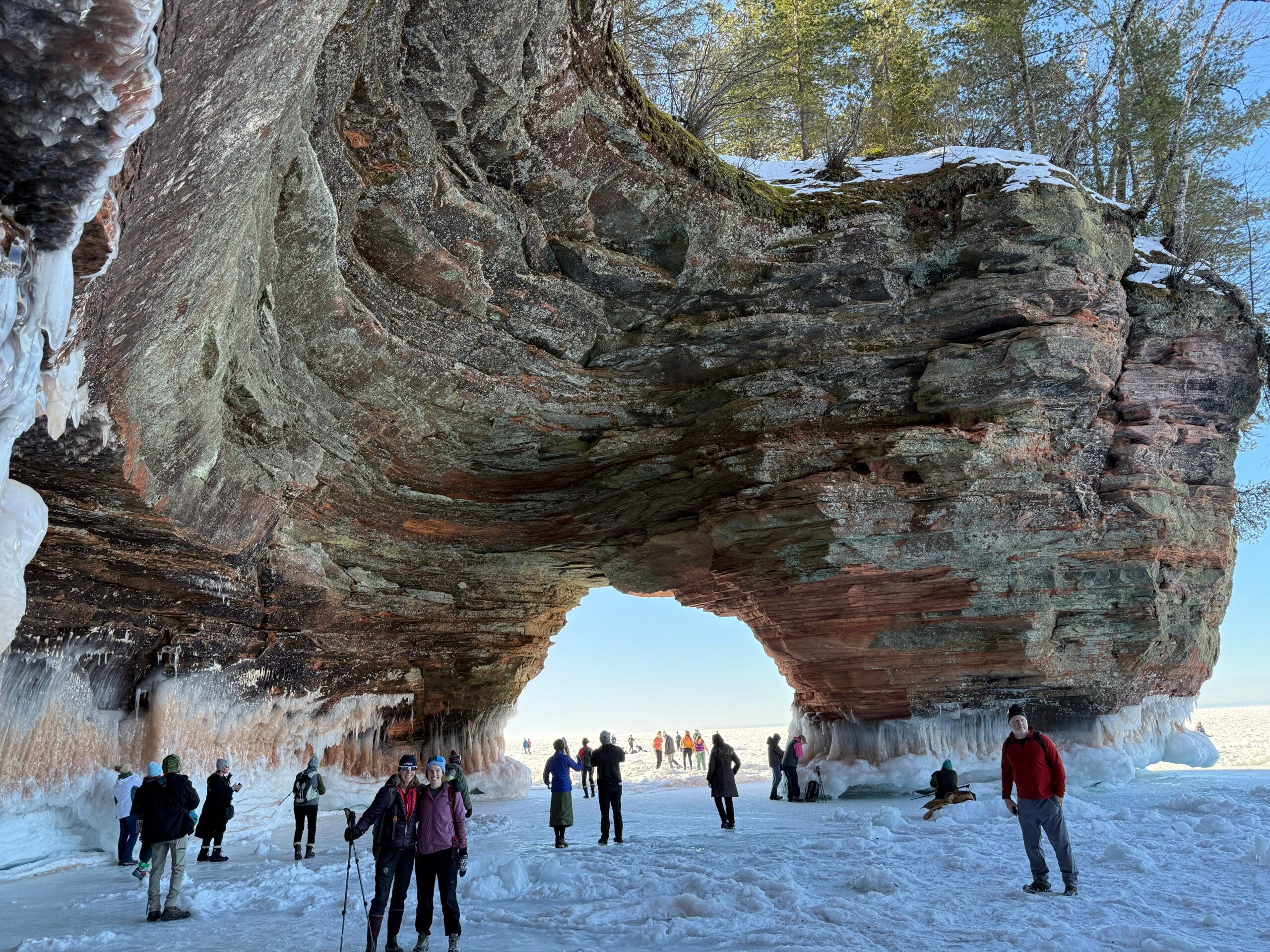
But today the conditions are perfect. Kids pulled in on sleds by their parents are yelping in glee, slipping and sliding around jaws of ice. Young couples hold hands, staring up in awe at four-story, frozen waterfalls. Others sit on portable camp chairs set outside the gaping maw of aptly named “Cathedral” or the crack in the earth known as “The Crevasse,” each formation a universe of ice and sandstone unto itself.
ADVERTISEMENT
All of us are under the collective spell cast by one of the most fleeting spectacles within the National Park Service. To see these caves takes patience. The last time they were open to the public was in 2015.
To experience such an oasis of fleeting beauty is extraordinary. But this year’s visit felt like divine intervention—a dose of natural awe and wonder sent from above to make it through fraught times.
No one needs more patience than Apostle Islands National Lakeshore Superintendent, BriAnna Weldon. “This rare winter event occurs only when ice conditions meet minimum safety thresholds,” she wrote me in an email. “Ice testing is only one part of preparing.”
All winter, the National Park Service regularly checks ice conditions, coordinates with regional ice testing, and receives daily forecasts from the National Weather Service’s Ice Center. To determine whether it is safe to walk miles across Lake Superior’s frozen surface, the park use six factors: “sustained low wind to form an unbroken shelf of ice; persistent subzero temperatures for strong ice formation; an ice shelf that is anchored to three land points and extending miles out from shoreline to withstand winds and lake currents; consistently frozen ground for ice shelf to adhere to land masses; thick, quality lake ice that can support people and emergency vehicles; and auger tests to confirm ice stability, thickness, and quality.”
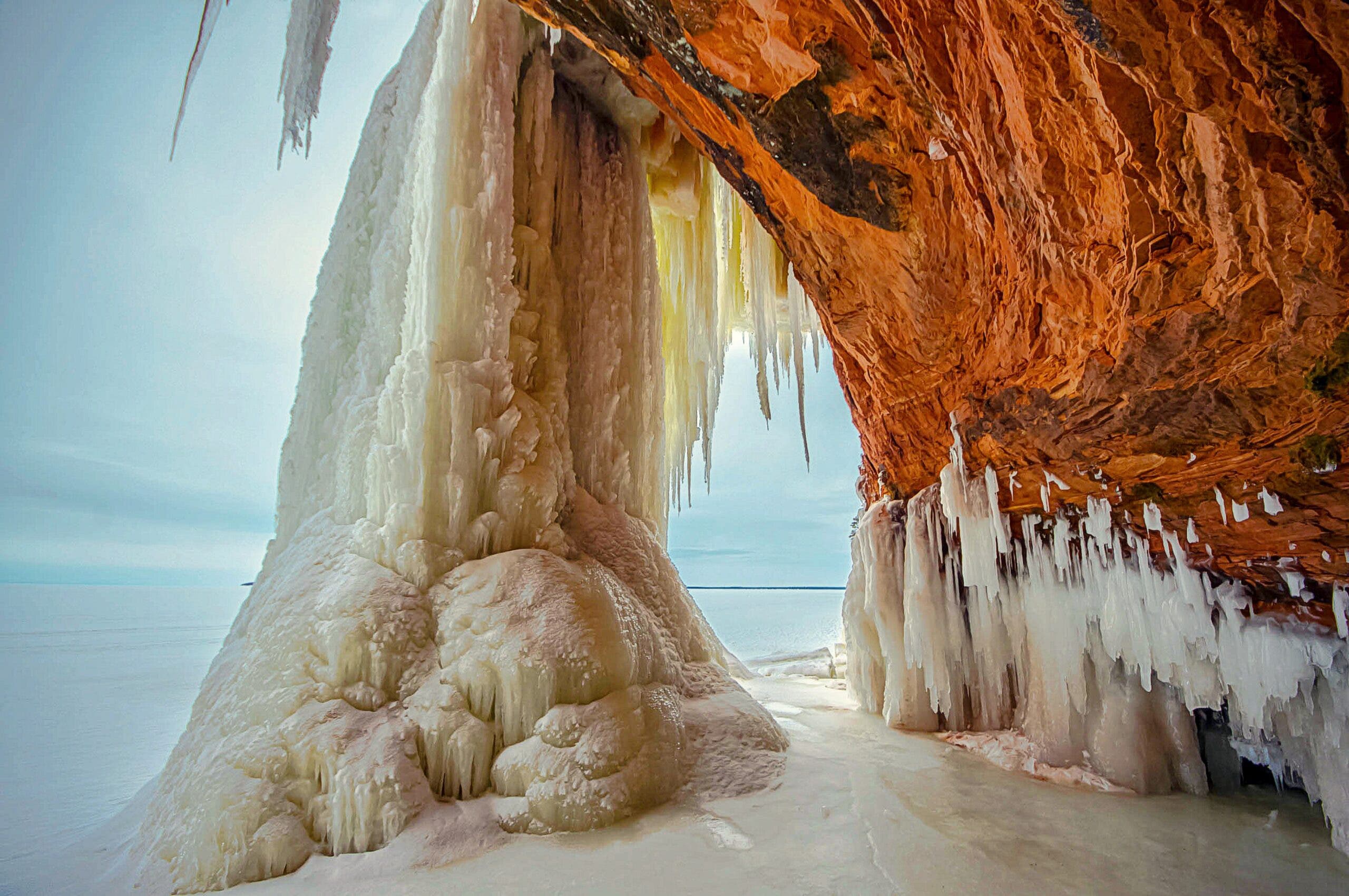
Once the ice is safe enough, the park staff must coordinate with emergency medical services and ice rescue teams, plus arrange road and transit access, incident response, and visitor services. “Without the support of numerous community partners and extensive interagency coordination,” says Weldon, “the ice caves event could not happen.”
ADVERTISEMENT
The Fleeting Return of the Apostle Islands Ice Caves
Since 2000, the caves have been open to the public for only six of 26 years, from a few days to a few months. In 2014, a record-breaking 138,000 people visited over a span of two months. In 2015, the caves had 38,000 visitors, but were open for only nine days.
This year, the park gave the public a day’s notice via its social media channels that conditions on February 16 might be conducive to opening the caves. After the alert, 2,500 adults paid the $5 entry fee. We met people from Milwaukee and Minneapolis, who drove for hours, much farther than our 70-mile road trip from Duluth, a route I know well. In 2021 I spent six months driving back and forth to the National Lakeshore, reporting a feature for National Geographic. But the winter caves had always eluded me.
To experience such an oasis of fleeting beauty is extraordinary. But this year’s visit felt like divine intervention—a dose of natural awe and wonder sent from above to make it through fraught times.
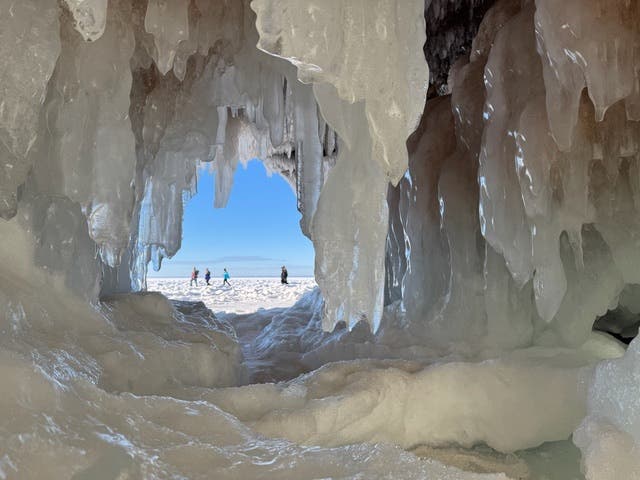
Roughly 24 hours after we walked off the lake on Monday evening, a powerful winter storm rolled through and broke the ice shelf near Meyers Beach into pieces. By 8 A.M. on Wednesday morning, photos from the University of Wisconsin’s Sea Cave Watch showed a lake wide-open, bobbing with an occasional slab of ice.
According to the National Park Service, it’s unlikely that another stretch of sub-zero temperatures and calm winds that form stable ice will return before spring, a not-so-subtle reminder to carpe diem.
ADVERTISEMENT
Stephanie Pearson is a contributing editor to Outside, a 2023 National Geographic Explorer, and the author of the new book 100 Hikes of a Lifetime U.S.A. She recently covered Minnesota’s Coldest Ice Fishing Derby.


