Published October 31, 2023 09:21AM
E. Jean Carroll Has Some Stories to Tell
In a conversation among three hall-of-fame veterans from Outside’s early years, E. Jean Carroll talks about her life, her career, and how she came to write a funny, much loved story that had serious feminist intent
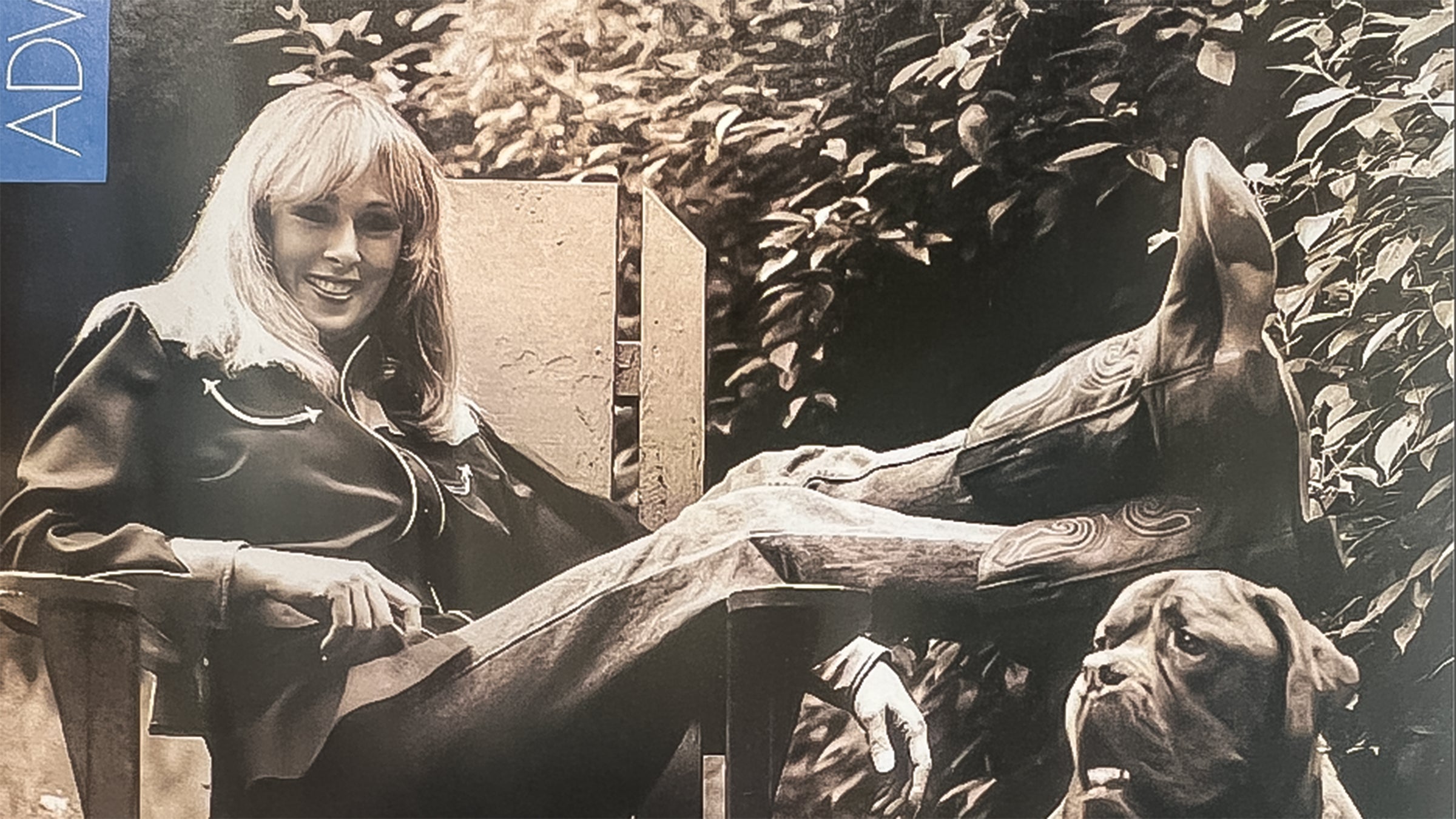
A 1990s author shot from the Ask E. Jean column (Photo: Courtesy E. Jean Carroll)
This story update is part of the Outside Classics, a series highlighting the best writing we’ve ever published, along with author interviews and other exclusive bonus materials. Read “Cowgirls All the Way,” by E. Jean Carroll here.
On the day in June when I was scheduled to interview E. Jean Carroll, it had been less than a month since she’d won a federal civil trial in New York against Donald J. Trump for sexually assaulting her and defaming her during a widely publicized campaign of verbal abuse. Consequently, the demands on her time had become rather intense. Among her many to-dos:
- Dealing with media requests from all over the world.
- Writing her Ask E. Jean column on Substack and cowriting a serial romance novel with Mary Trump—the former president’s niece and a prominent critic of his conduct and politics—while creating an online platform, with her attorney Robbie Kaplan, for women who’ve been sexually assaulted.
- Introducing her new rescue dog, a Great Pyrenees beauty named Miss Havisham, to Guff, her sweet old pit bull.
- Suing Trump for defamation. Again. After he called her a liar and a “wack job” during a CNN town hall held on May 10, a day after the verdict against him.
Carroll was so busy that it felt like our scheduled interview in upstate New York might not actually happen. I was nine minutes away from her remote mountain cabin when my phone rang.
“Have you already left?”
Uh, yes.
Beat.
“OK then! Meet me at the emergency room!”
Eight minutes later, I greeted her in the ER parking lot. She looked chic in a belted white cargo jumpsuit and black combat boots. On her cheek were a laceration and a purpling bruise.
ADVERTISEMENT
“I broke up a dogfight,” she said, sounding pretty chipper about it. Guff and Miss Havisham had vigorously disagreed; E. Jean attempted to mediate. One more adventure in a life overflowing with them.
Full disclosure: I’ve known E. Jean Carroll for 35 years, starting when I worked at Outside in the late 1980s and early ’90s and she wrote for us. Later, from 2013 to 2019, I edited the Ask E. Jean advice column for Elle. I’ve been friends with her long enough to know that she reveres Jane Austen and Joan Didion and is a vegetarian who’d dreamed of being a writer since she was six. But in all that time, she never uttered a word to me about what happened to her in a Bergdorf-Goodman dressing room nearly 30 years ago.
It was only when New York magazine published an excerpt from her 2019 memoir, What Do We Need Men For? A Modest Proposal, that I learned what she’d been carrying all those years—not just the horrible encounter with Trump, but bad incidents with other men, too. She lived with these traumas even as she hiked the mountains of Papua New Guinea as a writer for Playboy in search of what the magazine unfortunately called “primitive man” and conducted action-packed interviews with Hunter S. Thompson for her 1993 book Hunter: The Strange and Savage Life of Hunter S. Thompson.
You want gonzo? “I stayed with Hunter two weeks the first time,” she recalls, “and the second time about eight or nine days—before we got into a fistfight and I ran to the phone and dialed a taxi. When the nice lady dispatcher picked up, I screamed, ‘Help! Help! Help!’ And she said, ‘Are you at Hunter’s?’”
I know what Trump’s defamations cost E. Jean, because for 27 years she was a marquee columnist at Elle, providing counsel to women with problems that were sometimes frivolous but more often very serious. And when she spoke out about the primitive man who had sexually assaulted her in Bergdorf’s, she lost her job.
A definition of a resilient person is one who is able to hold contrasting ideas and experiences in her head and continue to live a meaningful life. E. Jean embodies this concept, which is good, as her dispute with Trump is far from over. In late June he countersued, saying that Carroll had acted with malice when, after a jury settled on a lesser charge of sexual assault, she publicly said that he’d raped her. Meanwhile, Carroll has another federal suit underway—it involves derogatory statements Trump made while in the White House—that appears to be heading toward a trial.
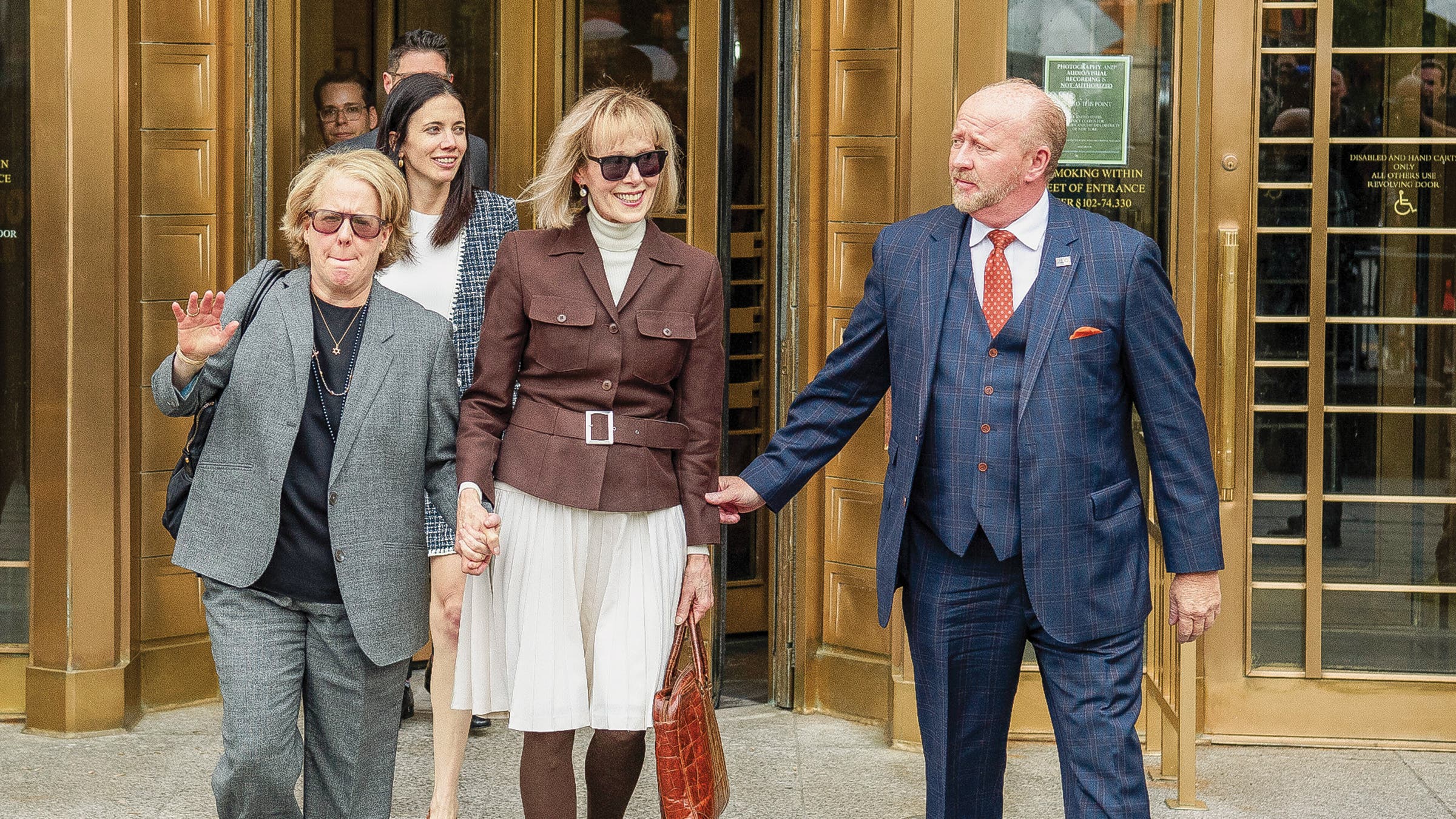
After all the ER drama was done—two hours, one tetanus shot, and one bottle of antibiotics—we finally went to her home, which is surrounded by a small forest of turquoise-painted trees. “The water-based paint helps them stay strong and grow fat and ward off bugs and look pretty at the same time,” she explained. The house is also fronted by a chartreuse sign in the driveway that warns: BEWARE THE HOUND OF THE BASKERVILLES / SHE IS BIG AND CRAZY.
ADVERTISEMENT
Inside, books are the central design motif. They overflow the shelves and are stacked in piles on the furniture and the floor. She used to keep some in the oven, until she got rid of the oven. We made a salad with crusty bread and discussed hard work, humor, adventure, and the ways men see, or don’t see, women—all ideas that permeate her 1981 Outside story, an elegant, hilarious, and seething-just-beneath-the-surface report on a competition and pageant called Miss Rodeo America. The interview features a helpful phone cameo from John Rasmus, Outside’s head honcho during those years and her editor for the story.
OUTSIDE: This piece was published in 1981—that was 42 years ago. Yet it feels like it was written last week.
CARROLL: Jesus. Well, the culture hasn’t changed. It was my first story for Outside. Ten days in Oklahoma City for the Miss Rodeo USA Championships! Nobody in magazines would send you anywhere for ten days now.
RASMUS: In the summer of 1980, I was out in Grand Teton National Park on vacation. Steve Byers—then E. Jean’s husband, and later the editor in chief of Outdoor Life—reached out to me from Montana. He said, “Come to Ennis. My wife is a writer, and this guy David Quammen lives nearby.”
CARROLL: Quammy!
ADVERTISEMENT
For those who don’t already know: Quammen, a columnist and feature writer for Outside in the eighties and nineties, did more than anyone in the magazine’s history to define how it covered natural science. He’s the author of many books, including Spillover and Breathless, which examine the conditions that led to the COVID-19 pandemic and the development of the vaccines.
RASMUS: I drove up there, and Byers, Quammen, and I had just enjoyed this fantastic day fly-fishing on a creek near the Madison River. We came back for dinner, and E. Jean was described to me as extremely focused on her work: “We may not see her. She writes all day out back in the shed with the spiders.”
CARROLL: Fourteen black widow spiders.
You were 37 when “Cowgirls” was published. What kind of jobs did you have before then?
CARROLL: I was a lifeguard. I was a teacher. I was in Chicago during the riots after Martin Luther King Jr. was shot. I taught gym there. I taught gym at the girls’ reformatory school in Saint Anthony, Idaho. From the time I was 12, those were the jobs I would take as I filled the mail with pitches to magazines. Nobody hired me, ever.
RASMUS: She proposed “Cowgirls” to us at a point when we were really trying to do more writing-for-good-writing’s sake—going for the humor, energy, and quirkiness that became central to the Outside brand. She was already very much part of the Montana writing scene in the seventies and eighties, a whole world of people with high ambition and deep literary backgrounds, countercultural and postmodern personas. E. Jean had confidence and star power, and her piece had a stream of consciousness to it. She didn’t explain too much, she just pulled you along for the ride.
Who were your heroes? Who was in your head while you were writing “Cowgirls”
CARROLL: Didion. There’s a lot of Joan Didion in that piece.
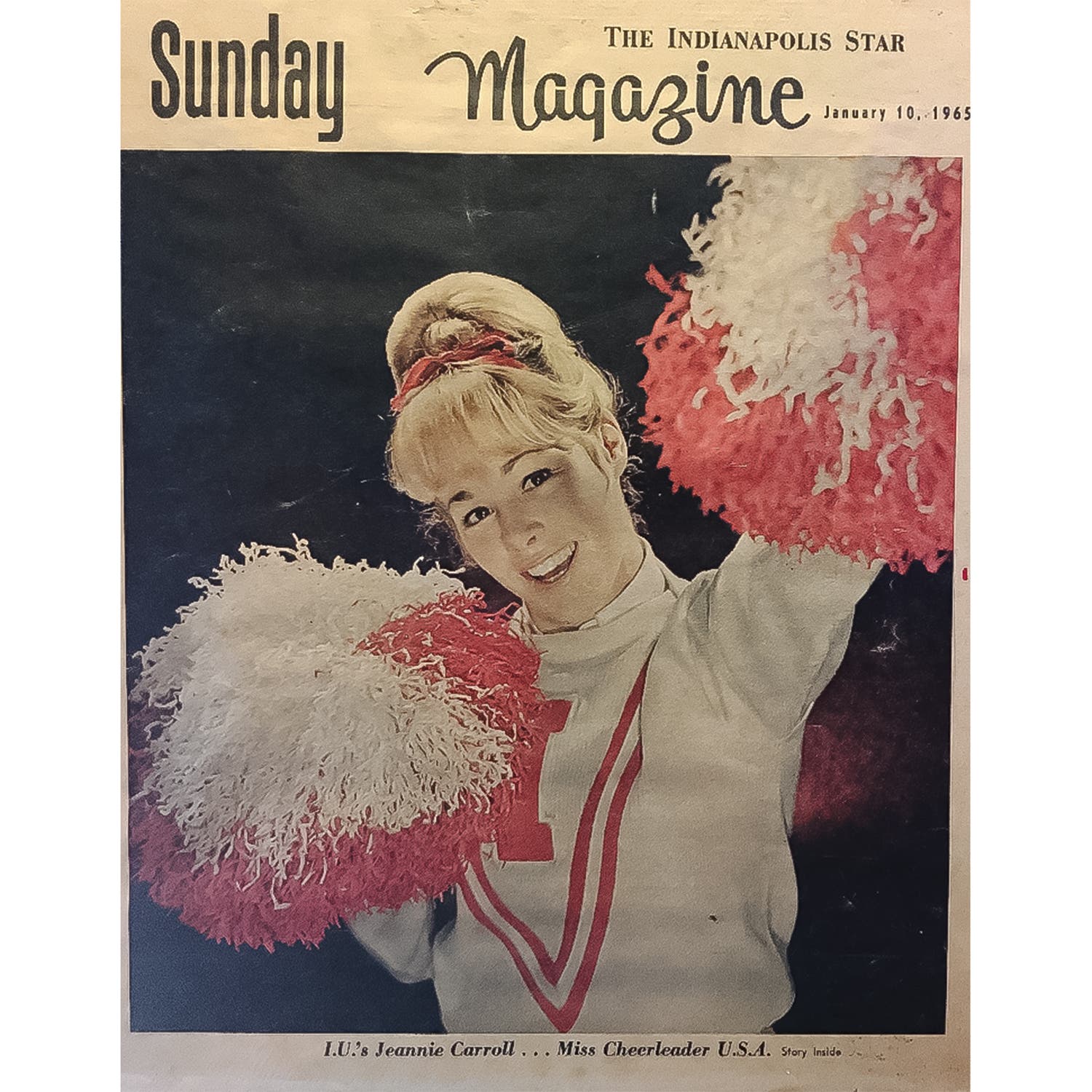
There’s a great line in the story where you say to Miss Rodeo Utah, “You look like you’ve won a lot of beauty contests. Have you ever entered one?” When you were in college in the early 1960s, you were a beauty queen yourself, and a cheerleader. What was that like?
CARROLL: At the University of Indiana, I was in a sorority, Pi Phi. They would put us up for these contests as a duty to the sorority—for instance, they told five of us to compete for Miss Indiana University. And all five of us ran up and down the runway. And because I have a large personality, and I love being on stage, and I didn’t mind strutting around in high heels in a bathing suit, and I did a comedy routine for my talent portion, and I thought it was all ridiculous, I won Miss Indiana University. My mother was happy because it got me a paid semester of tuition.
As for Miss Cheerleader USA, the athletic department put me up for it. I found myself in the finals and won the thing. It was fun—you can see in the pictures that I was enjoying myself. There were really beautiful girls in those contests, much prettier than me. But you’ve got to have that sort of oomph. I had the oomph.
RASMUS: You can just imagine what she was like on the phone when we were talking about the rodeo idea. “Rasmus! I’ve been a cheerleader, I know what this competitive life looks like. These cowgirls are great, they’re strong, they’re beautiful!” She talked William Allard, a famous National Geographic photographer, into doing the shoot for a reduced rate. How could we not do it?
CARROLL: They were real athletes, a real help to their parents on their ranches. They could turn those horses on a dime, because they needed to turn those horses on a dime. If a calf runs off when you’re moving the herd to high grass, you have to know how to handle a horse. They knew how—they were put on horses when they were two and three. Miss Utah took her first naps on her horse.
The story works on two levels. On one hand, it’s a very straight and fun telling of what you saw—the direction the arrows on their form-fitting jackets are pointed, how they handle a horse. But I sense an undercurrent of rage at the way these kinds of competitions diminish the cowgirls’ totality as serious women and athletes—which is what a woman on a horse is.
CARROLL: There was anger in there. I left a lot of stuff out. Three instances in particular made my blood boil. They had a lot of cocktail hours, events that the rodeo queens had to go to with the big boosters from Oklahoma and Texas—guys who were there to meet the queens. I was talking to somebody from Oklahoma, and he said, “Oh, Miss Oklahoma is such an airhead. Don’t even bother talking to her.” That’s how he talked about his own queen. But she was so smart. She was tall, really lean, I think she was at Oklahoma State and may have been going to vet school. Obviously, she had brushed him off.
They also told the queens they had to “loosen up.” And when they were getting ready to go to an event with all the big chicken pluckers from Alabama and such places, they had them parade around these guys in a circle, march around and act like they were having fun, and at the end they were told to yell, “Bullshit!” They made the queens say “bullshit” to get them to loosen up.
ADVERTISEMENT
What’s the third thing that made your blood boil?
CARROLL: A man who was connected to the officials at the competition, and who was always just around, came up to me on the first or second day I was there, looked me up and down, and said, simply: “No strings.”
Yuck. Do you think your life outside—the years in Montana and the trek in Papua New Guinea, the river expeditions and road trips—was a response in any way to the things that happened to you at the hands of men? Put another way: Did your life outside make you feel less vulnerable to those kinds of men?
CARROLL: Miss Lizzie, long ago, deep in the sticks of Indiana, my ma opened the door, and I ran outside the moment I could walk. I am still outside. Now I am the old crone on the mountaintop. And people are frightened of me.
Lisa Chase started her career as an editor at Outside, then moved to New York and worked for Premiere, The New York Observer, New York, and Elle. She followed her dreams and opened a restaurant in 2020, then followed her gut and closed it in 2023.
11/01/2023 This story has been updated to correct a detail about Steve Byers: he was once the editor in chief of Outdoor Life, not Field & Stream. Outside regrets the error.
Add Outside as a preferred source on GoogleAdd