Updated May 13, 2025 01:17PM
Mike de la Rocha Learned All His Greatest Lessons from the Ocean
In his new memoir, de la Rocha explores the meaning of vulnerability, manhood, and the healing power of the outdoors.

(Photo: Wade Brands)
Mike de la Rocha is a difficult man to define. He’s an artist and an advocate. He’s the voice of a generation and a bit of a beach bum. He’s an award-winning change-maker and the co-founder of two businesses: a Pasadena coffee shop that provides work for formerly incarcerated people, and an internationally renowned creative agency that connects celebrities with social change movements. And now, he’s an author, too.
De la Rocha’s forthcoming book is an ode to his profound and emotionally complicated relationship with his late father. The man, Ismael “Mayo” de la Rocha, could be an enigma. He was at once a professor who mentored thousands of students over the course of his long career, and a closed-off figure who struggled to teach his own sons emotional intimacy. The tale de la Rocha weaves is an intimately vulnerable story about culture, the trappings of masculinity, and the capacity we all have for change. In Sacred Lessons: Teaching My Father How to Love, de la Rocha reflects on the enduring lessons of the ocean and how surfing and the natural world helped him break through the layers of conditioning and forge a deeper relationship with his father—and with himself.
In the below excerpt, de la Rocha stands on the beach with his toes in the sand, looking out at the ocean and back into the past. As he reflects, he reveals some of the lessons his father did teach him—everything from how to whittle down your belongings (including toys) to the bare essentials, to how to withstand the shock of freezing water, even when your body begs you to flee.
As I stood there with my bare feet touching the warm dirt, I felt alive. I felt I was a part of something bigger than myself, connected to the past, to the present, and to the future.
As I made my way back to my campsite, I began to think about my father. In that precise moment, whether it was because I’d taken off my shoes to let my feet touch the ground, or because I’d spent time with the ocean, I realized my father is the reason I love the water so much. My father is the reason that every time I feel down, every time I feel alone, I go back to the beach.
ADVERTISEMENT
Some of my fondest memories as a child are of me riding my bike alongside my dad on the beaches of Ventura. I vividly remember him throwing our bikes in the back of his pickup truck and driving along the coast. I was absolutely mesmerized by the waves and the way the sun hit the sand and reflected off our bikes. We would ride our bikes for miles upon miles, and I wouldn’t once complain because I was not only at the beach, I was at the beach spending time with my father.
As I looked up, I noticed a huge cloud of smoke and pointed to the sky. “Papá,” I said, “what’s that?”
“It’s nothing, Mijo. Let’s keep going,” he replied.
Confused, I asked, “But Papá, what’s that horrible smell?”
Trying not to laugh because I’d used such a big word at such a young age, my father repeated, “It’s nothing, Mijo. Come on, let’s keep going.”
Not wanting to leave, I persisted, “But why does it smell so bad?”
My father couldn’t stop himself from laughing as he started pedaling away. “Let’s go!” he said.
Years later, I found out that I was smelling the stench of cannabis as I rode through my first ever live concert, listening to the music of the greatest jam band of all time, the Grateful Dead.
My father isn’t the typical beach guy. In fact, he doesn’t even like going into the water. But nature has always been the place that my father goes to when he needs to get away from the pain of life.
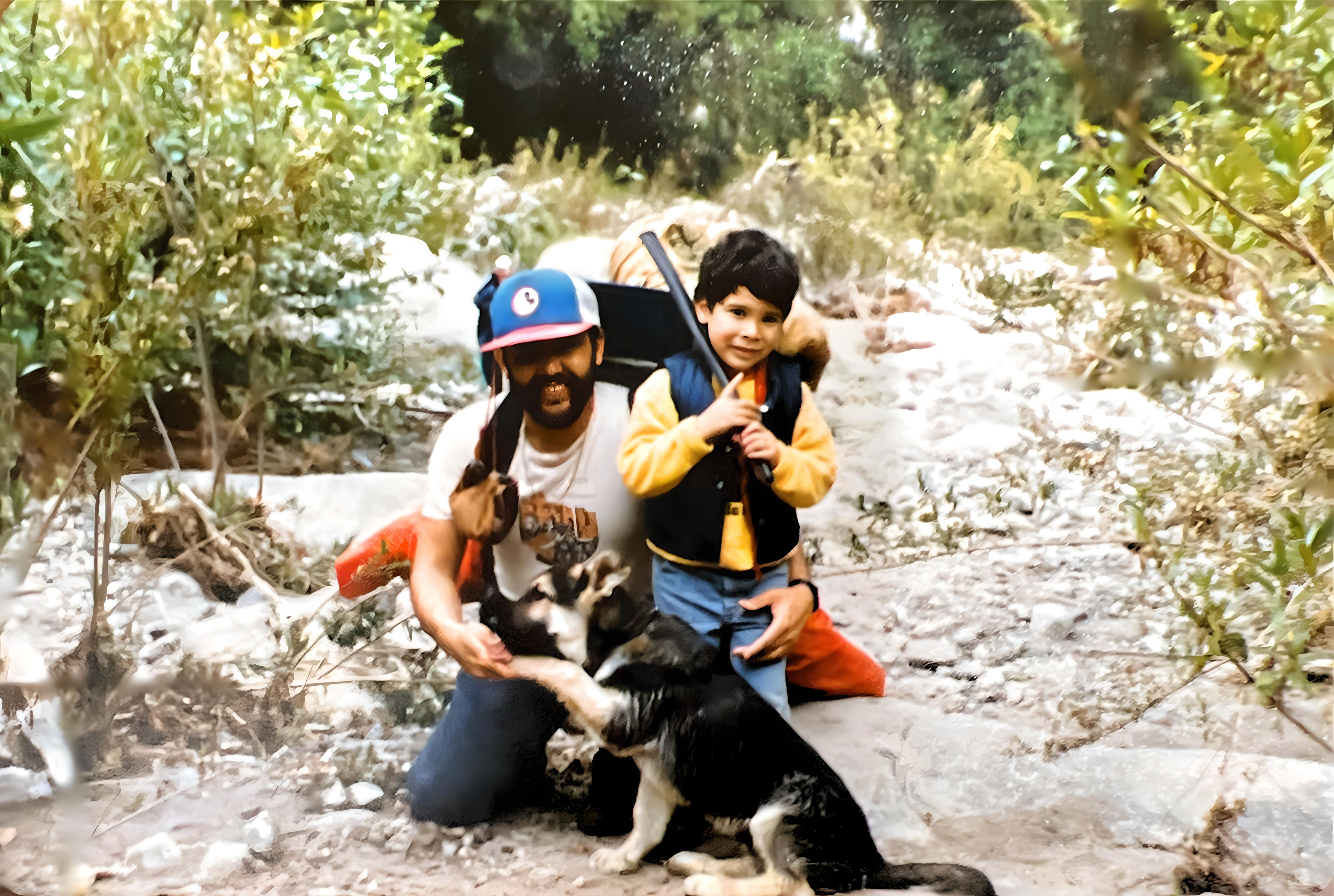
Even before I learned how to ride my bike, my father would take me and my brother camping at least three or four times a year. This wasn’t glamping, or even camping with bathrooms and showers down the road. This was real camping, complete with us having to pack everything that we needed in our own backpacks and then carrying them up the mountain all by ourselves. We would spend the entire day walking with these heavy backpacks until we finally stopped and put up our tents.
My father absolutely loved to go camping, because it’s one of the few places where he could just let go and not worry about work or life or anything else. He didn’t have to stress about whether he was going to be judged or ridiculed for how he looked or for who he was. He could be transported back to that feeling of abundance and acceptance that he’d felt as a child playing among the apple trees and orchards in Atascaderos. He could put himself back into a situation where he could relive that undeniable feeling of being loved.
ADVERTISEMENT
Looking back at it now, camping was a sort of ritual for my father to escape the bustle of everyday life every couple of months. Like running, it provided him with a space to disconnect from the monotony of work and reconnect with his core, his own inner being. And through these experiences, he taught me that being in nature was a powerful way for me to rejuvenate myself for the weeks, the months, and sometimes even the years ahead.
I remember being six or maybe seven years old, camping for the weekend with my papá and my brother in Santa Paula. I remember packing my small backpack and then looking over at my father and saying, “Papá, why are you packing so many things?”
“Because once we’re camping up in the mountains, we can’t come back home to get anything. We have to pack everything that we need right now.”
“Everything? Even my toys?” I asked as only a young, naive little boy would do.
“Michael, you can only take one toy with you because we have to take a lot of stuff with us. We have to take our sleeping bags, our tent, our food, and our clothes for the entire weekend. And Mijo, remember that we have to put everything in our own backpacks.”
ADVERTISEMENT
“Our own backpacks? But Papá, mine’s too small to take everything that I need.”
And with a smile, my father simply said, “I know, Mijo. Just pack one toy to take with you and we’ll figure out the rest.”
During those precious moments, my father was teaching me about what mattered most in life. He was teaching me that the material items were secondary to having the space and the time to just be with myself and my family. When we went camping, he was adamant about us bringing only the bare necessities, the essentials. No more, no less. And this was an important lesson that he wanted me to learn: that I didn’t need any of the material “things” that I thought I needed to be happy and content.
ADVERTISEMENT
As I contemplate this lesson that my father was trying to instill in me at such an early age, I think about my relationship with material possessions and overconsumption in general. I think about how I buy things that I really don’t need because for most of my life I’ve struggled to accept my inherent value. I’ve struggled with feelings of inadequacy and of not feeling worthy.
A direct byproduct of this way of thinking is that I buy unnecessary things that bring no tangible benefit to my life. Worse, I know that I have become addicted to shopping, which I now realize is a result of my childhood trauma and my not thinking or feeling that I was good enough. Shopping has, unfortunately, become a way to fill a void within myself.
Looking back on it now, I see that my father took me camping because he wanted me to learn that I had everything I needed within myself. That I didn’t need material goods to make me feel whole or bring me a sense of value and happiness. In fact, the opposite is true, and my love of surfing, an activity that anyone can do for very little money except for the cost of a surfboard and wetsuit, is proof of that.
I also remember my father taking my brother and me to the punch bowls to swim and to play in the water.
“Mijo, jump into the water,” my father would say.
I remember timidly looking at the water and saying, “But it’s too cold, Papá,” as I stood on the edge of the lake with my arms crossed.
“Jump into the water,” he would say in an even sterner voice.
And when he said it that way, with that tone, I knew he wasn’t asking me to do it, he was telling me I had no choice but to jump into the water.
Sucking up whatever courage I could muster, and giving my brother a side eye that said he’d better do it too, I jumped into the water without thinking about it. Was I cold? You bet. Was I scared? Absolutely. Did I want to immediately get out of the water? You know it!
ADVERTISEMENT
And every time I tried to get out, my father would say in an even sterner voice, “Mijo, you better stay in the water. Your body will get used to the temperature and you won’t be cold anymore.”
“But it’s too cold, Papá,” I pleaded.
It was no use because my father would say, “Stay in the water. Don’t come out. Put your head under the water. Michael, you’re going to be fine. Stay in the water.”
My father was definitely hard on me, but I know that he wanted me to learn the value of not giving up, of not taking the easy way out, of sticking through the discomfort of it all. He wanted me to get over the initial shock of the icy-cold water so I could find the joy on the other side. And he was always right, because afterward my brother and I would stay in the water for hours upon hours until the sun started to finally go down.
ADVERTISEMENT
My father always intuitively knew that the lessons my brother and I needed to learn could only be found in nature. He always knew that children, and people in general, learn through experience and watching others. That’s why he was so adamant about taking me camping before I could even walk. He wanted me to know that the outdoors provided not only the greatest lessons in life but also the greatest medicine. He wanted me to know intimately the healing power of the land and that anything was possible when we stuck together as a family, and as a community.
When my father’s back problems started to get worse, I did the one thing he taught me to do: I took him outdoors, or to be more specific, I took him to the beach. I made an appointment with a chiropractor whose office was next to the Santa Barbara beaches. Knowing that I had to do something drastic, I took my father to a chiropractor who was more like a shaman and who I hoped could help heal my father’s increasing back pain.
As I sat in the room next door waiting for my father’s appointment to end, I imagined him feeling better. I envisioned his health and vitality coming back stronger than ever. I even drew a picture in my mind’s eye of us camping together once again, only this time we’d be camping alongside the beach rather than on some steep mountaintop.
ADVERTISEMENT
Afterward, I took my dad to the grocery store to buy some herbs and other items the chiropractor had told us to purchase. And as much as I wanted my father to feel better, or for him to believe that changing his lifestyle and eating habits would improve his health, it was his choice to make. But no matter what I said to convince him, no matter what I did to make him consider that taking these small steps would help him feel better, my father was unfortunately too stuck in his old ways.
As we drove down the 101 Highway looking out into the Pacific Ocean, I instinctively rolled down my father’s window so the healing powers of the sun and the ocean breeze could bring him some semblance of comfort.
Trusting my intuition, I slowly turned down the radio and hesitantly asked him, “How are you feeling, Papá?”
“I’m fine, Mijo. Thank you for asking, and thank you for taking me to the chiropractor. I really needed that, and the massage part felt great.”
Sensing an opening for me to continue the conversation, I asked him, “Are you going to do what the chiropractor told you and try to walk more and watch what you eat?”
ADVERTISEMENT
Knowing that he didn’t want to let me down, or maybe not even wanting to answer my question, my father simply replied, “I’ll try,” even though I knew in my heart of hearts that he was lying.
As we got closer to the beaches of Ventura, I knew I needed to stop at the beach for my own sanity. I knew I needed to be as close as possible to the waves. So, this time without hesitating, I asked my father, “Papá, do you want to stop at the beach?”
“No, Mijo, let’s just go home. I’m tired.”
“Are you sure? How about we just stop for a quick minute?”
And without waiting for him to respond, I got off on the next exit and went straight to the spot where I had learned to surf decades ago.
ADVERTISEMENT
As we pulled into the parking lot, I found a spot where we could watch the waves hit the rocks. Knowing that my father was tired, and likely in too much pain to get out of the car, I sat there with him in complete silence as we both looked out into the nothingness.
I’ve always felt a little uncomfortable with silence, but for some reason on that day, I ignored the discomfort and didn’t say a word. I knew that the medicine that he and I both needed would come to us in that moment of quiet.
As I said before, I stopped at the beach that day because I needed to heal. I needed to let go of any expectations. I needed to surrender.
After a few awkward moments of us not saying a word to each other, I looked at my father and said, “Okay, Papá, we can go home now.”
ADVERTISEMENT
As I left that corner of the world that had provided me with so many moments of comfort, I looked in the rearview mirror and surrendered to a higher power. And without knowing what to do, and without wanting to leave my father’s side, I silently said a prayer as the waves of the ocean crashed behind us.
You can preorder Sacred Lessons: Teaching My Father How to Love either through de la Rocha’s website or via Simon & Schuster.