Published March 11, 2026 01:59PM
A High School Teacher Just Won the L.A. Marathon by 0.01 Seconds. You Won't Believe the Clip.
Nathan Martin is a 36-year-old substitute teacher and high school coach from Michigan. On Sunday, he became the L.A. Marathon champion in the closest finish in race history. Save the clip.
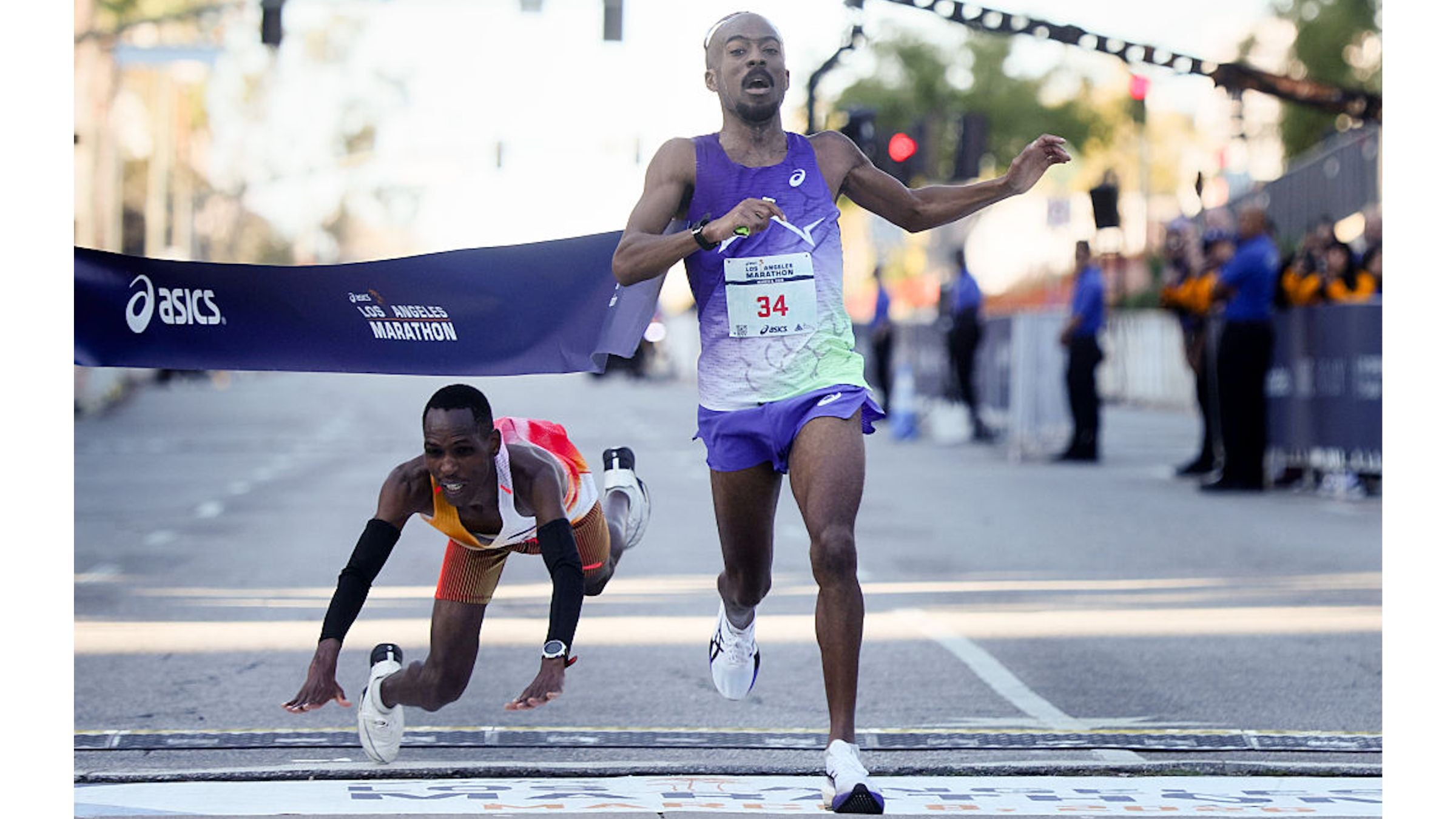
Nathan Martin crosses the finish line to place first with a time of 2:11:16.50 on a last-second sprint as Kenya's Michael Kimani Kamau dives and falls to the pavement during the 2026 Los Angeles Marathon (Photo: Ronaldo Bolanos / Los Angeles Times via Getty Images)
Nathan Martin just gave us the clip. You know the one.
There’s a playlist many runners keep on their phones or in their heads for those times you need some inspiration before a race, or, just to get up at 5 A.M. to do that speed workout. It’s like a pep talk and caffeine as a highlight reel. Prefontaine at Hayward Field. Shalane Flanagan crossing the finish in New York. That one Frank Shorter clip that looks pre-historic but hits you every single time.
As of March 8, 2026, Nathan Martin owns a permanent spot on that playlist.
If you haven’t seen the finish of the L.A. Marathon yet, stop reading this and go watch it. Seriously. We’ll wait.
OK. So. A 36-year-old substitute teacher and high school track coach from Jackson, Michigan—an American, a guy who corrals a bus full of teenagers to cross-country meets—just ran down a Kenyan elite in the final hundred meters of a 26.2-mile race and won the Los Angeles Marathon by one one-hundredth of a second. The kind of margin that exists mostly in slow-motion replays of sprints. It was the closest finish in the race’s history. It’s a marathon not a sprint, as the saying goes. Until it is.
ADVERTISEMENT
Michael Kamau had held the lead for miles, running with the authority of someone who’d done this hundreds of times. But somewhere in those final miles his cadence started dropping and his stride became less fluent, and Nathan Martin was out there cooking quietly. He said he knew Kamau was somewhere ahead of him but didn’t know exactly where, and with about 800 meters left, he decided to go. He entered deep into the hurt locker and found some extra grit.
That last 100 meters is the part that will wreck you. Martin surging. Kamau fading, then lunging, then crumpling to the pavement at the line. Officials rushing in. And Martin, somehow still upright, somehow still moving, on the other side of it all with the W, American flag draped over his shoulders.
Here’s what you need to know about the context, because context is everything in this sport.
ADVERTISEMENT
This year’s L.A. Marathon had a bit of a vibe problem going in. The heat was expected to be gnarly, and organizers, to their credit, genuinely trying to keep people safe, announced that runners who couldn’t hack the full 26.2 could bail at mile 18, take a turn onto Santa Monica Boulevard, and still collect a finisher’s medal. The running internet, as the running internet does, had some thoughts about this. Participation trophies at mile 18! The L.A. Marathon, now with an early exit option! People were roasting it with the kind of energy usually reserved for Satisfy drops and minimalist shoe discourse. And honestly, it was a little funny.
But then Nathan Martin happened, and suddenly the whole conversation shifted. He didn’t look for the offramp. He ran through 26 miles of Los Angeles asphalt, through the doubt that must accumulate like lactic acid in those final miles—and then he sprinted. Like someone who didn’t get the memo that you’re supposed to be destroyed by mile 25.
Let’s also say what needs to be said here: Martin’s personal best of 2:10:45, set at the 2023 Grandma’s Marathon, made him the fastest U.S.-born Black marathoner in history. And now he’s a Los Angeles Marathon champion. In a sport that, at the elite level, has often felt like it was happening somewhere else—in training camps in the Rift Valley, in European race circuits—there’s something that lands differently about a Black American man who coaches high school kids in Michigan lining up against the world and running them down.
ADVERTISEMENT
He’s consulting with his own coach about what’s next. But for right now, somewhere in Jackson, Michigan, a high school cross-country coach is the L.A. Marathon champion, and there’s a clip going around that belongs on every pre-race playlist ever made.
Save it. You’re going to need it.