Published December 7, 2015 12:00AM
The Theory of Everything
21 bold ideas to help you get healthy, eat smarter, and crush your next adventure
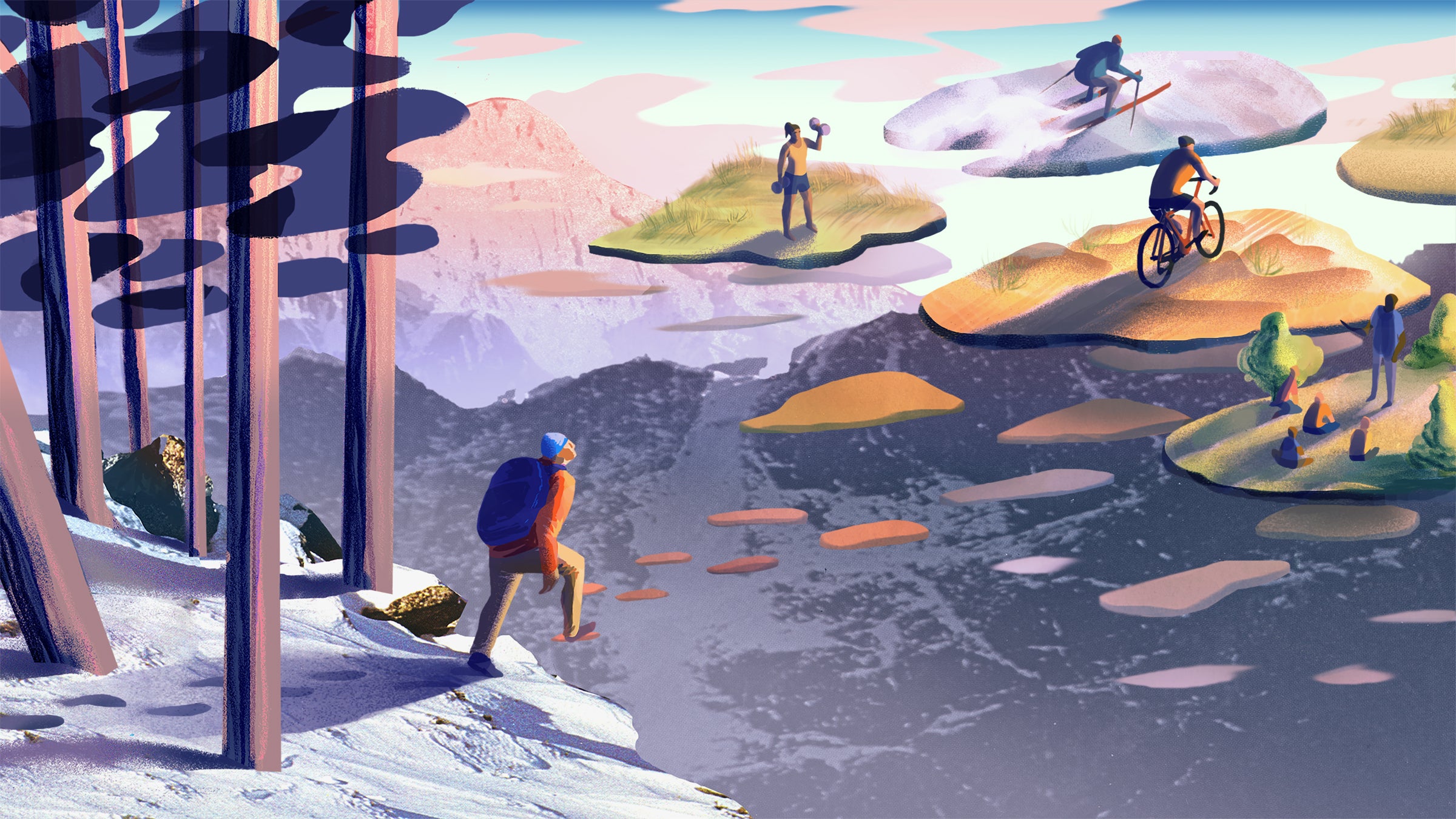
Unexpected connections and ideas abound in the great outdoors. We went hunting for them.
The short version of the Outside take on the world: live bravely. The longer version is… well, it’s a bit complicated.
Around the office, we have frequent heated debates on topics that touch on our core tenets of adventure, exploration, travel, health and fitness, and gear. So it was with a great deal of enthusiasm—and some anxiety—that we set about the audacious task of presenting our theory of everything. (Okay, so we aren’t covering everything, but we took on many of the most pressing issues that impact the Outside life).
As a starting point, we asked longtime contributing editor Florence Williams to investigate the idea that the best treatment for kids with attention deficit hyperactivity disorder is to get them outside. As Williams details in “ADHD Is Fuel for Adventure”, a new boarding school in Virginia is finding just that. By taking students who suffer from ADHD out of the classroom and into nature, the teachers are radically improving behavior and learning.
Even more surprising is the link between the disorder and adventure that Williams discovered during the course of her reporting. She explains that the acute hyperactivity and distractibility long considered dysfunctional by modern society—symptoms frequently treated with heavy medication—might actually be part of a crucial skill set that not only helped our prehistoric ancestors thrive, but that also keeps some of this era’s most celebrated adventurers alive.
ADVERTISEMENT
As soon as Williams sent us her piece, we were convinced that testing our boldest hypotheses would produce an array of immensely powerful stories. We immediately made assignments, asking some of our most intrepid writers to look into seemingly wild notions, from the belief that freezing (almost) to death is good for you and the argument that bike helmet laws are deadly, to the (crazy!) idea that vegans make the best athletes and the eerie suggestion that climate change has its own sound.
The result is exactly what we’d hoped for—an exceptionally surprising look at the forces shaping the world outside.
ADHD Is Fuel for Adventure
Some of the best medicine for kids with attention-deficit disorders may be extreme sports and outdoor learning. That's good news, because not only do they need exploration, but exploration desperately needs them.
By second grade, it was clear that while Zack Smith could sit in a chair, he had no intention of staying in it. He was disruptive in class, spoke in a loud voice, and had a hard time taking turns with others. He didn’t seem to care about anything at school. When his parents realized that his path would likely lead to worse trouble, they pulled the ripcord on eighth grade. Where Zack eventually landed is clinging spread-eagle to an east-facing slab of quartzite in the West Virginia panhandle. Read more.
ADVERTISEMENT
Why Up Is the New Down
The high-altitude, lung-busting challenge imported from Europe has become one of the hottest winter sports in North America. Why? Because this pursuit proves that premeditated suffering can be highly addictive.
ADVERTISEMENT
“I’m chasing Jenn Shelton through the frigid high country because I have a skimo problem. 'Skimo' is short for ski mountaineering, in this case ski-mountaineering racing, a masochistic winter sport that, for reasons I don’t fully grasp, I’ve become obsessed with. I’m not the only one. ” Read more.
Eating Right Can Save the World
The endless cascade of nutritional information—about localism, vegetarianism, veganism, organic food, the environmental impact of eating meat, poultry, or fish, and more—makes the simple goal of a healthy, sustainable diet seem hopelessly complex. We talked to scientists, chefs, and farmers to get the ultimate rundown on how you should fuel up.
(Hannah McCaughey (2), Sang An, Hannah McCaughey)
“Tell me what you eat and I will tell you what you are.” That’s what the French lawyer Jean Anthelme Brillat-Savarin, who happened to have a deep love of gastronomy, wrote in 1825. A century later, a diet-hawking American nutritionist named Victor Lindlahr rendered it as: “You are what you eat.” I propose revising it further: Tell me what you eat and I will tell you how you impact the planet. Read more.
ADVERTISEMENT
The U.S. Should Never Host Another Olympics
It's expensive, demanding, and in the eyes of the many cities that have refused to throw their hats into the five-ring circus, a total scam
After enough pleading and promises to make a desperate boyfriend seem hard to get, the International Olympic Committee thought it had the final list of candidates that would compete to host the 2024 Summer Olympics: Paris, Rome, Hamburg, Budapest, and—a last-minute substitute for Boston—Los Angeles. Read more.
ADVERTISEMENT
Avalanche Rescue Needs a Revolutionary
Swiss snow-safety expert Manuel Genswein has no patience for tradition-based rescue techniques. Now he's proving to the world that his way is the best way for saving buried skiers, one shovel and beacon at a time.
ADVERTISEMENT
On January 7, 2008, Todd Weselake, a 23-year-old photographer living in Fernie, British Columbia, picked up two friends, Janina Kuzma and Ian Bezubiak, for a morning of backcountry skiing and snowboarding on the northern slopes of Mount Proctor, a 7,851-foot peak within view of town. Read more.
Everything Is a Bargain, and Still No One Is Happy
Thanks to advances in materials, quality doesn't have to cost an arm and a leg
Sure, plenty of products boast obscene price tags these days. But the fact is that the evolution of construction techniques and introduction of new materials have actually brought down the price of gear. Read more.
ADVERTISEMENT
60 Is the New 25
People thought Ned was a freak of nature when he was winning mountain-bike races at 40. That was 20 years ago. Now the sexagenarian is crushing fat-bike racers a third his age.
It’s two days after Ned Overend’s 60th birthday, his back hurts, and he’s staring into the weeds at Suicide Six—billed as one of the oldest ski areas in the East—puzzling out how to avoid a broken hip. Read more.
ADVERTISEMENT
Vegans Will Own the Podium
Why ultrarunners, climbers, and NFL linemen are turning to plant power
More and more pro athletes are going vegan. But can their plant- based diet really allow anyone to perform at their best? Read more.
ADVERTISEMENT
Your Local Ski Area Should Be a Nonprofit
Community-led recreation holds the secret to building sustainable local resorts
It’s no secret that small hills are having a tough go of it. Between tight budgets, changing weather, and ever expanding conglomerate resorts, the only way to survive may be to forgo the pursuit of cash and seek 501(c) status. Read more.
ADVERTISEMENT
Simplicity and Fun Are the Keys to Staying Strong
With so many fitness offerings to choose from, it’s hard to separate what works from what doesn’t
ADVERTISEMENT
“Every few years, people try to reinvent the wheel,” says Steve Magness. But, he says, they are either doing one of two things: selling a quick fix that simply won’t work or repackaging something that’s already been tried before. Read more.
Funky Furniture Is the Future of Fitness
Things that make our lives easier might also be hurting us. A new class of tough designs saves the day.
Countless products promise to improve our lives by making them easier. (Think laptops, Boa closures, child leashes.) But a new class of industrial designers want to achieve that end by making things harder. Read more.
ADVERTISEMENT
Summer Is the New Winter at Ski Resorts
Ski areas around the country are adapting to shorter snow seasons by beefing up their summertime activities
With shrinking visitor numbers and low-snow seasons afflicting ski areas around the West, resort owners are realizing that attracting wintertime guests alone isn’t enough to survive. Read more.
ADVERTISEMENT
Mirrorless Cameras Will Change Photography Forever
But are they good enough for the professionals?
New mirrorless cameras, which are smaller and more portable, can now take photos and video that’s just as good, and in some cases better, than that of their old-school rivals. Read more.
ADVERTISEMENT
You Can Actually Hear the Climate Changing
Bernie Krause’s vast library of field recordings reveals a sad truth: wild sounds are quickly vanishing
ADVERTISEMENT
The 77-year-old began studying nature’s sounds at age 30, later earning a Ph.D. in creative arts. He has since traveled to the world’s most remote areas to create an audio library that began as an inventory of the intricate symphonies unique to each ecosystem but has become a way to document biodiversity and, most recently, loss. Read more.
The Outdoor Life Is a Magnet for Tech Geeks
Capital is venturing out of Silicon Valley to the nation's coolest towns
It’s easy to assume that you have to move to tech meccas like the Bay Area and Seattle to get in on the rush. But as it turns out, growing number of towns offer both a large number of tech gigs and the ability to live an active lifestyle. Read more.
