Published September 11, 2015 12:00AM
What Athletes Track
The data behind elite performances
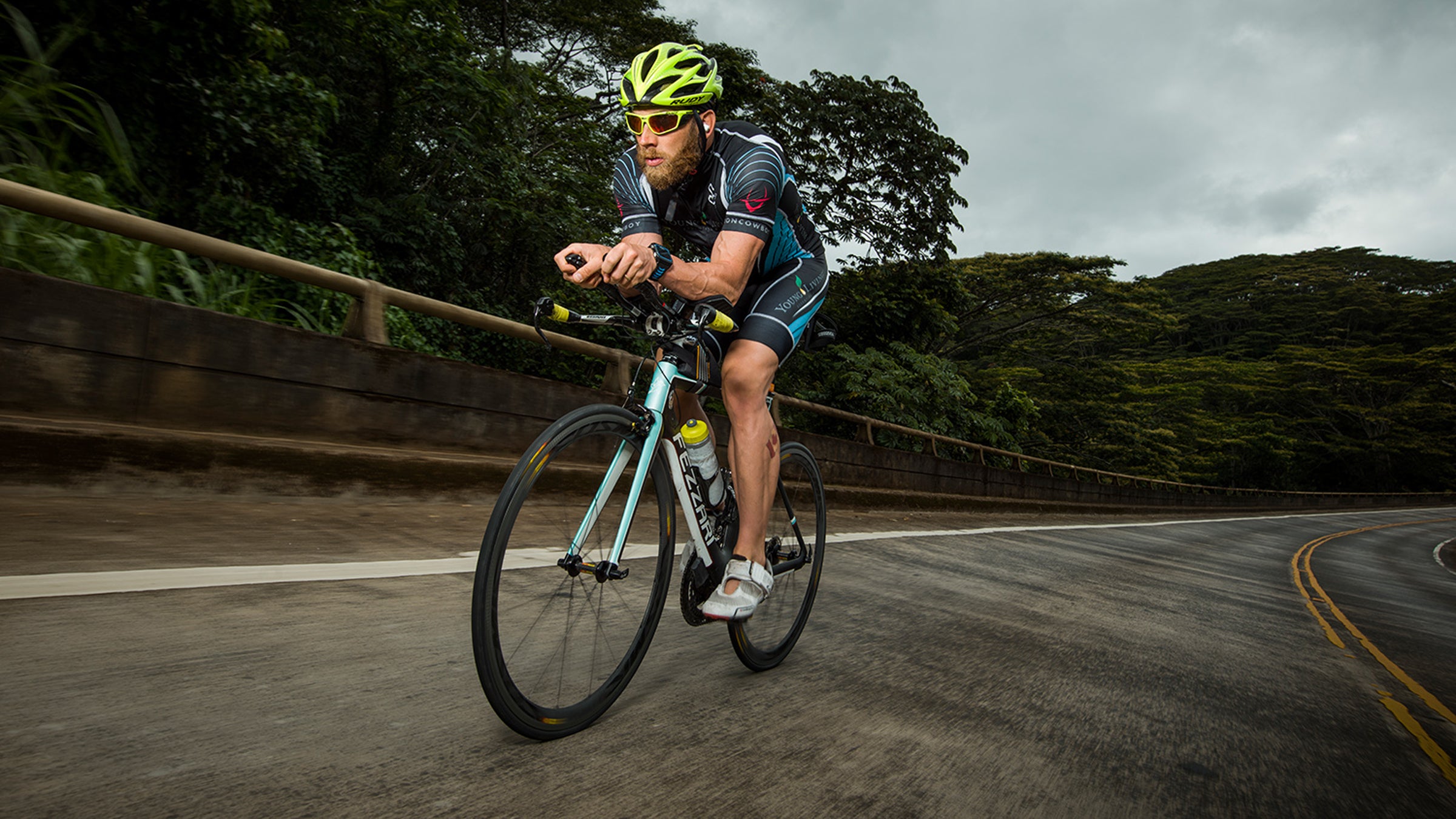
James Lawrence trains with Garmin's Forerunner 920XT, Edge 1000, and Vector pedals.
Their speed and power are way more impressive than yours, but most pro athletes rely on the same tracking gadgets the rest of us squint at during workouts. Take a lesson on using their favorite tech to get your numbers a little closer.
Ted King, Cyclist
As one of America’s most outspoken cyclists in the pro peloton, not to mention an avowed Strava junkie, Ted King is surprisingly dispassionate about metrics. “It’s kind of funny, but I find that amateurs nerd out far more than the average pro,” he says. King’s theory: the guys who are paid to crank out power aren’t as zealous, while weekend warriors examine the minutia for every last percent they can eke out of their legs. But the Cannondale-Garmin rider does pay attention, if only out of curiosity, displaying as many as nine data fields simultaneously on his Garmin Edge 1000 head unit.
What He Tracks:
- Power, Heart Rate, Time: “These are the things you pay attention to immediately on any training ride and interval,” says King. He uploads training data to a remote coach, who looks at every metric as part of the bigger picture of his overall fitness and race readiness, and tweaks accordingly. In a race, looking at your power output is a decent way to gauge what’s left in the tank, he explains. “You know, over the course of the previous years and season of training, what you’re capable of.” On a finishing climb, you might throw in an initial dig, but you have to quickly settle into a specific, sustainable power output. Of course, all that goes out the window if you’re in a bunch sprint or in a group on a punchy climb, where you have to respond to every attack. “You don’t race on your computer.”
- VAM (average ascent velocity)—“You can look deeper than just power and heart rate. You can be looking at VAM, which is a good way to compare and maintain fitness over the course of a season, or over the course of a career.”
The Tools: Garmin Edge 1000 ($500), Garmin Edge 810 ($400), Garmin Edge 510 ($330), Garmin Vector pedals ($1,500), Strava (free)
Takeaways: “At the end of the day, cycling metrics are so basic,” King says. “What are you producing, what are you capable of, and for how long?”
ADVERTISEMENT
Mike Foote, Ultrarunner
As one of America’s preeminent ultrarunners—a discipline that, over the course of a 50- or 100-mile course, requires pacing that’s based on a very clear understanding of your capabilities—it’s no surprise that Mike Foote is a bit of a numbers freak. He started keeping a training log back in 2009, and ever since he’s religiously kept track of each run, including everything from distance to calories consumed to how he felt on a particular day.
What He Tracks:
- Distance, Training Time, Vertical Gain/Loss:These are what Foote calls his “macro metrics,” though he also keeps an eye on his average pace, real-time pace over particular segments, and how much he eats on the trail. As he builds towards a goal race—the Hardrock 100, say—he strives to make his macro metrics in training mimic the race. He trains on terrain with a similar average grade of steepness, at close to race pace, eating pretty much what he’ll eat and carrying what he’ll carry on race day. “This way there are few surprises when I get to the start line,” Foote says. “My musculature, my digestive track and my mind are prepared for the effort.”
How he interprets all of these metrics, though, is in constant flux. “Sometimes I feel like I don't pay attention at all and just keep looking forward,” he says. “Sometimes I scour each and every piece of data, searching for the tiniest of clues to where I am in my training and, if something is going wrong, how to fix it.” Recently he’s started working with Jason Koop, the coach of just about every top performing ultrarunner in the states right now, to help him make sense of it all and, perhaps as a result, has begun to focus equally on all three metrics rather than simply chasing miles. “I feel better more consistently now because of it.”
- Feeling: “I try and grade how I feel during a run,” Foote says, with A+ being the best run of his life, and an F being skipping a run altogether because he feels so low. “This helps me to keep an eye on how my training is trending. If I jot down a few days in a row of C-'s, I'm going to see it’s time for a rest day.”
The Tools: Suunto Ambit ($150 and up), pulse oximeter
Takeaways: “I like data, there is no doubt,” Foote says. “But I also like to keep it relatively simple. I don't do a heart rate monitor because I find it is hard for me to stay present in the moment, and the data is almost overwhelming at times. Give me a GPS, allow me to track a few big numbers, throw in an honest daily assessment of how I’m feeling, and I think that will be enough to get me through my athletic career.”
ADVERTISEMENT
Greg Hill, Ski Mountaineer
All of Greg Hill’s biggest projects are numbers-driven, with one major focus (usually represented by an outlandishly large number)—feet of vertical ascent. The ski mountaineer set a one-time world record of 50,100 vertical feet climbed and skied in 24 hours, skinned 2 million feet in 2010, and last year put up 330,000 vertical feet in a single month. While he’s never been super scientific about his efforts in the mountains, there are a couple of metrics he pays attention to.
What He Tracks:
- Heart Rate: This summer, for perhaps the first time ever, Hill has been closely tracking his heart rate. In an effort to whip himself back into shape from an avalanche-related injury that sidelined him for most of the 2014-15 season, he’s been mountain biking the alpine singletrack above his hometown of Revelstoke, BC. All the while, he’s focused on keeping his heart rate in Zones 1 and 2. “I try to be between 120 and 150” he says. “It’s not crazy improving my fitness or anything, but it’s good for getting rid of the layers that I need to get rid of.”
- Vertical Feet Per Minute: This is the metric Hill lives by. His record-setting feats are longer, drawn-out efforts that require steady, incremental work day-in and day-out. To pace himself for days or weeks or even months on end, building towards a vertical-based goal, he keeps an eye on the Suunto Ambit3’s vertical feet per minute metric. “If I was trying to do a 10,000-foot day, I’d want to do 2,000 feet per hour, or roughly 33 vertical feet per minute,” Hill explains. “That way I’d know I was on par for 2,000 feet per hour and, ideally, five or six hours later with skiing down added, I’d be at 10,000 feet.”
The Tools: Suunto Ambit3 ($500)
Takeaways: Outside of those two metrics, Hill tends to be pretty laidback about the data he tracks during goal-oriented training. “As far as effort is concerned, I’ve always felt that if I’m going for a long day, I should be able to talk the whole time and I don’t need to pay attention to my heart rate too much. If I’m going for a sprint, then I need to make sure that I can’t quite talk. Old-school metrics.”
ADVERTISEMENT
Rebecca Rusch, Mountain Biker
ADVERTISEMENT
Despite a long competitive career spanning multiple sports and more than two decades, endurance athlete Rebecca Rusch (the self-described “Queen of Pain”) didn’t discover the true value of data until after she took up mountain biking. In high school cross-country, she says, “We didn’t have heart rate monitors or anything. It was just go as hard as you can all the time.” Later, when rock climbing and paddling spilled over into an adventure racing career, she got herself a heart rate monitor and watch, plus a “cheesy little cycling odometer” for navigation. At the age of 38, she started mountain biking and liked it enough to hire a coach. Still, it was another three or four years before Rusch started training with numbers. But eventually she learned to train smarter, not harder, and she’s only getting faster as a result.
What She Tracks:
- Power:“Power was a huge eye opener for me. There are quite a few times when my perceived feeling is just straight-up wrong,” says Rusch. Sometimes she feels weak, but her power reading tells her she’s doing just fine. Other times, she may be trying repeatedly to do intervals that have no power behind them. “On those days, I know that there’s no real benefit to the workout, so I quit early.” As an athlete who often trains alone, she also likes the immediate feedback a power meter provides. “You can tell if you’re having a good week, a good day, or even a good interval. Heart rate fluctuates on a daily basis, depending on a lot of factors, but power is objective.”
- Recovery Data: Rusch uses RestWise to track her day-to-day recovery. Drawing from metrics like resting heart rate, oxygen saturation, weight, amount of sleep and hydration level, coupled with more subjective measures including sleep quality, energy level, mood, appetite, and muscle soreness, the software produces a recovery score to let her know when she needs to take it easy. “It shows how daily stresses—from work that’s piling on or not sleeping well to poor eating or dehydration—can add up to poor recovery. It’s stuff that I intuitively know,” Rusch says, “but it puts a number right in front of you, and helps clue you in.”
The Tools: Quarq power meters, Garmin Edge 810 ($400), Edge 1000 ($500)
Takeaways: Some athletes rely too heavily on these gee-whiz gadgets, Rusch says. “Your perceived feeling, and what’s in your brain is a powerful racing tool.” So she trains with metrics, but races with her heart and her head. “If I want to chase somebody down, I’ll chase them down,” she says. “A lot of athletes just stare at that little screen, pacing themselves at a certain power, and it’s limiting.” In other words, a race should be seen as a chance to test your limits and, just maybe, break through to the next level.
ADVERTISEMENT
James “Iron Cowboy” Lawrence, Triathlete
ADVERTISEMENT
In early June of this year, triathlete James Lawrence embarked on the seemingly Sisyphean task of completing 50 Ironman distance triathlon—2.4 miles swimming, 112 miles cycling, and 26.2 miles running—in 50 consecutive days in 50 states. In addition to incredible physical endurance, the project presented a bit of a logistical nightmare that required strict adherence to a schedule. One small setback could ruin the whole operation, so pacing was key. Amazingly, the Iron Cowboy succeeded, covering 7,000 self-powered miles, burning roughly 275,000 calories, and losing feeling in his toes and fingers before finally crossing the finish of his 50th Ironman on August 25 in Provo, Utah. But he couldn’t have done it without tracking a few key data points to keep his times fast enough to finish, but not so fast he couldn’t recover in time to keep going.
What He Tracks:
- Power (Bike): “We really cared about the data on the bike—that’s the longest part of the day, and if we got out of line on the bike it affected everything else too much,” Lawrence says. He monitored power closely, and kept himself within prescribed boundaries. “We went off power rather than time, because we couldn’t control environmental factors that changed from one course to the next, like elevation and wind.”
- Pace (Run): The run worked basically the same way. He and his team set pace limits that Lawrence had to stay within in order to finish not fast, but fast enough. “My 50th marathon was my fastest one,” he says. “My last three miles where low-7:00 pace, because I knew I could go to sleep that night in a non-moving bed for as long as I wanted to.”
- Strokes Per Minute (Swim): As a triathlon coach, Lawrence says he takes the opposite tack of most swim coaches, who try to tease stroke efficiency out of their athletes. “I’m trying to get my athletes to increase their stroke rates up above 60 strokes per minute,” he explains. “Open water is totally different from swimming indoors—you’re dealing with uncontrolled environments like choppy waves and moving water, you’re dealing with sighting and you need that momentum to continually be moving you forward.” If you’ve got good technique, he says, the faster you can move your arms while being efficient, the more ground you’ll cover.
The Tools: Garmin Forerunner 920XT ($450), Garmin Edge 1000 ($500), Garmin Vector pedals ($1,500)
Takeaways: “I rely on and coach my athletes exclusively with power on the bike. I’d consider rejecting would-be clients if they’re not willing to use power. It’s the most reliable, unbiased form of feedback.”
ADVERTISEMENT
If You Want to Get Faster…
Track: Your heart-rate variability.
The most common way to plateau is to train at 80 percent all the time. Instead, make your hard workouts really hard, then recover properly. You’ll know you’ve gotten adequate rest when the time between heartbeats fluctuates. That’s called high heart-rate variability, and it means you’re ready for another intense outing. If your heartbeats are more regular, that’s low variability, and you should take a day off. Check and record HRV first thing when you wake up.
Tool: A Bluetooth heart-rate monitor like Wahoo’s Tickr X ($100), which can sync with a number of smartphone apps. Our favorite is the simple and intuitive Elite HRV (free; Android and iOS).
If You Want to Dial In Your Running Form…
Track: Your vertical oscillation and ground-contact time.
Fast runners take quick steps forward, not up, turning energy into motion more efficiently than midpackers. Ground-contact time refers to how long your feet touch the pavement, and vertical oscillation is the distance you bounce up and down with each stride; a lower number is better for each.
Tool: The Garmin Forerunner 620 watch ($350). It tracks both of these metrics, and a digital gauge changes color when your form is slipping.
ADVERTISEMENT
If You Want to Destress…
Track: Your breathing.
“Take a deep breath” verges on cliché when trying to tackle stress. But studies have shown that doing so helps get the body’s natural fight-or-flight reactions under control. Deliberately controlling your breathing lowers blood pressure, eases stress-hormone production, and balances oxygen and carbon-dioxide levels in the blood.
Tool: Spire ($150), a minimalist tracker that clips to your waistband and measures the rise and fall of your abdomen. It pings your phone when it senses that you’re too tightly wound, then guides you through breathing exercises to cool off.