Published December 10, 2021 03:09PM
What You Missed: A Q&A with Globetrotter Jonas Deichmann, the “German Forrest Gump”
We hear from ”German Forrest Gump” Jonas Deichmann, Colorado renames a controversial mountain, and a family of bears shows their holiday cheer
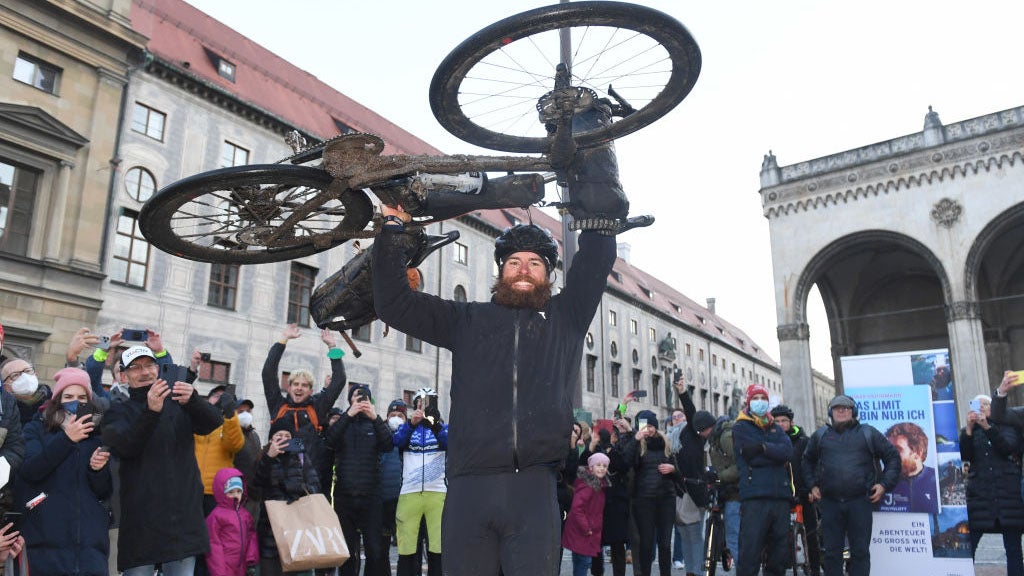
German extreme athlete Jonas Deichmann lifts his bike into the air at Odeonsplatz at the finish of his triathlon around the world. (Photo: Getty Images)
Welcome to What You Missed, our daily digest of breaking news and topical perspectives from across the outdoor world. You can also get this news delivered to your email inbox six days a week by signing up for the What You Missed newsletter.
Last week we brought you the story of Germany’s Jonas Deichmann, the man dubbed German Forrest Gump after he completed a round-the-world triathlon.
Over the course of 14 months Deichmann swam 284 miles in the Mediterranean Sea, biked 13,000 miles across Russia and parts of Western Europe, and ran the 3,100-mile length of Mexico. Throughout his journey, Deichmann battled extreme temperatures and fatigue. He also became a celebrity in Mexico, where throngs of fans ran alongside him.
We recently caught up with the 34-year-old Deichmann to hear about his voyage. (Answers edited for style and clarity.)
Outside: What memory from your journey brings you the most joy?
Jonas Deichmann: It was running through Mexico with the crazy other runners who were singing songs and having so much fun.
What moment brought you the most suffering?
It was my first big swim crossing. I usually swam along the shore, but sometimes I had to swim to a peninsula or island, and I’d have to cross seven or eight kilometers of open sea. At day five or six in the water, I miscalculated. There were some currents, so it took me longer to get where I was going. It got dark and I was still three kilometers from the shore. For someone who is not a swimmer, out there in the open sea, and it is pitch black, I was feeling that I shouldn’t be there.
How did you manage the mental challenges posed by this leg of the triathlon?
Swimming is physically challenging, but the mental side is so hard because it’s impossible to distract yourself. There is nothing to look at. When you spend seven hours in the sea, you just have to think about things. To keep my mind going, I always have small targets, and this is the big secret to endurance challenges. You always need to see a finish line. I don’t think about swimming 60 kilometers—I swim to the next rock. In my little attached raft I always have a bag with a chocolate bar, and I take it out and eat it, and I’m happy again. Then I swim to the next rock, eat my chocolate bar, and I’m happy again.
After swimming and biking for several months, you were delayed for 13 weeks at the Russian border. How did you cope with the wait?
I was in southern Turkey, which is sunny and on the beach. It’s perfect for many people, but for me it was horrible. When I was swimming or biking, it was all on me. Being stuck and waiting for the visa, things were out of my control, and I felt helpless. I know that when I complain it does not change my situation, so I focused on what I could control. Who can I contact? Can I change my route? In the end I got my permit.
ADVERTISEMENT
Federal Board Renames Colorado Peak
A mountain in Colorado’s Arapaho National Forest will be one of the first landmarks renamed after U.S. interior secretary Deb Haaland banned the use of the word squaw on federal land on November 22.
On Thursday, the U.S. Board of Geographic Names approved a petition filed by the Northern Cheyenne Tribe to rename the 11,486-foot peak as Mestaa’ehehe Mountain. The new name honors Owl Woman, an influential translator and member of the Cheyenne who helped maintain peace between local tribes and settlers until her death in 1847.
“This goes to show that there is nothing we cannot achieve if we think with our own hearts and always remember who we are doing this for,” said Teanna Limpy, director of the Northern Cheyenne Tribal Historic Preservation Office.
ADVERTISEMENT
The name change sailed through early decision-making rounds, and in September the Colorado Board of Geographic Names unanimously approved it, sending the final decision to the national board. The only major pushback came from Colorado governor Jared Polis, who was criticized after saying the new name was too hard to pronounce.
The mountain has several roads and trails that still bear its former name, most notably a pass between Idaho Springs and Bergen Park. The local county commissioner, Randy Wheelock, said there will likely be a discussion to change those name as well.
Bears Versus Blitzen
Member Exclusive
“Is Summer Camp Good for My Résumé?” Working as a camp counselor teaches you important skills that could jump-start your career. Outside
ADVERTISEMENT
Around the Outside Network
“Why Is Cory Richards Retiring From Climbing?” The only American to summit an 8,000-meter peak in winter is hanging up his ice axes. Climbing
“The Beta Tests: Scott Spark 900 Tuned” Beta gear editor Travis Engel explains why this rig stands out in the 120-millimeter trail-bike category. Beta
“We Found the Best Skiing in the World” Editor Sierra Shafer recounts her favorite ski trips in the U.S. and abroad. Ski
“Searching for the Ghost Grizzlies of the North Cascades” Grizzlies vanished from North Cascades National Park five years ago—or did they? Backpacker
