Updated November 18, 2024 09:38AM
Originally posted onTriathlete
Triathletes, Your Descending Is Hot Trash. Fix It or Bleed Time.
Gutsy descents defined the 2024 women’s Ironman World Championship in Nice, France, but everyday triathletes can get free seconds (or minutes) by practicing some key handling skills. Read how.
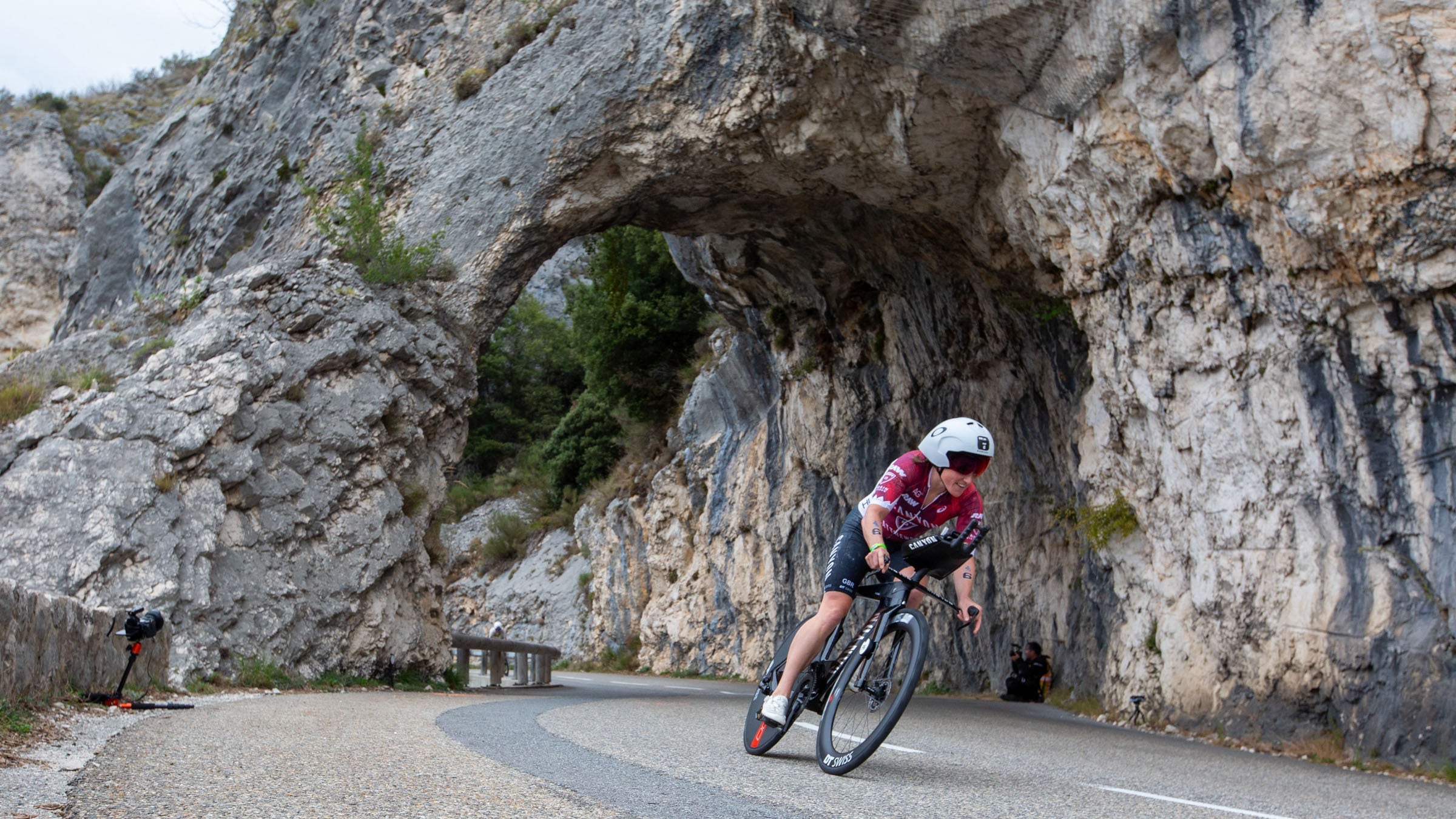
At the 2024 Ironman World Championship Nice, Kat Matthews showed us how good descending skills on a bike can make or break a race. (Photo: Brad Kaminski/Triathlete)
When it comes to bike training, most triathletes are locked into a power zone on their indoor trainer or focused on getting to the top of the next hill as quickly as possible. Time-saving details tend to come in the form of gear, like the latest reduced-drag skin suits or funky positions to place water bottles for full fairing effect. But even though building your aerobic base and finessing your position is always beneficial, you might be surprised just how much free speed – and time – you are leaving out on the course by not placing a bit more emphasis on those bike handling skills, particularly when it comes to descending.
One of the best examples of this is the Ironman World Championship course in Nice, France, with its 8,000 feet of elevation in the Maritime Alps. In 2019, we marveled at Rudy Von Berg railing it around the corners on familiar roads in the 70.3 worlds. Last year, we saw fellow Frenchman Sam Laidlow deliver similarly over the full distance as he became the youngest men’s winner ever. But perhaps the best example is that of British athlete Kat Matthews at the 2024 Ironman World Championship Nice, whose descending in the second part of the bike leg – much of it in the company of eventual winner Laura Philipp – meant that by the time the pair reached T2, they were seven minutes ahead of French local Marjolaine Pierre and the rest of the field had splintered in their wake.
To illustrate just how hard Matthews rode, she handily uploaded her data to performance tracking app Strava – and, thankfully, to give even more helpful context, so did many of the pro women she raced against. When we pore over the Strava data at different sections of the descent, we can can really show where the time gaps were created.
ADVERTISEMENT
How Descending Shaped the Race at the 2024 Ironman World Championship Nice
As you can see from the graphic, the Ironman course in Nice is one loop climbing to a rolling plateau before dropping back to the coast.
We’ll look at each of the notable descents in turn and then put them into the bigger picture of the race.
ADVERTISEMENT
Descent #1: Route de Grasse Toward Pont du Loup
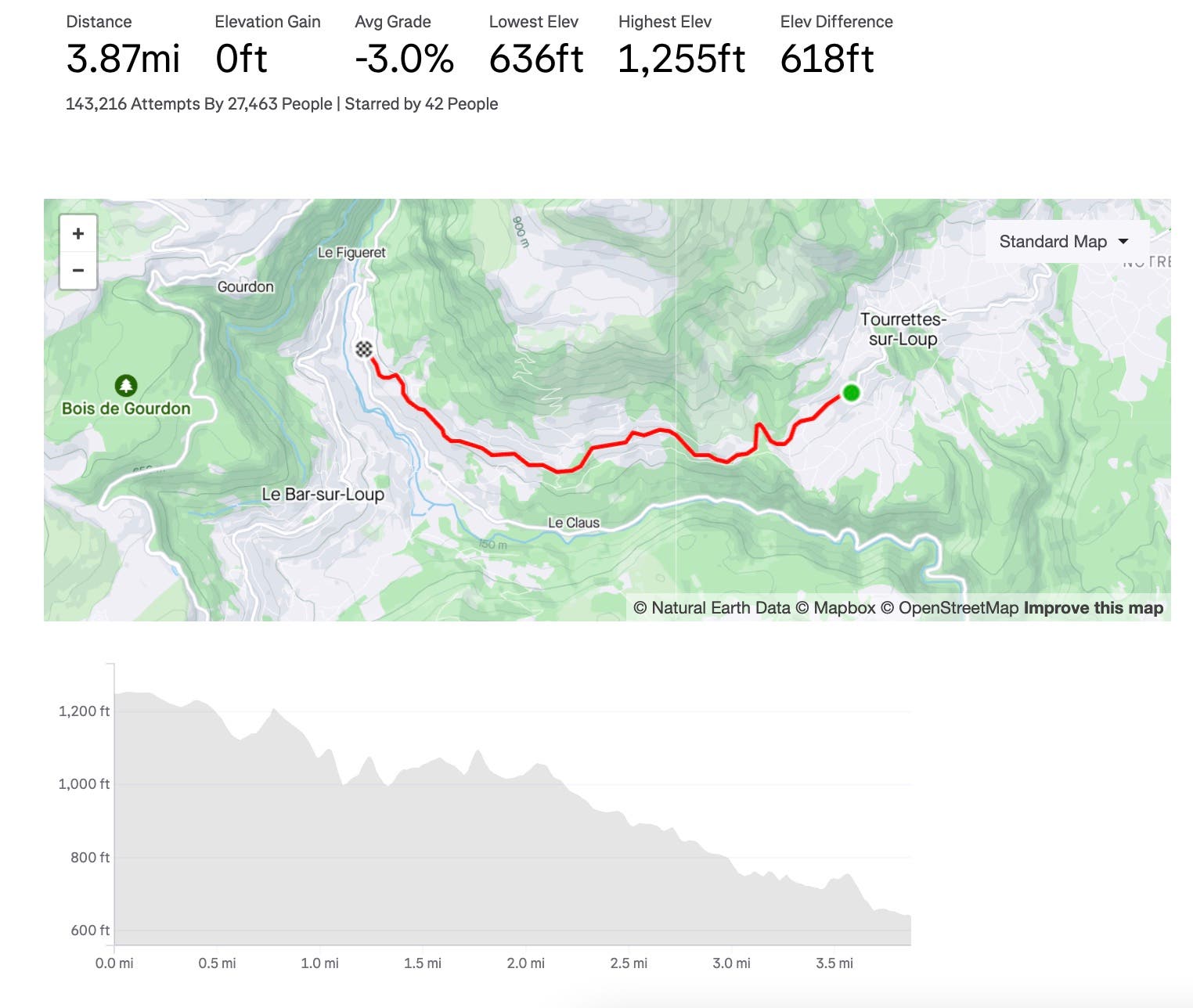
Just over 20 miles into the ride, there is the first descent before the major climb to Col de L’Ecre. At 3.87 miles, the “Route de Grasse towards Pont du Loop” segment on Strava drops 618 feet at an average grade of 3%.
It’s not a particularly technical descent, but we can tell the women are racing it – and also benefiting from closed roads – because the top eight times on this segment are set during the race.
ADVERTISEMENT
Matthews takes the QOM (“Queen of the Mountain” on Strava) and 13 seconds on Pierre. It’s worth noting that at this point, other than the descent, Pierre is on the charge, leading the race and putting time into everyone except Philipp (who is further back out of the water). That she loses even a few seconds here is a tell for what might come later.
| Kat Matthews | 6:36, 35.2 mi/h |
| Alice Alberts | 6:37, 35.1 mi/h |
| Marta Sanchez | 6:40, 34.9 mi/h |
| Rebecca Clarke | 6:40, 34.9 mi/h |
| Ruth Astle | 6:43, 34.6 mi/h |
| Barbora Besperat | 6:47, 34.3 mi/h |
| Marjolaine Pierre | 6:49, 34.1 mi/h |
| Jackie Hering | 6:52, 33.9 mi/h |
Descent #2: To Geolieres
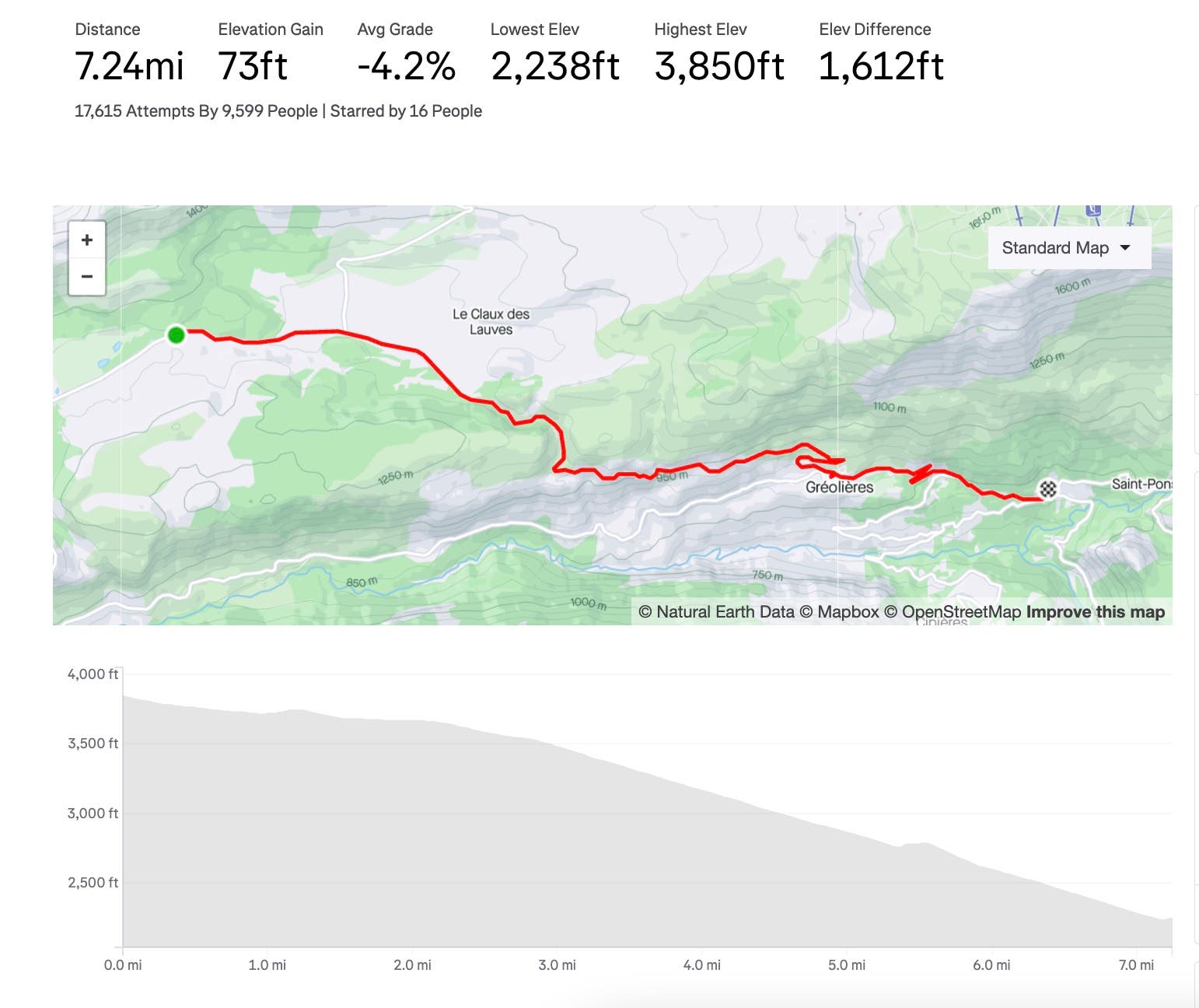
At nearly 68 miles into the bike leg, the first part of the main descent arrives: a 7.24-mile drop of 1,612 feet at an average grade of 4.1% to Greolieres. This time, there are some significant hairpins and Matthews takes charge. Matthews led the majority of the descending in the race.
While Matthews doesn’t put a huge gap into Pierre here, the French woman has one advantage. At this point the front three are all in a pace line, so Pierre can follow the leaders’ lines through the winding corners.
| Kat Matthews | 12:37, 34.5 mi/h |
| Marta Sanchez | 12:59, 33.5 mi/h |
| Alice Alberts | 13:03, 33.3 mi/h |
| Marjolaine Pierre | 13:04, 33.3 mi/h |
| Penny Slater | 13:21, 32.6 mi/h |
| Ruth Astle | 13:21, 32.6 mi/h |
| Gio Priarone | 13:29, 32.3 mi/h |
| Danielle Lewis | 13:45, 31.6 mi/h |
Descent #3: Full Descent
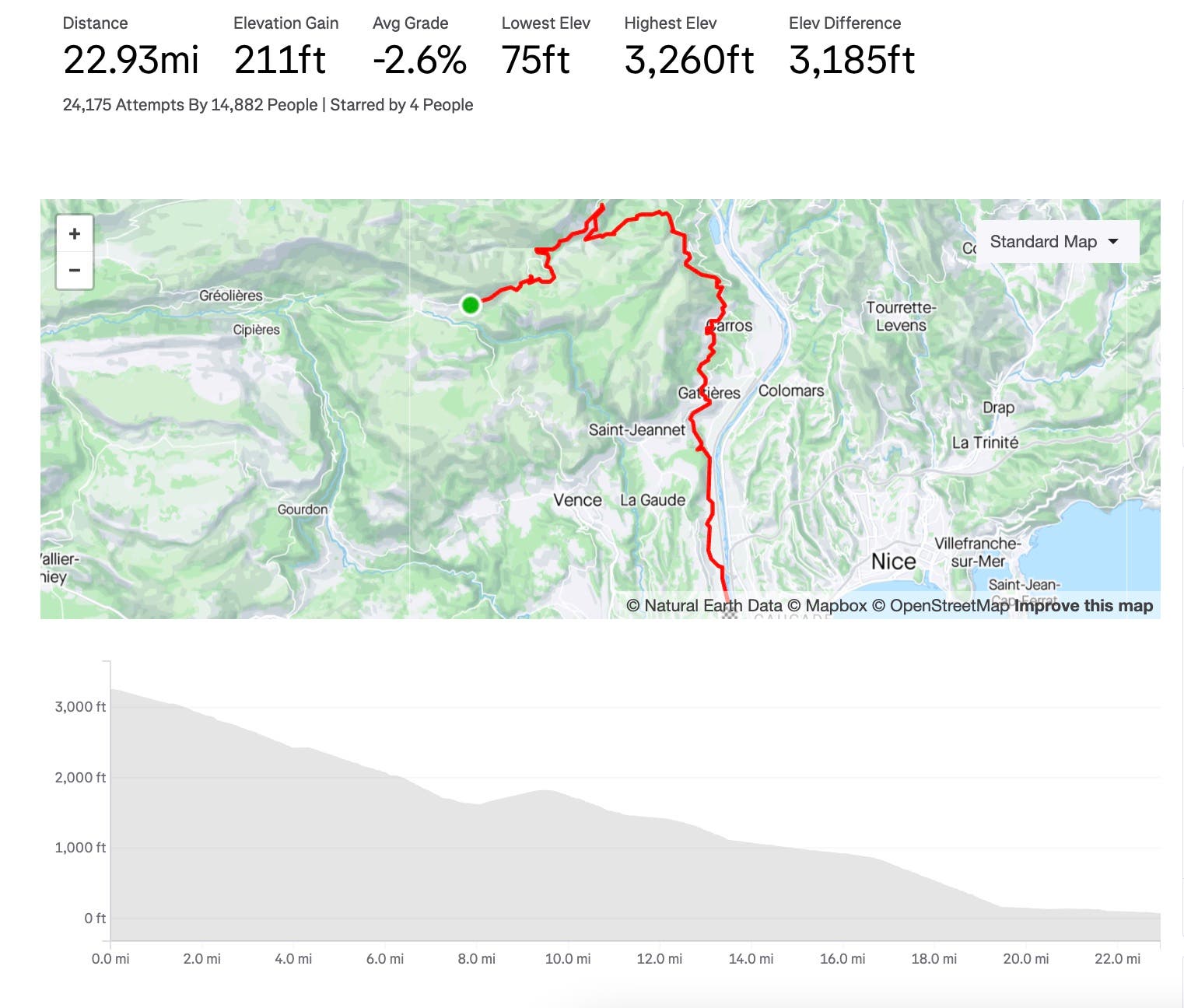
The second part of the main descent starts at 82 miles, and this is where the big split occurs and the front two get away. Over a 22.93-mile section dropping 3,185 feet at an average grade of 2.6%, Matthews is almost 4:30 minutes faster than Pierre, who still has the sixth quickest overall time on this segment.
This section is much longer and has plenty of twists and turns, particularly in the early parts, but much of it is also a pedaling descent. Matthews benefits by not only being able to handle the corners better, but being unafraid to put down the power on the exits to give an average speed almost 3mph faster – a huge margin at this level.
ADVERTISEMENT
Once this descent was over it was a flat run into the finish to complete the bike leg. Given it was into a headwind, Matthews and Philipp could also benefit from one another’s company to take turns blocking out the wind. Few other pro women had that opportunity because a consequence of the descent was that it had split the field even more.
| Kat Matthews | 44:16, 31.1 mi/h |
| Eloise du Luart | 48:11, 28.6 mi/h |
| Ruth Astle | 48:23, 28.4 mi/h |
| Alice Alberts | 48:24, 28.4 mi/h |
| Marta Sanchez | 48:37, 28.3 mi/h |
| Marjolaine Pierre | 48:43, 28.3 mi/h |
| Fiona Moriarty | 48:58, 28.1 mi/h |
The bigger picture
Let’s finish with the bigger picture by looking at the overall bike splits, specifically from the point in the race where the real descending starts. From around 65 miles, the race is predominantly downhill. Using the Ironman tracker link at 65 miles, we can see how quickly each athlete completed the bike leg.
| Laura Philipp | 1 | 3:13:38 | 5:02:25 | 1:48:47 |
| Kat Matthews | 2 | 3:16:58 | 5:05:46 | 1:48:48 |
| Marjolaine Pierre | 4 | 3:16:59 | 5:12:27 | 1:55:28 |
| Chelsea Sodaro | 3 | 3:21:34 | 5:15:14 | 1:53:40 |
| Marta Sanchez | 6 | 3:22:15 | 5:18:00 | 1:55:45 |
| Nikki Bartlett | 5 | 3:22:10 | 5:17:42 | 1:55:32 |
| Alice Alberts | 26 | 3:26:33 | 5:26:09 | 1:59:36 |
As you can see from the table, Matthews and Pierre were matched almost to the second for the first 65 miles, after which the gap between the two ballooned.
But we shouldn’t be too harsh on Pierre (who was open about her jitters going downhill), because she was on a par or faster than just about every other pro woman in the field. Yes, she lost time, but so did the rest. Philipp and Matthews are the outliers here, but it shows what is possible.
How much of an impact did it have on the overall result? It was certainly significant. Matthews (8:53:20) ended up beating third-place Chelsea Sodaro (9:04:38) by more than 11 minutes and just under half of that was taken here. Philipp and Matthews still ran the first and second fastest marathons, but race dynamics changed with the bike leg.
ADVERTISEMENT
These time chunks taken on the descent came without any great extra energy expenditure – it was concentration, confidence and efficient skills that achieved it. And those are things that aren’t exclusive to pros. In fact, if there’s one thing age-group triathletes should take away from this year’s Ironman World Championship in Nice, it’s that it’s well worth the time to improve your descending skills on the bike this off-season.
How to improve your bike descending skills, according to Kat Matthews
While technical skills are critical, the first and perhaps most important factor in becoming a better descender is to practice enough that it no longer scares you – it should be fun (because it is)! After the race, Matthews repeatedly stated how much fun she’d experienced on the course and how this ultimately set her up for a second-place finish in Nice.
In addition to that, we picked her brain for a little more descending advice after the race:
-
Ride with people technically better than you, and follow their lines on descents. This is particularly important when new to the sport – and a great reason to join a group ride.
-
Brake late and brake hard. This allows you to hold the speed you have for as long as possible and spend as little time as possible decelerating.
-
Push hard out of corners to get back to speed. (This seems obvious, but many people don’t do it.)
-
Use as much of the road as possible, enter wide, hug the apex, and exit wide. This, in effect, creates a bigger, wider corner that you can then take faster.
-
Stay in aero position as much as you dare. Nice, especially, just required confidence in yourself and your bike.
-
Get off the trainer and ride your bike. Skills you learn on flat corners translate to descents.