Published July 21, 2022 03:15PM
A Moment of Chivalry Between Tour de France Rivals
During Thursday’s 18th stage, Jonas Vingegaard waited when his rival, Tadej Pogacar, crashed on a descent
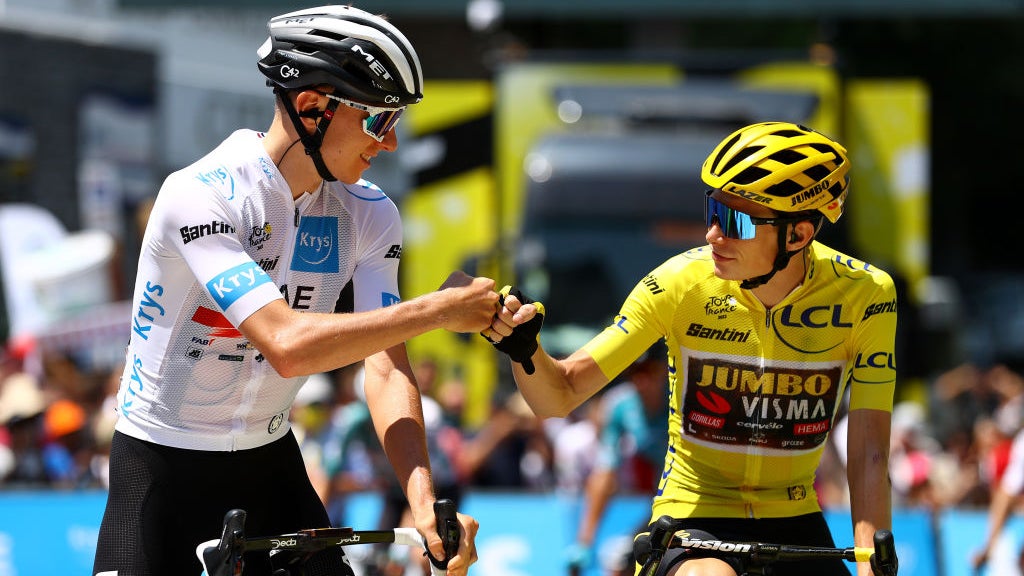
Vingegaard (right) and Pogacar are rivals but also friends. (Photo: Michael Steele / Getty Images)
This article was first published by CyclingTips.
Boring, or beautiful? Necessary, or foolish?
It’s certainly not the first time that rivals have waited for one another during pro cycling’s biggest race. But whenever these fleeting moments of chivalry happen, a familiar debate ignites: is this what we want from our champions? Do we want sportsmanship, or total victory?
ADVERTISEMENT
The race was on. Pogacar was the instigator, and he paid a price for his aggression. Vingegaard watched the incident happen.
The unwritten rules of the sport, as loose as they often are, dictate that Vingegaard was under no real obligation to slow down—he could have put his head down, called teammate Wout van Aert back from the breakaway, and sped toward the final climb of the day, Hautacam, as Pogacar attempted to chase.
And yet, he did not speed ahead. He waited.
In doing so, Vingegaard balanced sportsmanship with victory.
“I don’t think I needed to attack,” he told reporters after the stage. “I think it was better for me to hold a steady pace.”
ADVERTISEMENT
He had Wout van Aert up the road and another teammate, American Sepp Kuss, closing quickly behind. He had already almost crashed; a chain issue led to a rear wheel skid, he said in his press conference, and had little interest or inspiration to take any further risks.
There is no clearer way to signal confidence and strength than to calmly hand back an advantage to your closest rival.
Neither Vingegaard nor Pogacar seem to exhibit the characteristics of cycling’s controversial past champions. There is a quietness to both of them, a sense that they find themselves at the sport’s pinnacle not by accident. Both have a gratefulness and lack of ego that is rare at this level. There are few instances of ruthlessness. Plus, both men appear to be more placid in press conferences than some of cycling’s past winners. They also hug at the finish line and deliver handshakes after crashes.
They are, dare I say it, nice?
They are also proof that a more quiet leadership can be as effective as leadership through fear. They are not patrons in the model of Frenchman Bernard Hinault, or of American Lance Armstrong.
ADVERTISEMENT
There will always be a sort of faux ethical debate when we see riders choose to wait and not race, and pundits will argue over whether the sport needs killers or brothers fighting on the Tour’s slopes. The answer to that question inevitably ends up saying more about us than it says about the riders in question.
It wasn’t a flat tire, it was an error. Stopping was the fair thing to do. The cyclists race down as well as up. Waiting was right. He was going to win anyway. Et cetera.
We lay our own Tour desires upon the cyclists—preferences for a cutthroat battle or for human inspiration, or something in between. The riders simply react. And that’s why moments like the one we saw on stage 18 between Vingegaard and Pogacar, which are unplanned and instinctual, define athletes in our eyes. They offer glimpses into a rider’s character and drive. Only when under maximum stress do we truly see pro cycling through their eyes.