Published July 20, 2021 10:57AM
What You Need to Know About Climbing in the Olympics
With climbing’s Olympic debut less than two weeks away, we compiled a short explanation of how the competition will unfold on the world stage
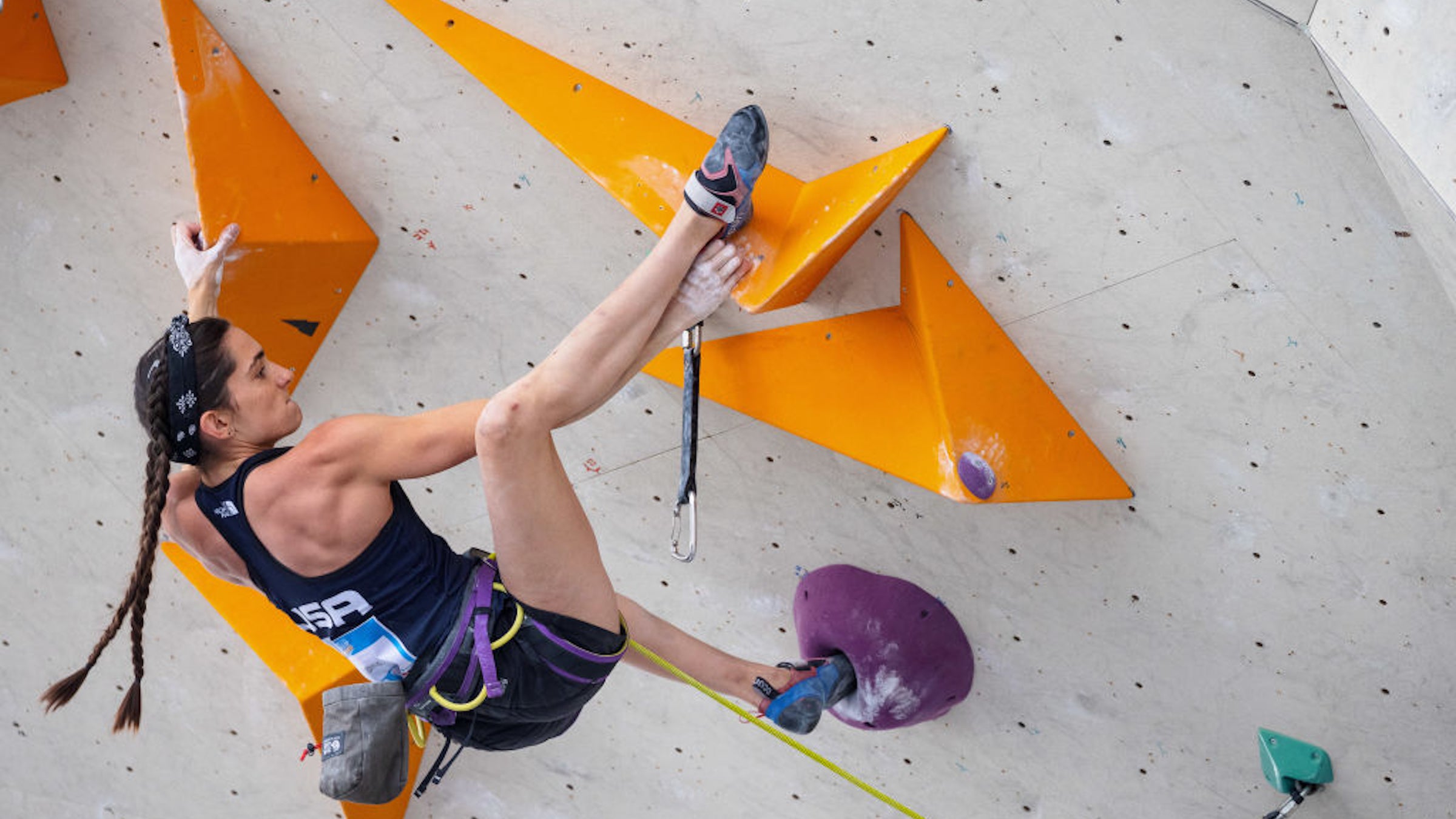
Kyra Condie, who will climb for the U.S. in the Olympics, competes during the women’s lead climbing semifinals at Kletterzentrum Innsbruck on June 25, 2021 in Innsbruck, Austria (Photo: Marco Kost/Getty Images)
On August 3, 2016, the International Olympic Committee announced that climbing would be included as a medal sport in the 2020 Summer Olympics. Exactly five years, dozens of qualifying competitions, and one global pandemic later, 20 men and 20 women from around the world will compete for gold at the Aomi Urban Sports Park in Tokyo. Starting on August 3, 2021, the competition will last four days, alternating between men’s and women’s events each day. Below is a short primer on climbing’s Olympic debut.
How Will the Competition Work?
There will be two rounds for men and women: qualifiers and finals. On Tuesday, August 3, 20 men will compete in qualifiers, which includes speed climbing, bouldering, and lead climbing (in that order, with rest periods between disciplines). From that round, eight men will move on to finals, held on August 5. Twenty women will compete in a qualifying round on Wednesday, August 4, with all three disciplines performed in one day. The top eight female competitors will move on to a final round on August 6. Due to COVID-19, organizers decided to ban spectators from the Games, so there will be no live crowds at the events. The Olympics will be broadcast on NBC, but with all competitions happening on Japanese time, check our watch guide for air times. (Keep in mind that the official title in all Olympics-related material is “Sport Climbing,” so if you see that on television or news listings, that’s a reference to the entire climbing event.)
What’s the Difference Between the Three disciplines: Speed Climbing, Bouldering, and Lead Climbing?
In most climbing competitions, each of the three disciplines is a separate event. A climber could compete in one, two, or all three based on their preference. A winner is deemed for each category, and their performance in one discipline has no effect on their ranking in another discipline. However, the Olympics is a combined format, which takes the athlete’s cumulative performance in all three (more on that later). Below is an explanation of the disciplines and how rankings are determined within each.
- Speed climbing will be on a standardized 15-meter route that uses the same holds and layout every time, so climbers can practice year-round on the exact route they will compete on. It’s done with a rope, and the goal is to get from the bottom to the top as quickly as possible. This portion will be a bracket-style tournament, where two climbers compete head-to-head to advance to the next round until a winner is determined. One interesting rule for the Olympic event is that a false start (leaving the ground before the start buzzer) will result in instant disqualification, which could create some upsets in the field.
- Bouldering will be on a 4.5-meter wall with a series of boulder problems, four in qualifiers and three in finals. Climbing without a rope, the competitor will have four minutes to complete one problem, then get a short period of rest before moving on to the next problem. The climber can make multiple attempts during the four-minute time limit, and the climbers have never seen these problems before. The holds, wall angle, and movements will be different for each boulder, focusing on technical sequences and gymnastic, parkour-style movements. Points will be given for reaching the top of each boulder and matching the finish hold with both hands while maintaining control. If the climber doesn’t reach the top, points will be given for reaching the marked “zone” hold approximately halfway up. Each climber’s score will read like this: 2T 2Z, meaning she reached two top holds and two zone holds. If there are ties after the scores are determined, the number of attempts for each top hold or number of attempts for each zone hold will be factored in, with fewer attempts resulting in a higher ranking.
- Lead climbing will be done on a 15-meter wall with one unique route, so the climbers have no prior knowledge of it. They will be allowed a six-minute preview session, where all the climbers get to see the route before competition starts. The lead discipline utilizes a rope and requires the climber to figure out technical movement sequences and have the endurance to stay on the wall for longer periods of time. With a total of 40 to 60 holds, each hold is worth one point, and the climbers will only have one attempt. If they fall, their turn is over. The highest score will be ranked #1, second-highest score is #2, and so on. A tie, or two climbers with the same number of points, will be broken by giving the better ranking to the person who climbed to the same hold faster.
ADVERTISEMENT
How Does the Combined Format Work?
With the IOC only giving climbing one set of medals per gender, the International Federation of Sport Climbing (IFSC), the governing body for international climbing competition, decided to combine the disciplines to include more athletes and countries. The Olympics’ combined format requires each climber to participate in all three disciplines at once: speed, bouldering, and lead. The climber will receive a ranking for each, then those will be multiplied together to determine a final number, and the lowest overall score wins gold. For example, if a climber places 1st in bouldering, 4th in lead, 18th in speed, the score would be 1 x 4 x 18 = 72.
The climbing community initially criticized this format because speed climbing is physically much different than bouldering and lead climbing, and it requires specialized training. Many speed climbers do not fare as well in lead and bouldering, and many top bouldering and lead competitors don’t do well in speed. A fair comparison might be requiring a track athlete to run a marathon and a 100-meter sprint as one event. Climbing has already been confirmed as a part of the 2024 Summer Olympics in Paris, and for that event, two sets of medals will be awarded per gender: one for speed climbing and one for lead climbing/bouldering.
Who Are the North American Climbers?
Each country was allotted a maximum of four spots, two women and two men. Unlike many other Olympic sports, no countries were guaranteed a spot, except for the host country of Japan, which was promised one slot for each gender. From the U.S., Kyra Condie and Brooke Raboutou will represent the women, and Nathaniel Coleman and Colin Duffy will represent the men. For our neighbors to the north, Alannah Yip and Sean McColl will represent Canada.
