Published November 13, 2019 12:00AM
Why Sasha DiGiulian Lobbies Congress in Her Free Time
As a climbing community, we may be politically diverse, but we all share the same passion, so let's come together to protect America's public lands
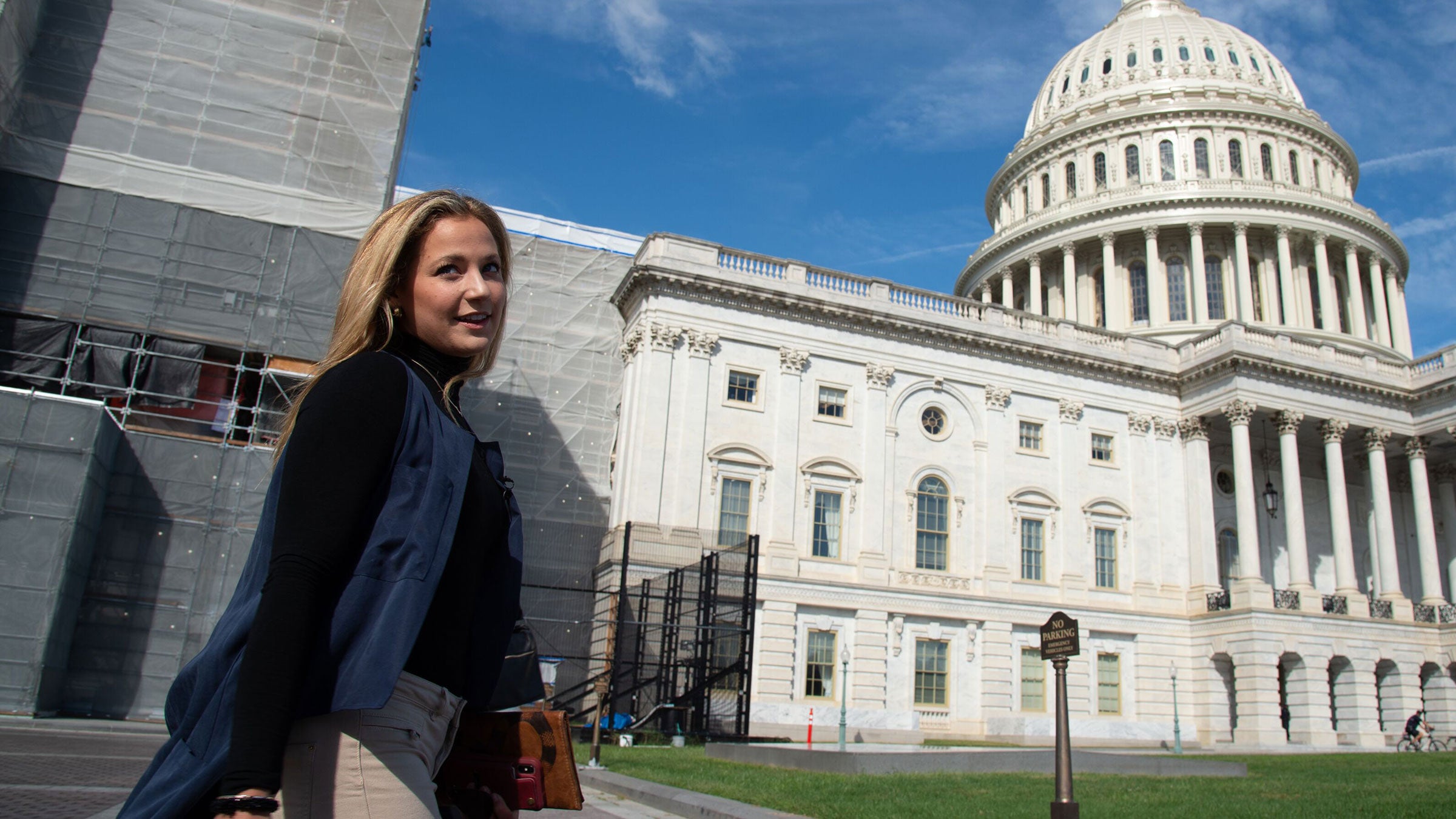
DiGiulian recently traveled to Washington, D.C., for her fourth-annual Climb the Hill event.
When I was nine years old, my mom drove me to Boone, North Carolina, to a place called Hound Ears. We stayed in a little log cabin and woke up early the next day. Climbers from all over sat on crash pads, sipping steamy beverages from their thermoses. People gathered around vendor tents trying to warm themselves against the chilly morning air. Still others flipped through a paper topographic pamphlet, planning their climbing day. This was the first-ever Triple Crown event, a competition and festival in the Southeast in which participants aim to do their best ten boulder problems in a day. It takes place in three locations: Hound Ears, Stone Fort in Tennessee, and Horse Pens 40 in Alabama. But Hound Ears is located on private land, so climbers can only come together to one day a year to recreate there.
That day, climbers ran up and down the mountain, looking for specific problems and trying their hardest to complete them. People from all over pulled pads together to create safe landings and cheered beta and encouragement to each other. I was young and new to the sport, and while my mom was there to support me, she wasn’t a climber herself, so we relied on other participants to help me locate boulder problems and spot me as I made my way to the top of them.
Walking along the crunchy fallen leaves, biting into my cold PB&J, and feeling the grippy sandstone under my skin and the camaraderie in the air heightened my love of the outdoors. It was just plain fun. I returned to school the following Monday and couldn’t wait for Horse Pens 40, the next Triple Crown event.
ADVERTISEMENT
Jim Horton founded the Triple Crown series in 1994 with one purpose: to raise money to keep one of his favorite climbing areas open. Climbing in Hound Ears, like many areas, faces access issues, because landowners do not want the sport happening on their property, often due to liability concerns. Coalitions like Access Fund, the Southeastern Climbers Coalition, and the Carolina Climbers Coalition purchase land to maintain and to develop the sport in these hard-to-access areas.
I have traveled to over 50 countries throughout my climbing career. What I cherish about the outdoors is what makes America so unique to people globally: our public lands. So recently, I went to Washington, D.C., for my fourth-annual Climb the Hill event, where Access Fund and the American Alpine Club team up to lobby on Capitol Hill.
Lobbying means highlighting an issue for your elected officials or introducing a policy that you would like to see supported by representatives. It’s important to note that every American citizen has the constitutional right to lobby on Capitol Hill.
ADVERTISEMENT
For me, protection of the places I love to climb is high on my lobbying list. According to Access Fund, nearly 60 percent of our climbing areas are on federally managed public lands. There are a growing number of bills, executive orders, and resolutions to transfer and diminish our public lands from public to privatized, and often they result in an extreme threat to our environment and wildlife.
As a climbing community, we may be politically diverse, but we all share the same passion. In this, climbing has the power to unite us and inspire all of us to protect America’s public lands.
Here is an overview of our lobby efforts this year:
- We supported the Colorado Outdoor Recreation and Economy Act (CORE), which aims to protect more than 40,000 acres of public lands in Colorado as well as withdraw 200,000 acres at Thompson Divide, near Snowmass and Aspen, from future oil and gas leasing. Want to tell the Senate to pass the CORE Act? Take action here.
- We also rallied around the Recreation Not Red Tape Act, which offers commonsense solutions to unite outdoor enthusiasts. It strives to improve and enhance outdoor recreation on our public lands.
- We fought legislation and executive orders undermining the Antiquities Act, including rescinding Bears Ears National Monument in Utah.
- We discouraged Congress and the president from prioritizing commercial interests over conservation.
- We pushed to maintain regulations that protect the integrity of our public lands, including responsible public-land uses, environmental protections, and development.
- We argued against cuts to the public-lands budget and supported maintaining the authority of those charged with protection of those lands.
My hope is that, together, we can respect the integrity of what sets America apart. A large portion of this comes down to protecting and advocating for our lands. While they cannot speak for themselves, the beauty of the land we all share should speak for itself.
