Updated March 3, 2026 08:38AM
Ski Mountaineering Films Like ‘Trango’ Make Other Outdoor Movies Seem Boring
After watching the new documentary by skiers Christina Lustenberger and Jim Morrison, our articles editor has a few thoughts on why ski mountaineering films overshadow other adventure movies.
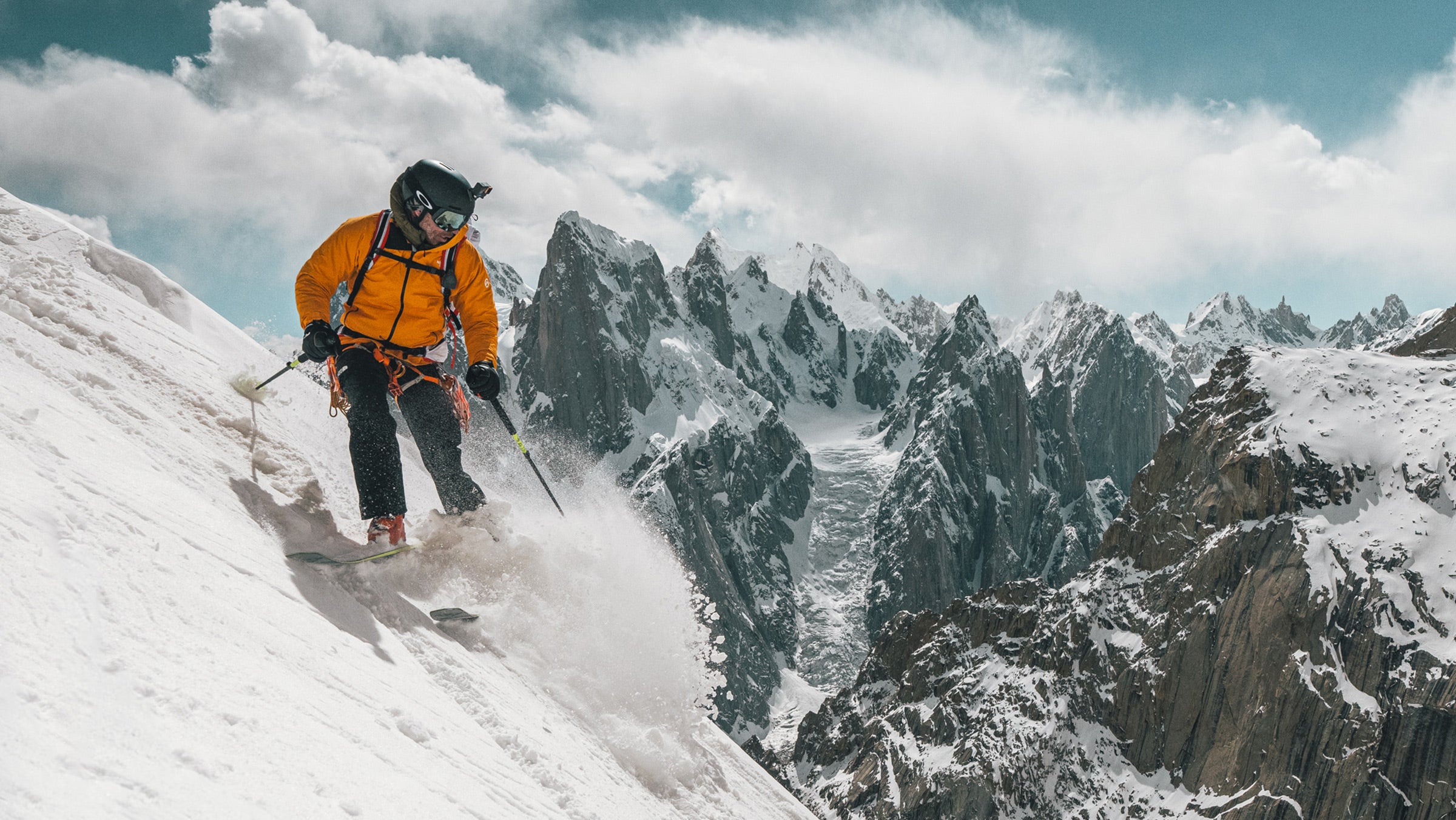
Jim Morrison descents the Great Trango Tower (Photo: The North Face)
Pakistan’s Great Trango Tower looks like something from a fantasy cartoon: a collection of granite spikes and marshmallowy glaciers that Tolkien would have gladly placed in Middle-earth Over the years, the mountain has provided the backdrop for an impressive collection of rock climbing movies, and I’ve watched more than a few ant-like alpinists slowly scale one of the dizzying spires. It’s thrilling, edge-of-your-seat stuff.
But alas, these movies now feel kinda boring. That’s because I recently watched Christina Lustenberger and Jim Morrison climb the 20,623-foot Great Trango Tower and then shred it on skis.
Trango, the ski mountaineering film produced by The North Face about the first descent of the peak, debuted at select film festivals last spring. The film is now touring theaters and festivals across North America, and you can watch it on the streaming service Documentary+.
The film chronicles Lustenberger, better known as Lusti, and Morrison’s two-year odyssey to become the first people to ski the massive glacier that sits atop Great Trango Tower like frosting on a birthday cake. Lusti and Morrison made their first attempt in 2023 alongside big-mountain skier Tanner McNutt, but avalanches and unsteady snowpack turned the trio back from the summit. Much of the film’s 42-minute run time chronicles the physical and emotional hardship of the first failed attempt.
ADVERTISEMENT
They ultimately returned the following summer alongside alpinist Chantel Astorga. Spoiler alert: the three topped out and then carved killer S-turns on their way down. The drone footage of the skiers descending the dizzying glacier is quite the payoff.
I recently asked Lusti and Morrison about the appeal of climbing and then skiing down a peak like Great Trango Tower. They spoke about the thrill of pushing themselves on bigger and more precarious peaks, and of breaking barriers within a sport that’s always been a playground for risk takers.
“We’re looking for the hardest thing possible, or for a challenge that was at some point interpreted as being impossible,” Lustenberger said.
But both of them also said that they are interested in taking on challenges that, well, look really cool.
“I’m really passionate about the aesthetic appeal of a ski line,” Morrison added. “A beautiful pyramid-shaped mountain in the middle of nowhere, covered in white, where you can make big turns down. A line coming off the world’s highest peak where you can just trace the band of white through a couloir.”
ADVERTISEMENT
Climbing and skiing a mountain because the whole ordeal will look beautiful and kickass, even if unintentionally, is a way to align the interests of extreme athletes and the general public. And perhaps that’s the true appeal of Trango and other recent collection ski mountaineering films.
Casual outdoor adventure fans (myself included) can sometimes struggle to appreciate media projects based on the newest gnarly climb, or the latest and greatest achievement by an alpinist. I couldn’t tell you the difference between a 5.15a and a V9-7 route rating if my life depended on it.
But even I know what looks gorgeous. Even I can appreciate the footage captured by an overhead drone of a skier traversing a steep slope.
And ski mountaineering films also add a new and thrilling element to the traditional emotional ebb and flow that many adventure films now follow. Be it Free Solo or Meru or The Alpinist, these movies hit their crescendos once the central character reaches the top. Most of the film captures the physical and emotional toil of the ascent. But we don’t really care how Alex Honnold or Jimmy Chin gets back down.
Reaching the top is just part of the journey in Trango or Robson or any other ski mountaineering film. The climb is just as tricky and frustrating and painful as a traditional alpine ascent. But then comes the skiing, which is typically more nerve-wracking and stressful and woowee! fun than the uphill stuff.
Footage of a ski descent on any monster peak will always have, as Morrison put it, aesthetic appeal. And it will always grip your attention. I challenge you to watch the first two minutes of Andrzej Bargiel’s ski descent of Mount Everest—and then close your laptop. It’s impossible not to flip open your computer and watch the remaining 28 minutes.
A few years ago, Outside magazine published this story, titled We’re Living in the Golden Age of Adventure Filmmaking. The piece surmised that the current crop of outdoor filmmakers had mastered the art of narrative storytelling, and of transforming elite outdoor athletes into compelling characters. So, while the movies they produced had always looked great, now the projects also had the structure and rhetorical devices to keep audiences entertained.
I still believe that to be the case. But for ski mountaineering films like Trango, the storytelling and narrative arc are just icing on the cake. I’m here for the footage of a skier zooming down a mountain.
I had the pleasure of speaking with Lusti and Morrison recently about Trango. Here are some highlights from our conversation.
OUTSIDE: What was the appeal of trying to ski the Great Trango Tower?
Christina Lustenberger: For this project, the appeal was the mountain. Look at the picture of the line we skied. Show it to the general public, and anybody who sees it is going to be like, what? The terrain we skied is mind-boggling even to us. It’s such a unique mountain that is so different from anything else I’ve skied or even seen. I think that is what drew us in.
Jim Morrison: It’s such a wild landscape. We’re used to seeing these big, snowy mountains, with ski lines going down them. The Trango Towers are the opposite of that. It’s this dramatic collection of cliffs in this really remote place. When you see it, you think of legendary alpinism and of these famous climbers. And to go there with a pair of skis and come back down is really different.
You just completed a lengthy media tour for Trango. What do news outlets want to know about the film and the expedition?
Morrison: What Christina does on skis, to the general public, seems crazy. They want to know why and how. Is she actually crazy? Or, is there something else that is elevating her above everybody else? The answer is her deep passion and her push to achieve something on skis. People asked us about the preparation for this project. Christina said ‘Well, I pitched the story in the summer of 2022 and we didn’t go until April of 2023, and there was all of this time to prepare for the expedition.’ I was laughing because I’m like Christina is 40 years old, so there were 40 years of preparation to get to the top of the mountain and blast down it on skis. All of her dedication of perfecting her craft got her ready for skiing in a high-consequence environment. People ask me why I’d go all the way to Pakistan and ski above a cliff. There’s something appealing about being in that situation and knowing that the only way you’ll get out of it is if you’re 100 percent committed and focused.
How do you recover from an expedition like this?
Lustenberger: I had a more challenging time recovering after our second trip to Trango. After the first year, when we didn’t accomplish it, I had this purpose and drive and fire. We told people we were going to head back and get it done. And then, after spending two years chasing the same goal, I kind of had a letdown after the second year. My personality is to always think about what is next? The next challenge, or the next rung of the ladder I want to achieve. After we did Trango, I was mentally and emotionally fried. I took a month of being gentle with myself and allowing my motivation and inspiration to come back. That process of what is next as an athlete or an artist, I think we can relate to that.
Morrison: When I came back from Pakistan I was going to go to Everest that fall, so I took a bunch of time off to rest. People think that it’s really hard on the body doing these projects in the mountains. The irony is that we’re doing a lot of physical activity and training during our normal lives back home. On an expedition, we are spending most of our time doing nothing. You come back from an expedition having eaten poor food, maybe drinking contaminated water, and living in a really tough environment. Your body is actually destroyed from the lack of normalcy and of good nutrition. A lot of times you get weaker on one of these big trips.
