Published March 4, 2026 12:44PM
Yellowstone’s Acidic Echinus Geyser Is Erupting Again For the First Time in Years
The eruptions began in early February. It’s unknown whether the eruptions will continue into the busy summer tourism season, but it’s a reminder that Yellowstone is an ever-changing, dynamic landscape.
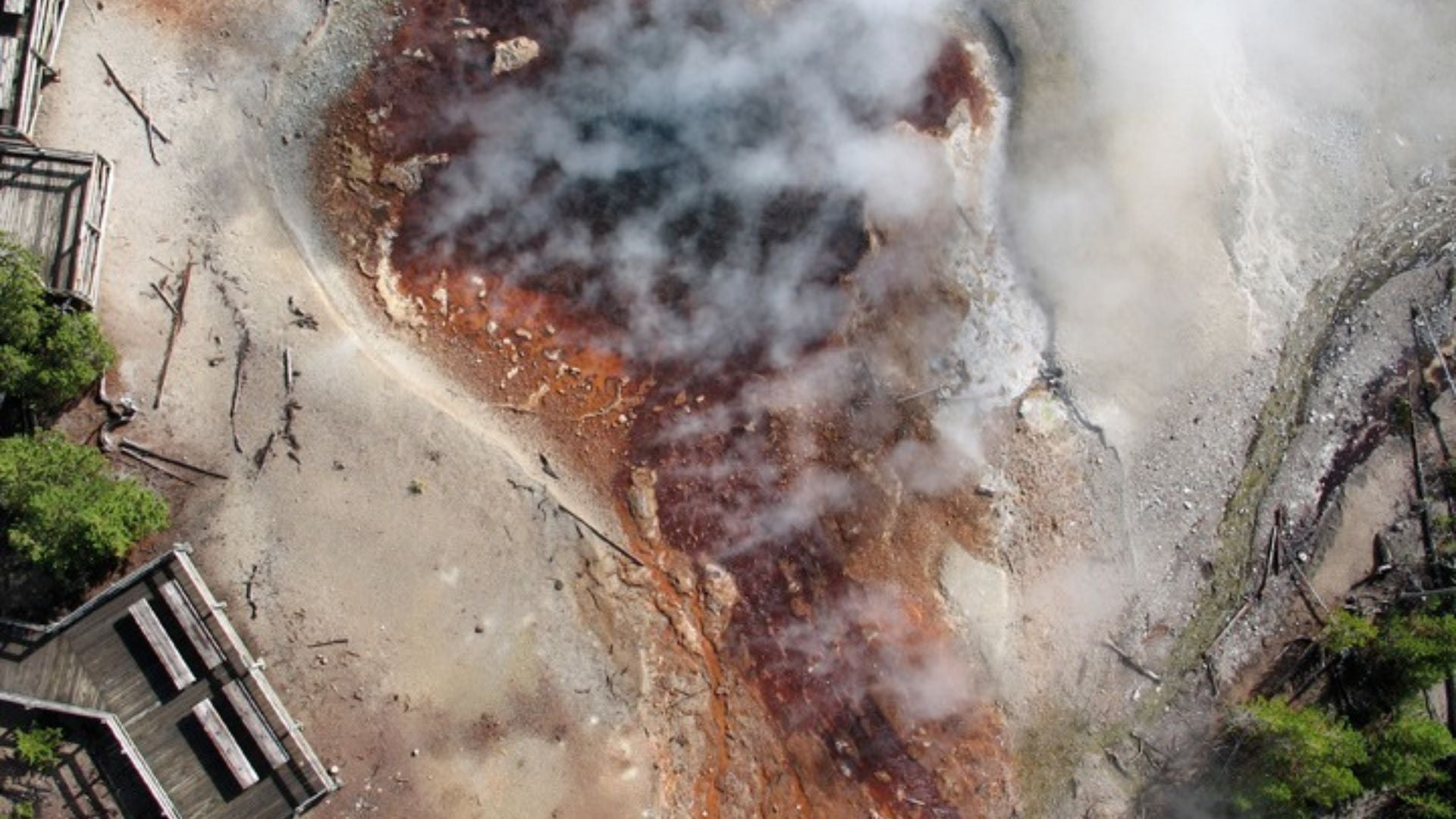
Aerial footage of Echinus Geyser in Yellowstone (Photo: USGS)
Steamboat Geyser, which shoots water 300 feet skyward—higher than from any geyser on earth—oftentimes steals the show at Norris Basin in Yellowstone National Park. But a few hundred feet away is Echinus Geyser, the largest acidic geyser in the world. And right now, Echinus is showing off.
Yellowstone researchers wrote in a March 2 blog post that for weeks, Echinus has been erupting for up to three minutes at a time, reaching heights of 30 feet. For the last six years, Echinus has been mostly inactive.
Measuring about 66 feet across, Echinus has an acidic chemistry similar to orange juice or vinegar.
“Acid geysers are rare because acidic water can break down the rock that makes up a geyser’s plumbing system. At Echinus Geyser, however, the composition is due to mixing between acidic gases and neutral waters, and the acidity is not sufficient to eat away at the rock,” wrote the U.S. Geological Survey (USGS)
The first eruption since 2020 occurred on February 7, followed by additional eruptions on February 9, 12, and 15. As of February 16, eruptions occur every two to five hours.
Home to more than 10,000 hydrothermal features, including Old Faithful and the Grand Prismatic Spring, Yellowstone hosts half of the world’s active geysers. Magma deep within Earth’s internal plumbing system superheats groundwater, eventually forcing it to the surface. Eventually, this flash of hot, steamy water breaks through the ground in the form of a geyser.
Prior to 1948, the USGS says that Echinus was mostly dormant with only occasional eruptions. In the seventies, the geyser erupted regularly, every 40 to 80 minutes. By the eighties and nineties, eruptions were extreme, sometimes lasting over 90 minutes. Eruptions were so regular and powerful—sometimes reaching 75 feet or more—that the National Park Service built a boardwalk around Echinus for spectators.
ADVERTISEMENT
But by the early 2000s, Echinus slowly dwindled into dormancy.
Will the eruptions continue into the busy summertime tourism season?
“It’s probably not too likely given the geyser’s tendency to wake up for a month or two before going back to sleep, and there were no eruptions during the last few days of February, so it might already have gone quiet,” wrote the USGS. “But change is constant at Norris Geyser Basin, so perhaps the show will continue into the summer! Fingers crossed…”
Regardless, Echinus is a reminder that Yellowstone is an ever-changing, dynamic landscape.
