Published August 31, 2010 12:00AM
If you buy through our links, we may earn an affiliate commission. This supports our mission to get more people active and outside.Learn about Outside Online's affiliate link policy
Bachelor of Lost Arts
Herein, a primer on the talents—like chopping firewood or putting an edge on a knife—that will never be obsolete.
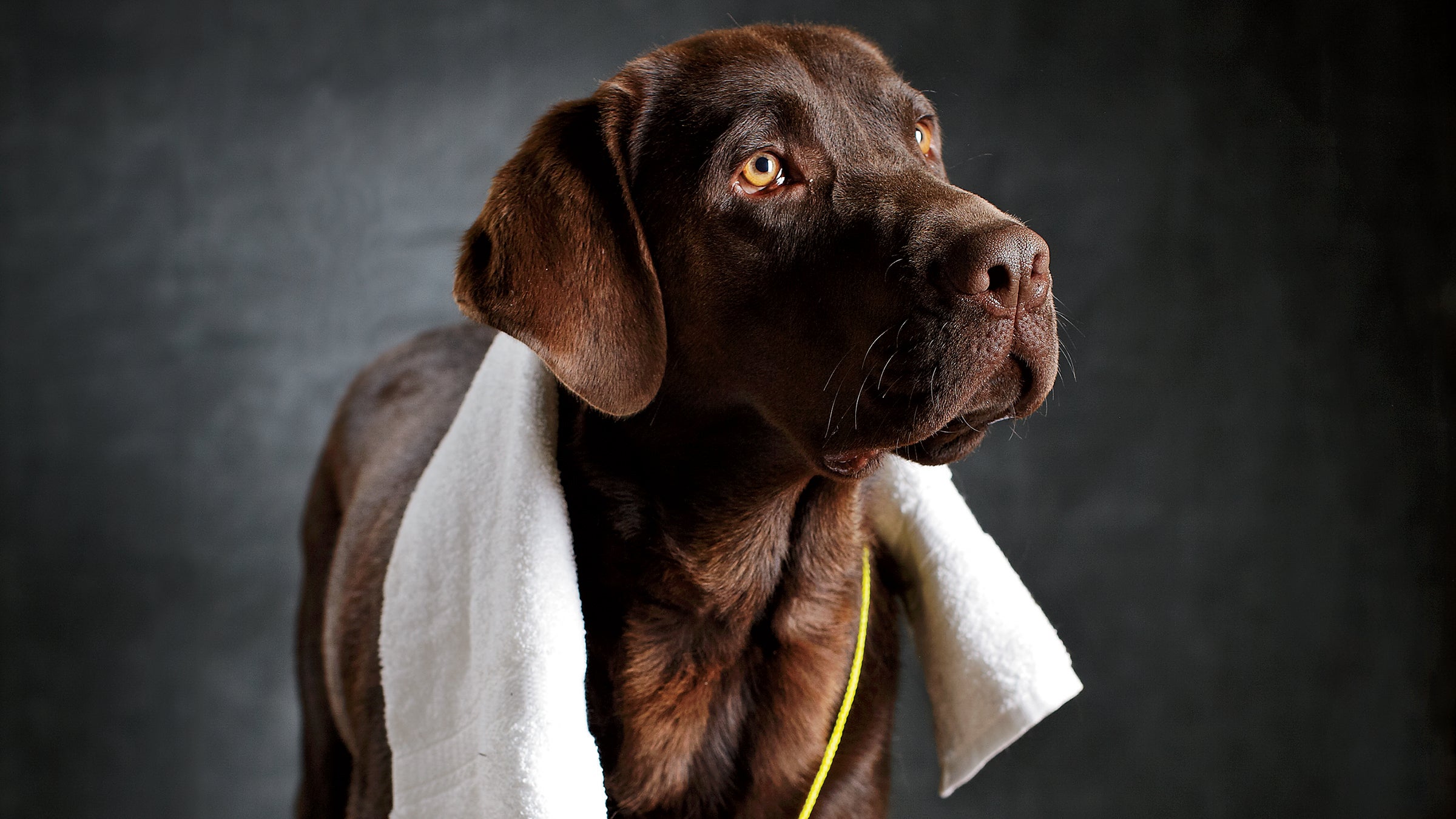
Danger, the adventure dog. (Photo: Inga Hendrickson)
The excuse goes something like this: “I don’t want a robot. I want my dog to be himself.” Right. Especially since he’s so “friendly” that he can’t help but vault the fence to chase every cyclist. But if you’re going to bring your dog along on your adventures—and really, nothing beats it—he needs the self-control to ignore rabbits, stay close, leave food alone, and avoid being a nuisance. With my Labrador Danger, I experimented with several training methods. Here’s what I learned.
Train Your Dog
- A dog needs to know only four things: sit, here, heel, and stay. If he does nothing more than come when called, even when squirrels or other dogs are around, you’re doing fine.
- Behaviors followed by positive consequences are more likely to berepeated. Behaviors followed by negative consequences are less likely to be repeated.
- Start positive. Clicker training, which uses a plastic noisemaker to mark a successful behavior at the instant it occurs, is an easy and effective way to begin. (Karen Pryor’s 1999 book Don’t Shoot the Dog! does a nice job of explaining it.)
- Figure out what your dog truly loves—treats, affection, squeaky toys, etc.—and reserve his favorites for rewards.
- They’re always learning, not just when you’re training.
- Once your dog knows—really knows—what he’s supposed to be doing, set boundaries, apply corrections, and make it clear that obedience, though it will be rewarded, is not optional.
- You cannot be the Dog Whisperer. The American Veterinary Society of Animal Behavior recently came out against the pack-leadership, dominance/submission training model. Instead of trying to impersonate an alpha wolf—trust me, you’re bad at it—just be a human leader. Stand up straight, speak clearly, and don’t repeat yourself.
- With dogs, it’s about getting what they want: food, play, retrieves, affection. And to get what they want, they’ve got to give you what you want: calm, attentive behavior.
For Overachievers
Train Your Dog to Find Gourmet Mushrooms: Just as they can sniff out cocaine in a suitcase, dogs can find chanterelles. Get three 12-inch cardboard boxes and put a few dried chanterelles from the supermarket in one of them. Put the boxes in an empty room with the dog and wait. Don’t say anything. Most dogs will explore the boxes. When your dog sticks her nose in the right box, immediately say, “Good!” (or snap your clicker) and give her a reward. Mix up the boxes and repeat. When she’s got it down, require a sit-and-speak for the reward. Now, before you have her search, give the cue,“Find mushrooms.” Lastly, hide the mushrooms around your yard. Once your dog can reliably show you where they’re hidden, try it in the field. Identify your finds carefully before eating. —Grayson Schaffer
ADVERTISEMENT
Pilot a Canoe in Whitewater
Back in the 1990s, on North Carolina’s famously crowded Nantahala River, my buddy Luke and I were among the rare canoeists on the water. I fondly recall plowing our tandem Dagger Ocoee into the brightly colored kayakers bobbing in eddies. “God damn,” I remember one guy remarking. “I only shoot ducks out of those things!” That’s the beauty of a canoe. You can stroke them in flatwater, load them with weeks of supplies, and, if you know what you’re doing, shoot them down some pretty serious whitewater. A few pointers on the latter:
-
At a minimum, you and your partner should be able to catch eddies and peel out in swift current. At least one of you should have a rock-solid low brace. Not familiar with these terms? Take a class (paddling.net/schools).
- Prep the boat. Make sure your “painter” (bow and stern) lines are ready to self-deploy. If you dump, these are what you’ll use to grab and land your boat.
- Stow away all loose gear and make sure the boat is well balanced, both fore-to-aft and side-to-side.
- When scouting rapids, look for the sneak route, especially if you’re running the rapid “open” (with no spray deck). You’ve got your food and clothing on board, so you’re not looking for the most exciting line.
- Plan your moves early. A fully loaded 17-foot canoe doesn’t pivot like a playboat.
- Slow down. Talk your way around obstacles. Learn how to back-ferry above rapids to get a better read on the situation.
- Punch it. Speed equals safety. When you hit the pile, the bowman needs to lean forward—and dig in!
For Overachievers
Canoe with Your Spouse: It’s called a divorce boat for a reason. But the problem isn’t the canoe—it’s you. More specifically, your natural instinct to yell things like “Right! More right! More right!!!” and “That’s not a !@#$ draw!”To avoid such situations, start on very mellow stretches of whitewater. Ahead of time, work on your tone. Say things like “You’re doing great, but honey, we really need to get right of that hole” in a calm voice. And never, ever promise that you won’t capsize. It’s a promise you can’t keep. —Sam Moulton
ADVERTISEMENT
Brew Your Own
As with tying your own flies, justifying home-brewed beer on financial grounds requires some fuzzy math, like ignoring start-up costs. And it’s not necessarily better than a pint from a good brewery. But it’s your pint. Make it definitely so with a partial mash kit, which requires more craft than the instant brew kits out there, but is far cheaper than a tedious all-grain process.
Here’s how I brewed up two cases of Blood Light from a red chile chocolate porter kit purchased at Santa Fe Homebrew Supply. It came with the hops and malt extracts (the big time-saver), and I bought the jugs, hoses, and bottling kit. Total: $150.
- Crack open a beer.
- Browse Charlie Papazian’s The Complete Joy of Homebrewing ($15, Harper Paperbacks).
- Remove the label from your malt can and soak the can in hot water to soften the syrup.
- Boil two gallons of water and add the malt extracts, stirring until dissolved.
- Add the hops pellets and stir the malt mixture (now called the wort) for 30 minutes.
- Pour three gallons of water into a fermentation carboy.
- Pour the wort into the cold water and sprinkle yeast on top.
- Let the wort stand for ten minutes and then stir in the yeast.
- Insert your airlock cork into the neck of the carboy.
- Let it ferment for ten days, then siphon it into bottles to condition for two weeks. Enjoy. (If that first batch puckers your lips, set it aside for a few weeks. Like wine, beer mellows with age.)
For Overachievers
Make Moonshine: When I was 15 and fixated on Prohibition arts, my grandfather T. Walter Brown introduced me to George, a former coal miner from Marion County, Tennessee, who, while smoking a hand-rolled cigarette, explained the process for concocting “ruckus juice.”
- Build a red-clay furnace along a lonely creek.
- Add a half-bushel of white cornmeal to a boiling still, cook sufficiently, pour into a wooden barrel along with a gallon of uncooked meal, and go home.
- The next day, return and thin out the mash. Add water, stir, then add a gallon of malt and sprinkle a double handful of rye on top.
- Cover the barrel and go home.
- Return five days later and pour your brew into the “thump” barrel. Build up a fire and stir the mash. Steam will hit the barrel’s cold brew, causing it to bubble and thump (it can be heard for several hundred yards through the woods on a cold day). Place a container under the end of the condenser. Insert a funnel lined with a clean, fine white cloth and a double handful of washed hickory coals, the latter to remove “bardy grease,” which can make you ill.
- When the thumping stops, ignite a spoonful of your product. If the flame burns mostly blue, it’s ready to pour. Remember to tie yourself to a tree before imbibing—so as not to wander. —Stayton Bonner
ADVERTISEMENT
Entertain at a Campfire
First, divorce yourself from any obligation to the truth. Southerners, though maligned for our deficiencies in other areas, are, without a doubt, the world’s best storytellers. This is because we couldn’t care less about facts. Truth to a southerner is as useful as tits on a boar. If you’re not from the South, you’re at a great disadvantage. So you need a refined technique. Have a drop of something cheerful. Slow down. People say a story shouldn’t take too long. That’s not true. When you know you’ve got the audience’s interest, slow down until people get uncomfortable, until they’re wondering whether you’re an idiot. Then deliver the knockout. You have to deliver the knockout. You also have to be competitive. You need to steal from comedians, but also from crazy people. Truly crazy people have a gift with language. They can upset expectations, which is all that campfire storytelling is. That, and doing your duty as a human at our primal gathering place. Once I was at a fire in the Himalayas. The buzzed porters started singing song after song, these gorgeous songs. They finally asked when we were going to join in with some American songs. We had nothing. It was pathetic. From that moment, I’ve always been ready to sing a song at a fire. People talk about the wonders of the modern world, the progress of technology. That’s fine. But have your bases covered. —Mace Fleeger, north Florida native and storyteller, as told to Abe Streep
For Overachievers
Play an Instrument: Start with the guitar. It’s easy. Lyle Lovett, Bruce Springsteen, and Bob Dylan don’t need any more than three chords; neither do you. Start with G, C, and D. Learn to play them without a pick. (It’s dark and you’re drunk; you’ll lose it.) Don’t be too obscure—people need to sing along—but don’t sing “Free Fallin’, ” either. Learn a Sam Cooke song. And remember to use your voice. Think it sucks? So does Neil Young’s. Have a sip of whiskey and let ’er rip. —A.S.
ADVERTISEMENT
Find Yourself with a Compass
GPS’s (and batteries) fail. And learning to read a map and use a compass builds good navigation habits, meaning you’re less likely to get lost in the first place. Most important, though, exploring without a gadget makes you pay close attention—which is why you’re out there in the first place.
- Learn to read a topographic map. North is at the top, the scale is at the bottom, those squiggly lines represent 40-foot changes in elevation.
- Orient your map so it points to magnetic north*—turn the housing until north is at the top, line up the north arrow with the red arrow graphic, and turn the map until it lines up with the edge of the compass.
- Find an identifiable feature, like a mountain summit, and take a bearing on it: Point the compass’s direction-of-travel arrow at it and turn the housing until the red arrows line up.
- Set your compass down on the map so that the long edge touches the feature you can see.
- Line up the red arrows again and draw a line on the map. Repeat this process with one or two more features in the distance. You’re standing (roughly) where the lines intersect. —Justin Nyberg
*Magnetic north drifts from true north, depending where you are.
Cook a Great Meal in the Backcountry
Just like at home, the kitchen should be social: It’s where the party is happening. Welcome people in. I make Navajo tacos and have folks help pat out and fry their taco. As for the food, it takes the same amount of time to make something good as it does to make something lame. I like simple but authentic dishes made from scratch: French tortillas for breakfast, which are flour tortillas dredged in egg, milk, and cinnamon and fried on the griddle; taco salad for lunch; and, for supper, feijoada, a take on a Brazilian dish featuring grilled sausage, black beans, rice pilaf, sliced oranges, marinated red onion, and caramelized bananas. I don’t leave home without a good spice kit and condiments. They transform the cooking and don’t weigh anything. I always pack dried New Mexico red and frozen roasted green chile, sea salt, fresh garlic, fresh ginger, and Thai spices. You know it’s a good meal when there are empty plates and they do the dishes—then start asking about the next meal. —Martha Clark Stewart, veteran of more than 100 Grand Canyon float trips and owner of Mosey’s Cantina, in Haines, Alaska, as told to Ryan Krogh
ADVERTISEMENT
For Overachievers
Cook over a Fire: The most important part is the wood. If you’re on a river trip, you’re looking for driftwood. Juniper is great. Or you’re looking for acacia. If you’re in the mountains, you should be gathering downed and dead wood. (Hardwoods, in general, are best.) Build a little trench, no bigger than two feet long by 10 inches wide. Get a couple of flat rocks to put on either side near one end of the trench. This way you can start a fire and move your coals underneath. The essential cooking item is a little grill to prop up on rocks. It’s probably 12 inches by five inches—just to elevate a pot. Make sure your vessel has a bail handle (like on a bucket) that stands up on its own. You won’t burn yourself trying to grab it. And bring a few of them that nest into each other. Unlike when cooking on a backpack stove, you’re not limited to a one-pot meal. —R.K.
ADVERTISEMENT
Grow Your Own Vegetables
Not because it’s sustainable but because what you grow tastes better than anything from the grocery store. The key is intensity: lots of nutrients, sun, heat, and water. The more energy that goes into your garden, the more food that comes out.
-
Build one or more 8'x4'x2' raised beds. Materials (avoid pressure- treated woods, which can leach poisons):
- Four 2″ x 12″ x 12' planks
- One 4″x4″x8'post
- 40 or so 4″ plastic-coated wood screws
- Two 4' x 8' sheets of 6″ x 6″ sidewalk remesh
- One clear 6-mil plastic painter’s drop cloth
- Saw 4' off of each of the planks and screw them together, with 2' lengths of the 4×4 at each joint for support.
- Next, fill the box with the blackest, most nutrient-rich organic dirt you can find. If you need to call in a dump-truck load from a soil yard, each bed should need two cubic yards.
- Prop the remesh into the beds in an arch shape and cover it with plastic. Bricks, staples, or spare wood all work to pin the plastic in place. You’ve now got a hoop house on a raised bed that will concentrate and store the sun’s energy—and reduce evaporation—for hot-weather plants like squash, herbs, tomatoes, peppers, and melons. Get your tomatoes as starts (spring for the gallon size) and plant the rest as seeds a week before your area’s last freeze. My two boxes, one slightly shaded for lettuce and strawberries, produce more veggies than I can eat. —G.S.
