Updated May 24, 2024 02:22PM
If you buy through our links, we may earn an affiliate commission. This supports our mission to get more people active and outside.Learn about Outside Online's affiliate link policy
How to Live Out of Your Car
Professional vehicle dwellers share their tips for making the most out of life on the road
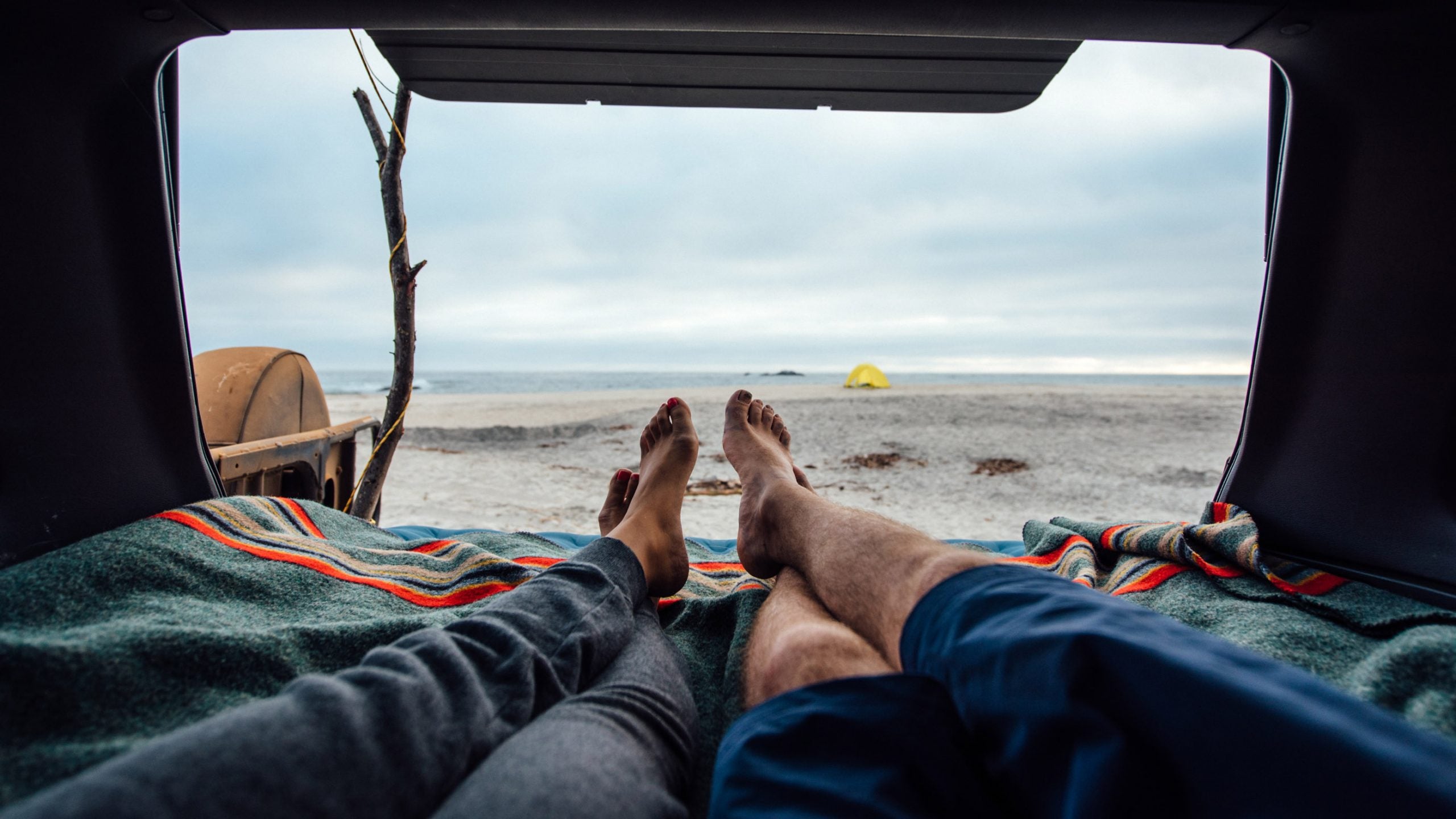
How's this for a backyard? Living in your car might involved cramped sleeping quarters, but it opens up a literal world of outdoor life.
Want to give up on being stationary and move onto the road? Living in your car can be as simple as finding a quiet place to park, but with these tips from veteran road warriors, you can be comfortable and safe while visiting places you never thought you’d see.
Living in a Car: Why Do It?
Increasing numbers of people are willingly giving up their apartments for a home on the road—or, at the very least, adapting their lives to be more mobile. Their reasoning often comes down to these core symbiotic benefits: financial freedom, mobility, and simplicity.
Consider this: You can buy a used Dodge Sprinter (the ultimate vehicle for van dwellers) for about $10,000 and outfit it for life on the road for another few thousand. That’s equivalent to less than a year’s rent in Los Angeles; less still for those living in New York or the Bay Area. A long-wheelbase Sprinter is going to give you about 110 square feet of living space—and access to millions of acres of state and national parks, public land (including national forest and wilderness areas), as well as our neighbors, Canada to the north and Mexico (and beyond) to the south.
Not being tied down by rent while living out of a vehicle allows for near-infinite mobility. For Reed Rombough, the 26-year-old who runs Nomad Construction, a contracting business that’s as mobile as it sounds, moving into a 2003 Dodge Sprinter finally gave him the freedom to accomplish many of his travel goals. Last year alone, he spent three months climbing in Patagonia and another three months trekking in Nepal and climbing in Thailand. (He also climbed in 14 different states between those trips.) For Rombough, work and life are closely tied together: wherever he parks his van, he picks up contracting jobs; sometimes it’s the other way around. The former allows him to work wherever he wants to be; the latter allows him to explore places he might not otherwise see.
If 110 square feet doesn’t sound like much space, that’s because it isn’t, and even that’s luxurious compared to most vehicles. Crystal Tan, a climber and photographer who lives out of her Subaru Forester on long trips between work and school, praises the simplicity associated with life on the road. Since there is limited space in her Forester, Tan is forced to travel with less stuff and brings only the things she really needs (which usually includes a trad rack and sleeping bag). This habit has even influenced her everyday life when she’s not traveling.
To best utilize the limited space in her Forester, Tan and her boyfriend removed the rear seats and built a custom bed with drawers in the back, which provides storage space for gear and cooking supplies as well as a place to sleep. The combo eliminated their need for eating out and staying in hotels while traveling, which makes extended trips even more accessible.
ADVERTISEMENT
For Andy Cochrane, director of marketing at Oru Kayak and inhabitant of the TacoMama—a built-out 2015 Toyota Tacoma—living out of a truck is a rebellion against the status quo. “People perpetuate norms about the right way to live without being conscious of them. Specifically home ownership. Very few people question the American dream to buy a house. It’s a rite of passage. It offers security and comfort; it’s a spot for your growing family; it shows your affluence,” Cochrane says. “Or maybe all it shows is your willingness to follow someone else’s dream. Maybe it only makes you happy because it helps you fit in.” For the 28-year-old, it does the opposite: “[Homeownership] takes away the greatest joy in life—serendipity—and replaces it with monotony.”
Truck life, on the other hand, facilitates simplicity. “When you don’t own many things, you don’t worry about many things,” Cochrane says. “I’m the happiest I’ve been in years, and this is surely part of that function.” That happiness also probably stems from his now-enhanced ability to run, ski, and adventure more freely, as well as greater flexibility to spend more time visiting friends, meeting new people, and taking more ocean swims and fewer actual showers.
Living out of a truck may defy the status quo for Cochrane, but in some ways it provides the same security as a traditional home—albeit with a mobile spin. Lizzy VanPatten, a climber who spent the past summer guiding at Smith Rock, makes the case: “I can live wherever I want within driving distance without having to first worry about finding a new home, moving, and getting a job. For me, it’s as simple as picking a place on a map, fueling up, and driving. It makes trying new things a whole lot less intimidating knowing that I can always leave if it doesn’t work out.” Feeling the tug of that sort of freedom? Here’s how to go about it.
ADVERTISEMENT
Storage Tips
Chances are that if you’re reading this, your idea of life on the road will be defined by adventures in the outdoors. Those adventures require gear. And gear takes up space. Lots of space. When you’re living out of—and often sleeping in—your car, every inch matters. Use them wisely.
Get a Cargo Rack
The easiest way to increase your storage space is by adding a roof rack to your rig. We’ve been using Yakima’s recently updated StreamLine System. We love it for its compatibility (the company custom-designed brackets for almost every vehicle dating back 35 years), easy installation (adding the Base Rack System to the naked roof of my 1995 Pathfinder took less than two hours and was doable solo), and for the wide array of carry and cargo accessories—Yakima offers multiple solutions to haul everything from a kayak, canoe, or SUP to skis and boards to every type of bicycle imaginable.
Plan on doing a lot of off-roading? Check out the LoadWarrior, which provides plenty of lash points for jerrycans, drybags, bikes, or just about anything else. The SkyBox 18 Carbonite offers enough extra space to securely haul bulky camping, climbing, and snow gear for four people.
ADVERTISEMENT
Plastic Storage Bins
The quickest, cheapest, and easiest way to organize stuff inside your vehicle is with plastic storage bins like the ones you can buy at Target. They aren’t pretty, but they provide a great temporary solution that’s as inexpensive as it is convenient. If you’ll be spending much time living out of your vehicle, though, you might want to read on for further for inspiration.
Do a Custom Build-Out
Feeling ambitious? This solution is costly and time consuming, but it offers the most personalization for specific vehicles and specific needs. Cochrane, for example, removed his truck’s backseats to install a mini-fridge and propane tank and built a small closet and dog bed. He then added an ARE commercial cap to the Taco’s bed. A six-by-six-foot drawer in the back acts as his kitchen, pantry, and storage, and a four-inch-thick memory foam mattress on top is his bed. Two Goal Zero Boulder 30 panels charge a large battery that provides electricity if he needs to stay up late to work, and LEDs strung around his ceiling provide light at night.
Rombough took advantage of his Sprinter’s voluminous interior (as well as his own construction skills) to build what he describes as “a tiny cabin on wheels.” When he got the van, it was just an empty metal box. (The 158-inch wheelbase version used to be a DHL delivery truck; the yellow paint is still visible in the doorjambs.) He quickly went to work, spending 16 long days and $3,200 to complete the inside.
The walls and ceiling are made from quarter-inch beadboard stained with an espresso varnish and coated in two layers of polyurethane for durability. Three cabinets store his clothes; a three-foot-long bookshelf above the bed is stocked with guidebooks and reading material. The bed itself is just four inches shy of a queen (Rombough cut a memory foam mattress topper to size). Beneath the bed and behind the shelf is enough storage space to accommodate all of his construction equipment, three crash pads for bouldering, and enough climbing and mountaineering gear to send gnarly lines all over the world. He also keeps a full-hydraulic jack down there for on-the-fly repairs.
Don’t know where to start? Home Depot rents tools, and YouTube will show you how to use them. Have a popular vehicle? You can probably even find diagrams or blueprints online to build it out. Or just hire Rombough to do the job.
ADVERTISEMENT
Sleep System
If you’re doing a full build-out, you’ll probably put a lot of thought into your bed since that’s where you’ll likely spend the most time inside (besides the driver’s seat). Your sleeping system can also be as simple as folding down or removing the seats and inflating a luxurious sleeping pad. Pair that with a down quilt and you’ll be good to go. Looking for a quick and easy solution that doesn’t take up much space? Check out the Therm-a-Rest NeoAir Dream and a Rumpl Down Puffy Blanket. Together, they won’t take up more than a few liters of space yet will provide a great amount of comfort and warmth.
Tires
Tires are the only part of your car that touches the road. And they’re especially important when logging tons of miles, particularly when those miles are on dirt or gravel roads or in extreme weather. Tires that come stock on most vehicles are usually garbage and underperform in virtually all road conditions. Instead of refitting the stock rubber when it wears out, upgrade to something more suited for the road less traveled. Upgrades are often cheaper than the tires your van came with.
A lightweight all-terrain tire is a good option for people doing stuff outdoors. You’ll get better grip on loose surfaces as well as vastly improved puncture resistance. We really dig the Maxxis Bravo 771 on lighter vehicles like Subarus, while the slightly heavier BF Goodrich K02 remains the best all-around option for trucks, vans, and SUVs and is great on snow.
Better yet, let the tires come to you. In some areas, Tire Rack has partnered with mobile tire installers who will accept shipment of your tires, and then come fit them wherever you are: in a driveway, parked on the curb, or in a lot.
