Published December 21, 2024 02:00AM
Originally posted onRUN | Powered by Outside
A Tale of Two Records on the Arizona Trail
Nick Fowler and Georgia Porter set FKTs on the trail by wildly different methods
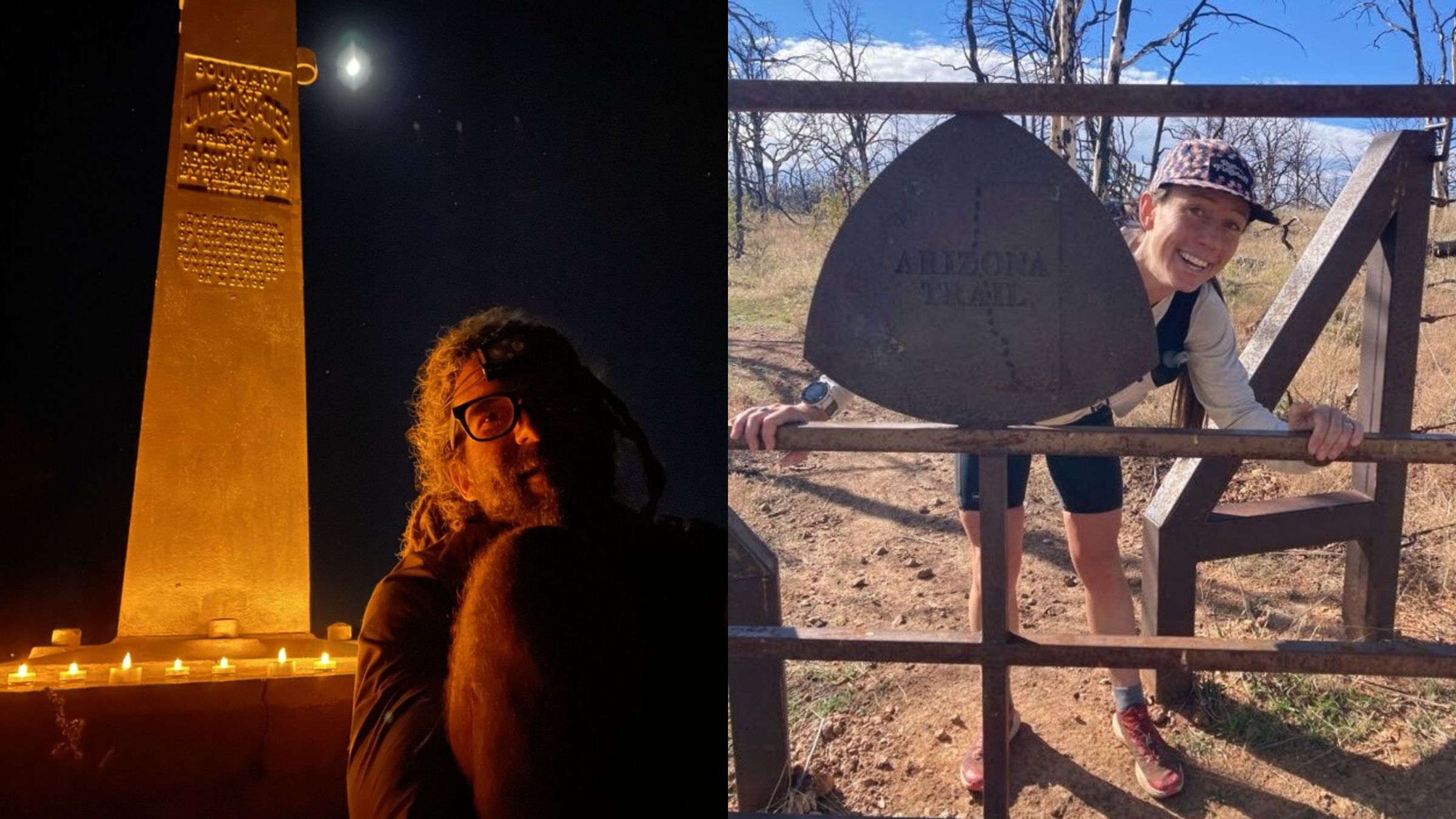
Nick Fowler (L) and Georgia Porter (R) had a record-setting week on the Arizona Trail. (Photo: Nick Fowler and Georgia Porter)
If you want to set a fastest known time on the 817-mile Arizona Trail, you have to start fast. At least, that’s what both Nick Fowler and Georgia Porter proved this fall.
On October 28, they independently set out from the Utah-Arizona border and started their trek south with the goal of setting a record. While Fowler was traveling in a self-supported style and Porter enlisted a crew, the two shared numerous commonalities beyond the same start date, chosen to capitalize on the ideal fall weather.
Each exceeded record-setting pace over the first few days on the Kaibab Plateau. Both ended up sleep deprived, with immense foot pain, and practically hobbling to the finish line at the U.S.-Mexico border. And both completed their attempt with a record: Fowler with a self-supported Arizona Trail FKT of 12 days, 17 hours, and 33 minutes—the overall record on the trail. And Porter with a women’s supported Arizona Trail FKT of 16 days, 22 hours, and 6 minutes.
But dig into their approaches, and it’s clear that even with similar goals in mind, no two FKT setters think alike.
ADVERTISEMENT
A Rough Start
Fowler didn’t run or sleep much in the lead-up to his FKT attempt. Since setting the self-supported FKT on the Pacific Crest Trail last summer, Fowler had his sights set on Arizona. He had already done the AZT in 30 days in the spring of 2023, prior to his PCT attempt. He knew he wanted to shoot for the record in the fall, and started working out what he’d have to do to achieve it. But in early September, less than two months before Fowler’s attempt, a new priority came into his life: Canyon, his new son.
“My training program was calf raises in the kitchen while holding my son,” Fowler says. “And then when I go in the living room, holding my son, I would do single leg squats.”
ADVERTISEMENT
With a new baby in tow, Fowler didn’t get in quite as many pre-trail miles as he’d hoped. A couple weeks before starting the AZT, he headed out to Arkansas for an attempt at a 70-mile day on the Ozark Highlands Trail, but “it absolutely kicked my butt 43 miles in.” Nonetheless, he showed up to the Utah-Arizona border and set out feeling confident that his training from the summer, which included an FKT on the 425-mile Oregon Coast Trail, would carry him through.
“By day two, I was puking my guts out crossing the Grand Canyon, curled up in the fetal position, being passed by hikers in flip-flops, and I slowed down to two-hour miles,” Fowler says. “And I quit.”
About 100 miles in, on the South Rim of the Grand Canyon, Fowler turned off his tracker. He caught a hitch to Flagstaff, feeling defeated. But after a night of rest, he realized all was not lost.
“I was like, maybe I can still do this,” Fowler says. “Everything’s already in place. I’m already here. And if I’m spending time away from Canyon, it’s gotta be something.”
RELATED: A Guide to Running The Grand Canyon
Running in Her Backyard
As Fowler was making his way back to the start, Porter was rallying her crew for her own FKT attempt.
The 36-year-old ultrarunner had two 100-milers under her belt from 2023, including a win at Colorado’s High Lonesome 100. And she was ready for more.
“I think I was just craving adventure,” Porter says. “The full spectrum of highs, lows, challenges, victories, the whole thing.”
From her home in Flagstaff, Porter had already ventured onto sections of the AZT, so choosing her backyard trail for an FKT attempt seemed like a natural choice. Before she started running in her mid-20s, Porter did a lot of backpacking. She had a fascination with long trails and big adventures. But in contrast to the self-supported style favored by thru-hikers like Fowler, Porter found her stride alongside a team.
ADVERTISEMENT
“It was really fun to have a crew and to share this experience with a group of people,” Porter says. “It ended up being probably the most enjoyable part of my experience, to share it with this incredible group of humans.”
After scouting parts of the trail in the brutal heat of July and August, Porter felt she had a good grasp on what she would need for her attempt. She set off from the northern terminus feeling confident, aiming for Joe “Stringbean” McConaughy’s supported record of 13 days, 3 hours, 21 minutes, which would require 63 miles per day.
“Day one Georgia, I don’t know her anymore. I’ve since died and been reborn a few times,” Porter says. “Looking back, I was really naive running the pace I was running. But it was really exciting. I felt amazing that first day. And it was clear, especially in the first week, there was so much to learn on the go for both me and the crew.”
Round Two
By the second night of his restarted AZT record attempt, Fowler slept at mile 143. By his fourth night, he had been averaging 70 miles per day.
“It just started getting hard, but it was so fun,” Fowler says. “I wasn’t expecting to do that. And especially because I hadn’t been training.”
After dealing with stomach issues and vomiting on his first go around, Fowler was hungry. He began the trail consuming around 300 calories an hour, but by day nine upped his intake to 600 calories per hour. Nuts, chips, candy, and a personalized protein shake concoction featuring 800 calories and 58 grams of protein helped Fowler refill the calories he was losing moving for close to 20 hours per day.
“I stick with what works,” Fowler says. “There’s about half healthy stuff, half junk food.”
ADVERTISEMENT
Physically, Fowler was feeling the effects of nearly 300 miles of hiking by day four. But mentally, compared to his 52-day effort on the PCT, the remaining time on trail felt manageable.
“In my head, I’m like, ‘dude, I only have nine days left,’” Fowler says. “‘I’m in a single-digit phase, this is awesome. I feel great.’ When I had nine days left on the PCT, I was dead, like beyond exhausted.”
Things started to take a turn on day six, in the Mazatzal Mountains. A downpour and heavy winds made for a tricky camp setup after 55 miles, the lowest mileage day yet. As Fowler struggled to secure his tarp, his down quilt ended up getting soaked.
“One of my tent stakes came out and the whole thing collapsed on me. I had to crawl out in the rain and re-pitch it with a rock,” Fowler says. “My quilt got wet halfway through the trip and it stayed wet the remainder of the trip. So I was sleeping in a wet quilt in subfreezing temperatures.”
ADVERTISEMENT
Poor sleep contributed to some wrong turns and “bonus miles” on days nine, 10, and 11. His goal of sub-13 days was still in sight, but it wasn’t going to be easy.
“I was hurting bad. I was out of Leuko tape, I was out of Rock tape, I was out of Ibuprofen, I was running out of battery,” Fowler says. “I had backup plans of being able to call people to get some mental support at the end, but I was running out of battery so I couldn’t even do that.”
The Trail Takes Its Toll
Four days into her FKT attempt, Porter’s feet were in excruciating pain. She’d been running in “old junky shoes” with 500 miles on them, and ended up having to cut her fourth day short, falling off her original goal of beating McConaughy’s supported record. But Porter spent the night in Flagstaff, her home, and her sister paced her the next morning.
“I cried while she held me for 10 minutes and just kind of grieved that,” Porter says. “Then we proceeded to have a really good section together that morning. And things started to turn around in letting go of some of my outcome goals and just being present for the experience.”
ADVERTISEMENT
Porter was moving 16 or more hours each day, her feet getting more and more beat up with every passing mile. When she laid down to rest in a specially outfitted Land Cruiser at night, the pain flared up, making it hard to sleep. But by the fifth day, she realized the pain was only going to worsen as her journey went on, and she’d have to learn to live with it.
“It forced me really to say, ‘OK, then I’m going to lean into it. I’m going to feel every tiny little sensation of it and really get to know this pain and not run away from it,’” Porter says. “I’m really grateful for that because it completely shifted my relationship with pain and my pain threshold.”
Her emotions oscillated like the terrain. Heading into mile 600, at the base of Mount Lemmon near Tucson, Porter was on a high.
“I rolled into camp and I was like, ‘It’s smooth sailing from here on out, boys. I feel great,’” Porter says. “The next day we did Mount Lemmon, and I started having an Achilles issue pop up. The descent off Mount Lemmon is steep. It’s really technical. It was really hot. I do really poorly with all three of those things, and I just started to dip into this low.”
ADVERTISEMENT
Porter couldn’t find enjoyment in the experience. She just wanted it to be done. As the day continued, she realized she had fallen into a depression. She explained her emotional state to her friend and pacer Will Schenk, bawled her eyes out, then kept pushing as she processed.
“I was like, ‘No, I just need to feel this. It’s what’s here right now,’” Porter says. “It was a really beautiful lesson: the only way out is through.”
RELATED: Mental Strategies to Break Down Long Distances
The Final Push
By the time the finish line was in sight, Fowler and Porter were struggling. For Fowler, poor sleep in his wet quilt meant he couldn’t finish in one fell swoop. He had to continue resting as much as possible up until his last night.
“I’m always so freaking tired and fried at the end that I’m just holding on for dear life,” Fowler says. “I took smelling salts with me to try and force myself to stay awake. But I had to sleep for three and a half hours the last night, and then I only had 49 miles to finish. So my lowest mile day out there was the day I finished.”
ADVERTISEMENT
Fowler pulled up to the U.S.-Mexico border at 7:31 P.M. on November 9, 12 days, 17 hours, and 33 minutes after he’d started. He achieved his goal of sub-13 days, completing the trail six hours faster than anyone before.
As Fowler was headed back home to reunite with his son, Porter was running on fumes. Listening to Rage Against the Machine kept Porter moving up Mount Miller, the final climb of the trail. One of her crew members handed her a Red Bull, and despite usually not drinking energy drinks on the trail, she pounded it and pushed on.
“It felt like I was on empty, but I was able to access and dig into these deeper wells within me that I didn’t really know were there,” Porter says. “I’ve never accessed them before. That felt awesome.”
ADVERTISEMENT
With a brain that felt like “scrambled eggs” after a 22-hour push, Porter made it to the U.S.-Mexico border at 4:07 A.M. on November 14, setting a new women’s FKT of 16 days, 22 hours, 6 minutes. Her crew was there to celebrate with her, but she wasn’t in as celebratory a mood as she expected.
“I thought the finish would be like, ‘My gosh, I’m going to feel all these emotions.’ But I was just like, ‘I want to go to bed,’” Porter says. “It felt very surreal, honestly, to even feel like it was done. So it was kind of hard to grasp in that moment.”
RELATED: This Belgian Endurance Junkie Took Down One of Ultrarunning’s Biggest Records
ADVERTISEMENT
Solo vs. Supported
The AZT was Fowler’s fifth self-supported FKT in three years. He has no ambitions to join the ultrarunning world anytime soon. (“Do people not realize you could do the exact same course on non-race day for free?”) His solo record attempts allow him to tap into his preferred state: Alone time.
ADVERTISEMENT
“My ideal day is just me and a mountain and nobody else,” Fowler says. “I do think that there’s a lot of benefit that can come from a support team, but I also think that in certain moments I would get frustrated if there was a bunch of people crowding me.”
For Porter, on the other hand, having her crew share in her highs and lows, her sleep deprivation, her laughter and tears, made the experience a team effort.
“It’s beautiful to have such different experiences, but for me this was done in a community and so all I want to do is talk about how awesome my crew was,” Porter says. “There was so much support pouring in from people who weren’t there as well. I just feel a lot of gratitude for that.”
As winter sets in, Fowler is home taking care of Canyon, enjoying baby noises more than he ever thought he would. And after getting some much-needed post-trail rest, Porter has her sights set on another big effort in her home state: the Cocodona 250.
ADVERTISEMENT
“When I was out there in my lows, I was like, ‘This is the end of my career. I’m never doing this shit ever again,’” Porter said. “But a week after, I’m already signed up for Cocodona, so my spirit is clearly not done with this experience.”
RELATED: How Tara Dower Became the Fastest Ever on the Appalachian Trail