Published October 3, 2023 03:00AM
Someone Died the Day I Bought These Boots
How a new pair of Limmers taught me a few things about life, death, and the trails we hike in between

The author near her home in southern Maine (Photo: Greta Rybus)
On my 21st birthday, my father bought me a pair of hiking boots and I held a man’s hand while he died.
We’d been driving on back roads from New Hampshire home to Maine when we pulled over at the scene of an accident. An elderly man in a red truck had gone into cardiac arrest and driven off the road; there was no ambulance in sight. A group of people were standing by and someone helped my dad and me, both EMTs, lift the man from the driver’s seat and lay him down in the grass. He was gasping like a swimmer in the last yards of a race. His tongue was turning gray. His hand was big and warm and stiff, and I held it as if I were about to run across the road in the safety of his shadow, like I used to do with my father’s. The fingers of my other hand gripped his wrist. I could feel the pulse press up and out of the skin. I was losing it, it was beating him. His heart stopped as the ambulance pulled onto the shoulder.
“Back away, miss,” they said. A policeman offered me hand sanitizer. We watched for a while as the men from the ambulance used an AED to help the man on the ground, but not long enough to see them give up. Then we got in the car and drove the rest of the way to Maine.
ADVERTISEMENT
When I got back and carefully pulled the boots out of their box, my first thought was that they were cursed. They were the kind of boots I’d always wanted: black leather with hooks for the laces and thick rubber soles. Limmer boots, from the famous company in Intervale, New Hampshire, made and sold to us by a man wearing a greasy leather apron. My dad said it was a mark of experience if somebody was wearing these on the trail.
For a long time, I refused to put them on. I wished they weren’t mine. I told myself this was because they were too big, and not because we’d seen that man die. Not because, witness to his death, I’d been unable to help.
All summer the boots sat in the back of my car, in their little cardboard coffin, and I wore old boots to work, with the soles chewed out, and pretended. I was working two jobs—one on a flower farm in midcoast Maine and the other at a nearby Outward Bound sailing base—and I didn’t have time to take them back and exchange them. I didn’t have time to hike, either. The boots were bulky and stiff and I didn’t need them.
It was one of my bosses, Susan, who finally convinced me to put them on, lace them up, and throw out the box. She was running a flower farm and did arrangements for weddings, but not so many years ago she’d been the first mate on a schooner. I jokingly called her the Air Traffic Controller—she had three kids and as many acres of unruly blooms—and she always knew what to do in a crisis, whether that meant setting up a last-minute carpool or consoling a tearful bride. I’d admitted to her that an unfamiliar feeling of superstition (or was it guilt?) had made me reluctant to try on the boots. We were in the barn, stripping leaves off sticky peonies and listening to NPR.
“The way I see it, they’re probably lucky,” she said. “You tried to save a man’s life, didn’t you?”
ADVERTISEMENT
“Yeah, but he died anyway.”
It’s hard to look stern with an armload of pink flowers, but she did her best.
“You were there. You didn’t just drive by. You tried.”
I mumbled something about being legally mandated to act because I’m an EMT, but she wasn’t listening.
“Tomorrow, wear the boots.”
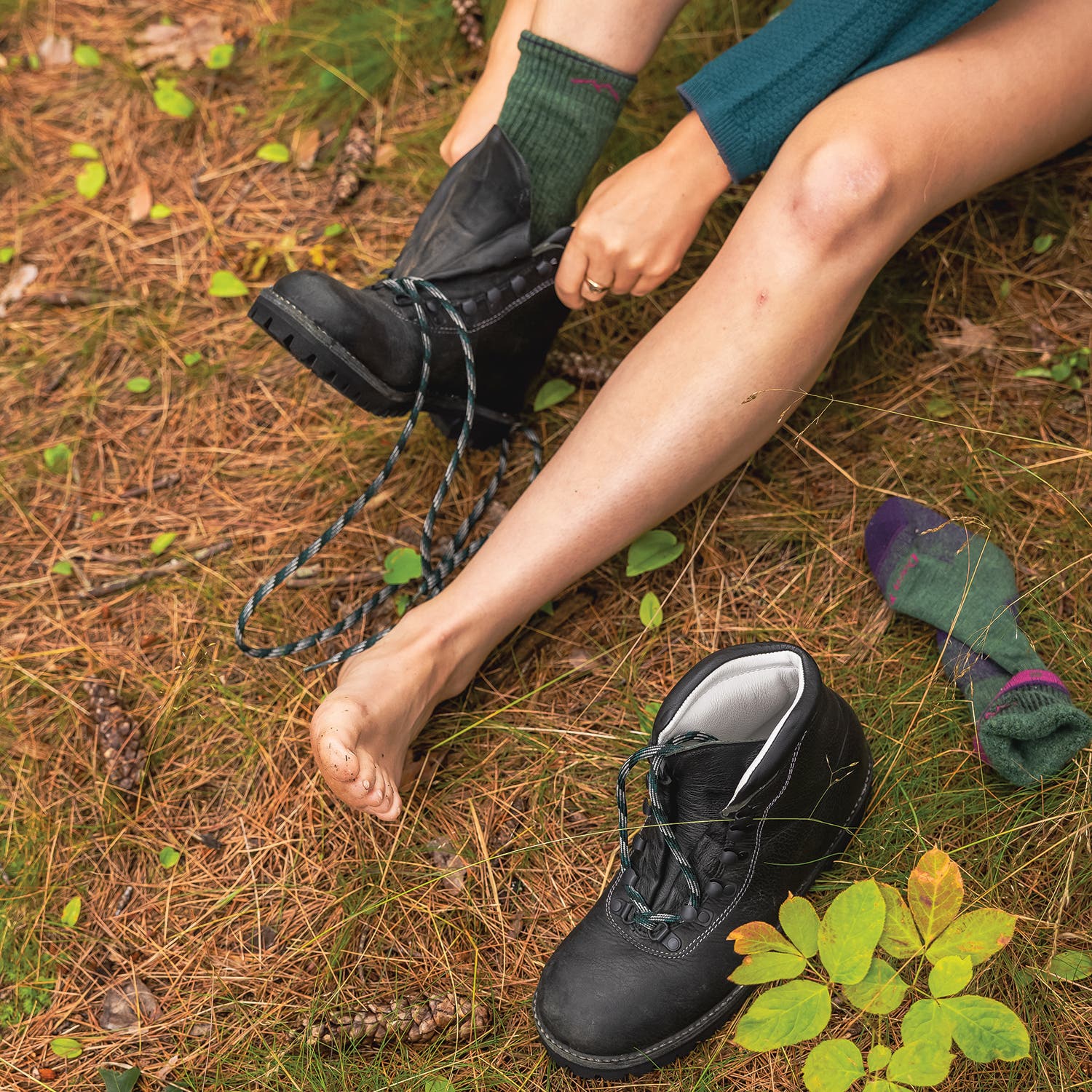
The Limmers were the second pair of hiking boots I’d ever owned—the first were purple-laced Merrells my dad gave me when I turned 16.
A friend of mine had committed suicide earlier that year. People always say that when something hard happens, you just need to keep putting one foot in front of the other. My dad, a former Outward Bound instructor, took that advice a bit literally. He thought that going for a run at sunrise and plunging fully clothed into the ocean could solve anything: uncertainty, heartache, even the common cold.
ADVERTISEMENT
This was easy to do on an island in southern Maine, where 56 steps led from our kitchen’s back door to the shore facing the mainland. In the final month of spring, I broke in the new boots by running up and down a steep set of stairs that led from our house to the water, wearing my big, red Gregory pack, weighted down with smooth granite cobbles we picked up off the beach. My dad followed a few paces behind. That summer, we hiked the 100 Mile Wilderness together, a remote section of the Appalachian Trail in Maine.
I thought I was prepared. In my mind, filling a water bottle was about all the planning you had to do to cross an ocean, but my dad, who borders on obsessive, felt differently. He was quick to find and extricate the novel hidden in my pack and replace it with extra socks. We packed. Unpacked. Packed again. Finally, near the end of July, he deemed us ready.
We camped the first night within staggering distance of the trailhead. The tent was small. My father is tall. Tonight, he reassured me, would be the only time we did this. The tent was just a backup; we planned to stay in lean-tos every night of the trip.
ADVERTISEMENT
Breakfast was cold oatmeal we’d soaked until daybreak. Then we walked, strode into the forest with hiking poles swinging and our lives on our backs. The realization that there weren’t going to be any luxurious stays in lean-tos sank in by night three. They were all full. Not just full, but teeming with loud, smelly humans of questionable sanity, some the vanguard of the latest batch of through-hikers on the Appalachian Trail. My dad and I slept head to foot in our microlight solo tent, blackflies biting us through the fabric. I lay stretched out on my back, arms pinned to my sides. I’d never taken up so little space. I felt vulnerable, like the flimsy fabric of the tent was scanty cover beneath a watchful sky.
It didn’t matter. This was a landscape of beginnings, where each day existed for itself. I stumbled out of the tent at sunrise and back into it at dusk, living not just by the day but for it.
White Cap Mountain was the tallest summit on the trip, and I’d already hiked it, although not with 40 pounds on my back. I’d done a three-day section of the trail with my school the previous fall, when I was 15. We were split into two groups, crossing paths at the peak. My friend—someone from school who I associated with pranks and daydreams; laughter in the bathroom one day, tears the next—was in the other group. We looked at the view together. Then she went down the mountain to the south and I went north. Less than two months later, and entirely unexpectedly, she took her life. It was too much to feel until later—I buried my questions, and my fears about asking them, in schoolwork. In the cluttered attic of my heart, I threw sheets over every teetering pile and every sharp corner and I let them gather dust.
I thought of my friend, who would not hike this mountain again, and I knew that there was nothing for me to do except keep being there, keep seeing the trees. Not everybody could.
During the week it took my dad and me to walk from Monson to Katahdin, we never talked about the death of my friend. He made me walk first, and if I looked back, he was always there. We’d set out to walk 100 miles in ten days, and we did it in seven. I hoarded evidence of my having been there at every step—in the scuffs on my boots, the dirt in the creases of my hands, the scrapes on my knees.
ADVERTISEMENT
A character in one of my favorite books, A Room with a View, says that “by the side of the everlasting Why there is a Yes—a transitory Yes if you like, but a Yes.” This time, when I reached the summit of White Cap, I looked out alone. With my finger, I traced the rivers to where they unraveled into soft green-blue woods. I thought of my friend, who would not hike this mountain again, and I knew there was nothing for me to do except keep being there, keep seeing the trees. Not everybody could.
I had walked very far to receive this gift from her, and the memory of her laugh when we’d pretended to shake hands on the path.
“Glad to have made your acquaintance,” I’d said that day, and now I looked down at my aching feet in their muddy boots. I turned my back on the long way I’d come and faced the view. And I told her again I was glad.
For a long time, before my boss intervened, I kept the boots in the back of my car and didn’t wear them. I wished we’d been another five minutes down the road.
That fall, over big shallow bowls of risotto at my uncle’s house, I came to understand something. My mother and I were sitting at his dining table, tea candles in mismatched glasses between us, the shadow from the arched neck of a stuffed antelope on the wall. We were in Washington, D.C., where my family is from, in the row house I so loved visiting. My uncle has been a successful nonfiction writer for the past 40 years, since he graduated from college. A great lover of novels—his living room was crowded with floor-to-ceiling shelves that sagged from their weight—he had written one for the first time. He was telling us about how it had changed him.
“I used to think about that expression, ‘If a tree falls in the forest and nobody is there to hear it, does it still make a sound?’ ” he said. “Yes, of course it does. But now I think the answer is no, no, that it doesn’t make a sound and that’s God.”
ADVERTISEMENT
My mom rolled her eyes.
“Just because you never go that deep!” he said. She got up to wash the dishes. I took another bite of risotto so she wouldn’t see me smile.
“What I mean is that things happen if we don’t see them, but we make the meaning,” he said. “God, whatever—it’s in us.” He went on. Even if the novel isn’t any good, he said, at least he’d written it. He had worked through long, hard days to see the view and to say something about it—a testament to his having been here at all.
ADVERTISEMENT
When I did not save a man’s life on the side of the road, when I watched him die, I saw the tree fall and I heard it. And it was not like my uncle said. It would have meant all the same things that it did without my being there, affecting people I did not know and could only imagine. But because I was there, it also meant something to me. It reminded me of the death of my friend, how she had chosen to die alone. That was a heavy stone in my pack, a weight I did not want to carry.
At the end of that long summer, when my hands were always pricked from rose stems, I dug the boots out of the rubble in the back of my car and sat on the tailgate to lace them up. I was at Camden Hills State Park, and I walked a short way, alone, to the top of Mount Battie. There was an old World War I memorial at the top, a tall, round tower made of stone, and a sign with the first stanza from a poem that described the view.
“All I could see from where I stood,” it read, “was three long mountains and a wood; I turned and looked another way, and saw three islands in a bay.”
I remembered this place. My first hike had happened here, not long after I learned to walk. This was where dad and I would come every summer to camp, where I’d smudged borrowed books with cream cheese and jam in the park beside the old public library. I looked out at the islands, thatched tightly with green spruce, the beaches with gray rocks crisped to black at the edges along the high-tide line and the smooth granite cobbles further down. And I looked at my feet then, in their new boots, shyly exhibiting the first signs of wear—a scuff in the leather of the left toe, dust already filling in between the laces.
ADVERTISEMENT
The boots are big and stiff. According to the man we bought them from, they may last the rest of my life. I wouldn’t have it any other way. I’ll no longer cast off my past experiences or the inevitable future ones as extra weight. These are the boots that I’ve been given, and I will wear them well.
Luna Soley has written about lobstering, sea kayaks, and Patagonia jackets for Outside and Outside Online.
