Updated January 29, 2024 12:00AM
Why Did I Hike 50 Miles Through the Jersey Suburbs? Teddy Roosevelt Told Me To.
The 26th president once demanded that military personnel be able to walk 50 miles in 20 hours. I set off on an ill-fated mission to see if I could do it myself.
(Photo: Erin Douglas)
It’s 5:30 A.M. on an unseasonably warm October morning, and I’m standing in the driveway of my New Jersey home, waiting for my friend Paul. The lawn sprinklers have just kicked on, their susurration joining the predawn chorus of crickets. A bright, waxing gibbous moon is reflected in the hood of my Subaru. I’m about to take a good, long hike—the longest I’ve ever done in a day—for no real reason other than an obscure edict from the 26th president of the United States.
0:00
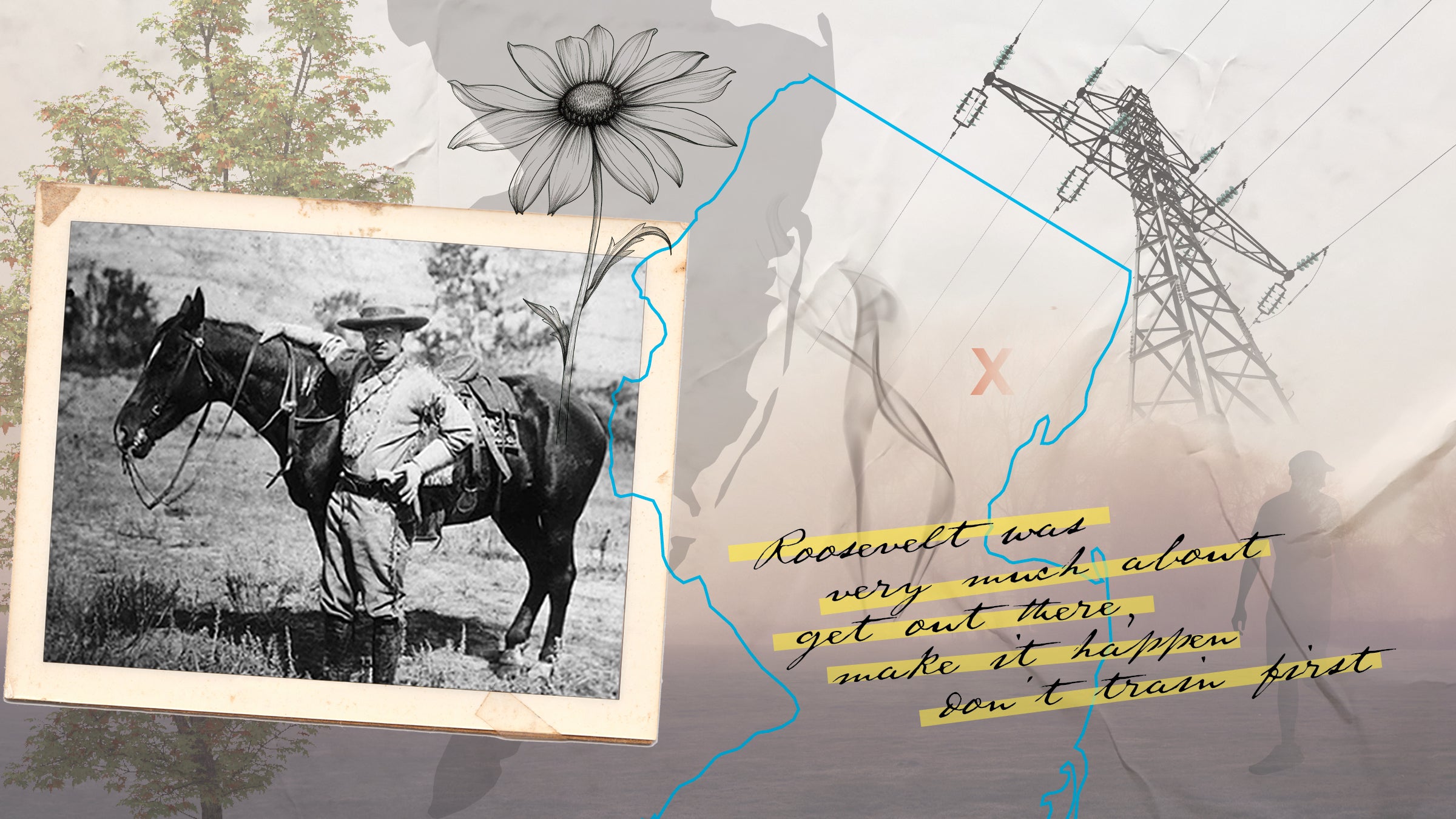
On December 9, 1908, President Theodore Roosevelt signed, with little fanfare, Executive Order No. 989, headlined “Marine Corps Officers’ Physical Fitness.” It directed each officer of the United States Marine Corps to undergo a physical examination and a series of tests every two years.
The tests were simple. Officers would have to ride a horse 90 miles, “this distance to be covered in three days.” Officers ranked “in the grade of captain or lieutenant” were also required to walk 50 miles, with “actual marching time, including rests, twenty hours.” Seven hundred yards of this needed to be completed “on the double-time”—something like a slow jog. This test too could be spread across three days, allowing the soldiers sleep and recovery time.
ADVERTISEMENT
Order 989’s rationale was spelled out bluntly: “In battle, time is essential and ground may have to be covered on the run; if these officers are not equal to the average physical strength of their companies the men will be held back, resulting in unnecessary loss of life and probably defeat.”
Neither the Army nor the Navy, which each got their own respective executive orders with the same test, escaped Roosevelt’s attention. “I have been unpleasantly struck,” he observed in a letter to Secretary of the Navy Truman Newberry, “by the lack of physical condition of some of the older officers, and even some of the younger officers.”
Roosevelt was in the waning days of his presidency, a time when outgoing leaders often try to settle up unfinished business, notes Ryan Swanson, associate professor of history at the University of Mexico and author of The Strenuous Life: Theodore Roosevelt and the Making of the American Athlete. “Executive orders sort of come and go, and aren’t really that enforceable.” But the one-time Rough Rider’s final volleys stemmed, Swanson argues, from concerns that, after a long period without a war, the Army was becoming a bunch of bureaucrats, unprepared for conflict.
And then there was Roosevelt himself. There was probably no other President in U.S. history so concerned with the bodies of the body politic. “I wish to preach, not the doctrine of ignoble ease, but the doctrine of the strenuous life,” he said in a famous 1899 speech that mixed personal uplift with more than a bit of saber rattling. Swanson says that Roosevelt, like other Progressive-era reformers, worried that “urbanization was making us weaker”—that we were living in unhealthy cities, that we were toiling in offices rather than plowing the fields of the Agrarian Republic (by 1900, only 40 percent of the country worked in agriculture).
There was, undoubtedly, some political stage-management at work. Roosevelt knew how to project the image of a strong leader. But he certainly walked the walk. Plagued by asthma and extreme myopia as a child, battling injury and struggling with his own weight as an adult, Roosevelt spent virtually his whole life engaged in the “strenuous life.” One of the first things Roosevelt did upon assuming the White House was to build a tennis court, on which he played hundreds of times. He was an avid boxer and dabbled in jujitsu. And one of his favorite ways to shake off the stresses of high office, notes Swanson, was to set off on impromptu hikes through Rock Creek Park, five miles north of the White House. He particularly favored what he called a “point-to-point walk” wherein he would perambulate from point A to B, directly, no matter what cliff, pond, or impenetrable vegetation was in the way. Roosevelt, recalled British ambassador Mortimer Durand, “made me struggle through bushes and over rocks for two hours and a half, at an impossible speed, til I was so done that I could hardly stand.”
ADVERTISEMENT
And so, when Roosevelt issued his series of executive orders on the fitness of the military branches—the predecessors to today’s physical readiness tests, or PRTs—it wasn’t merely the fiat of an armchair general. This was a man, after all, who, after being shot during a speech in Milwaukee, continued orating with a bullet inside of him. (The bullet was slowed somewhat by a sheaf of papers tucked into the inner pocket of his coat).
The orders immediately kicked up complaints. As historical journal The Grog recounts, “Navy Surgeon James Gatewood complained that the endurance test would leave participants in a ‘depressed physical state.’” The Navy’s surgeon general said it could put the lives of officers over 50 at risk. As if to carry the torch for his own initiative, on January 13, 1909, Roosevelt (then 51) and a small party of Naval officers set out for a horseback ride to Warrenton, Virginia, a distance of 49 miles each way. Following a 3:45 A.M. breakfast of steak and eggs, Roosevelt, on his own steed Roswell, set out into a day marked by freezing rain, eventually returning to the White House at 8:30 P.M., declaring the ride—yep, you guessed it—“Bully!”
Shortly after, Roosevelt was out of office. His successor, William Taft, demolished the tennis courts. A subsequent order, 193, did away with the test and called for a monthly ten-mile walk, “to be completed in neither more than four nor less than three hours.” Roosevelt’s challenge may have faded into historical memory, were it not for its later rediscovery by John F. Kennedy who engaged in his own Rooseveltian crusade, albeit with a Cold War twist.
According to the podcast Ultrarunning History, Kennedy charged his Marine Commandant with putting a group of his officers to the test in 1962. While not intended for the general public, word got out, and there was a brief, nationwide “50-mile frenzy” in the early 1960s, with everyone from Eagle Scouts to a mother of three to the President’s brother, Robert, completing 50-mile walks. But this mania soon subsided, and all most of us know today of Kennedy’s fitness program were the push-ups and shuttle runs we might have been asked to do in our grade school gyms.
When, not long ago, I learned about Roosevelt’s Executive Order, I got it into my head that I needed to attempt it. I started looking for suitable hikes, briefly fixating on Cranberry Lake in the Adirondacks, which is encircled by a 50-mile trail (and people who complete it are awarded a patch). But that involved a long round-trip drive from my home in Madison, New Jersey, and a hotel. I came across a popular race in Maryland known as the JFK 50 Mile. That also involved a drive and a hotel, and I didn’t want chip timing and aid stations. I didn’t want something I was supposed to train for. I wanted to go back to the source, and Roosevelt specified a walk.
A far simpler idea soon dawned on me: Why not just leave straight from my front door? The main problem is that I live in the New Jersey suburbs. On Walkscore, my address rates a 22 out of 100 (“almost all errands require a car”). The state, which can sometimes seem like one long divided highway flanked by strip malls—“bagels/nails/tanning”—is hardly a pedestrian paradise.
But I knew there were nature reserves, patches of trail here and there. I wondered if I could somehow stitch them together, like the narrator of John Cheever’s classic story “The Swimmer,” who swims across his town via his neighbor’s pools, “a quasi-subterranean stream that curved across the county.” I asked my friend Paul Rosica, an expert in the local terrain who crafts an annual “dirty” bike ride that sends road bikes onto single-track, if he could craft a route.
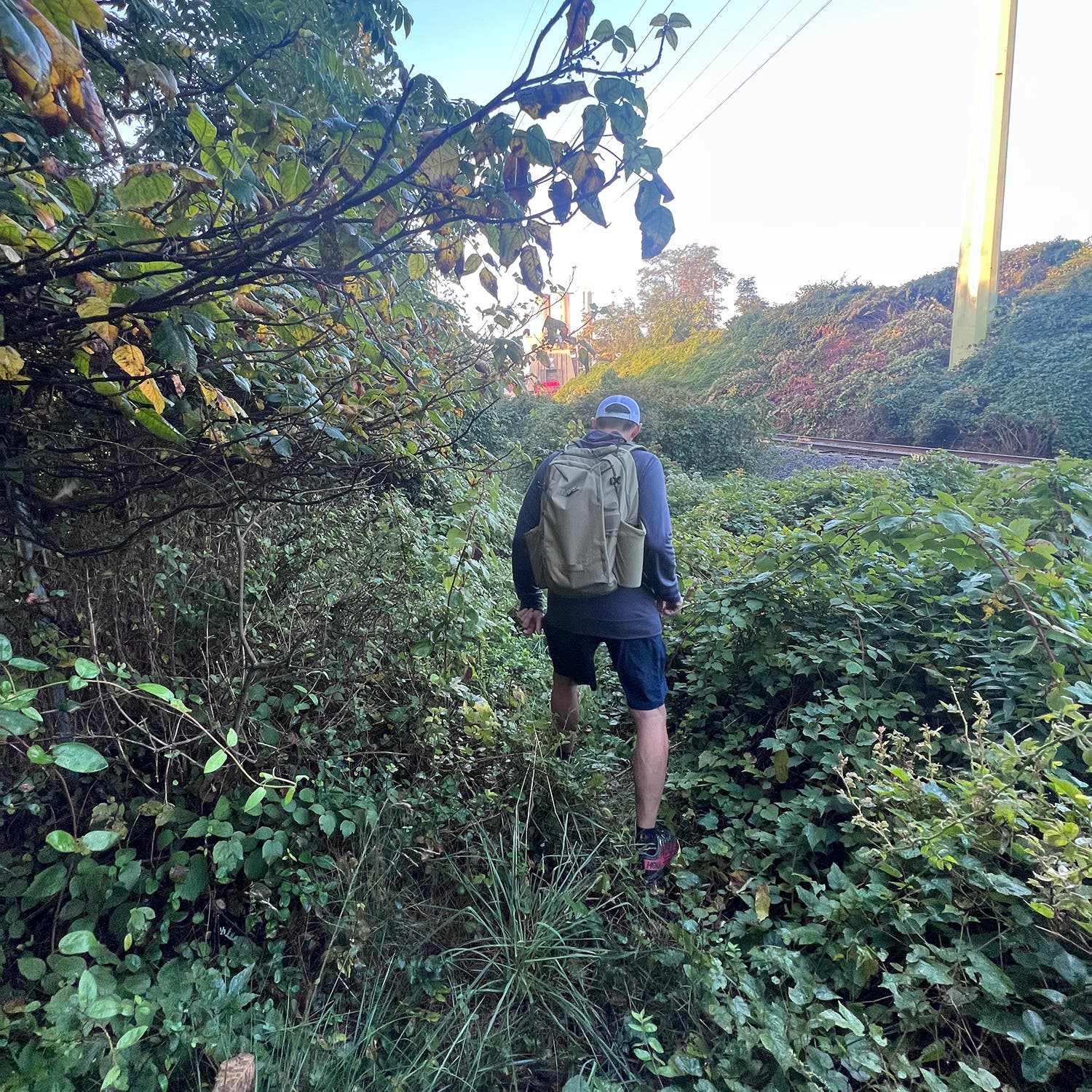
He could. He also asked if he could come along. And so, on a Tuesday morning, as the world was getting ready to go to work and to school, we set off from my driveway. It was warm, and the walk would be long, so I went for lightness: a tech T-shirt, REI running shorts, Saucony Kinvara 14s, and a 2.5 liter Osprey hydration pack, stuffed with peanut butter sandwiches and Fig Newmans. Rounding it out were a headlamp, Band-Aids, and a phone battery pack. We headed toward Morristown, passing the historic home of Washington’s Headquarters, eerie in the predawn gloaming. We passed a pair of adults smoking cigarettes on a jungle gym at a local park. At one point the trail was impassable, choked with weeds, so we walked on railroad tracks, attracting surprised stares from the workers at a cement plant.
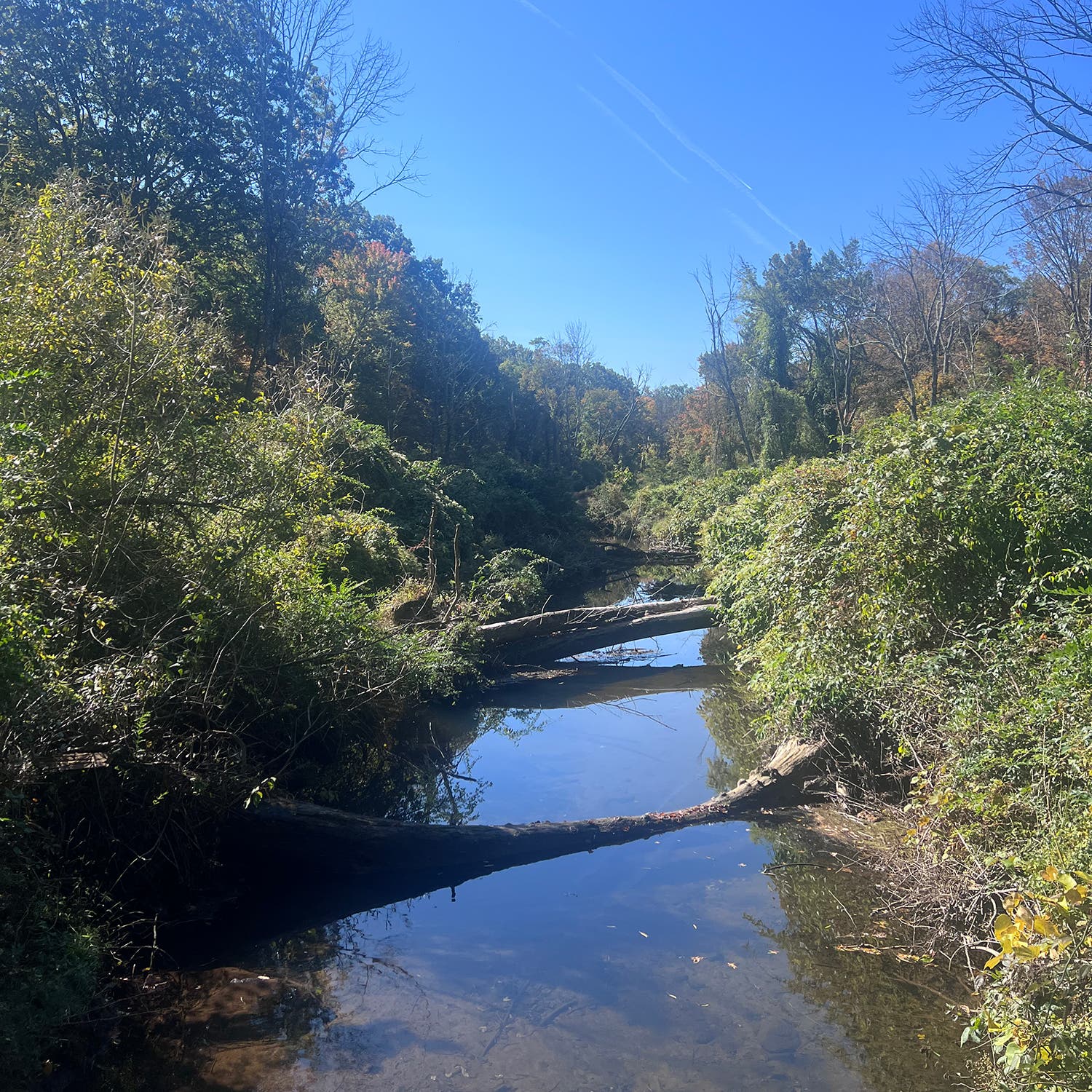
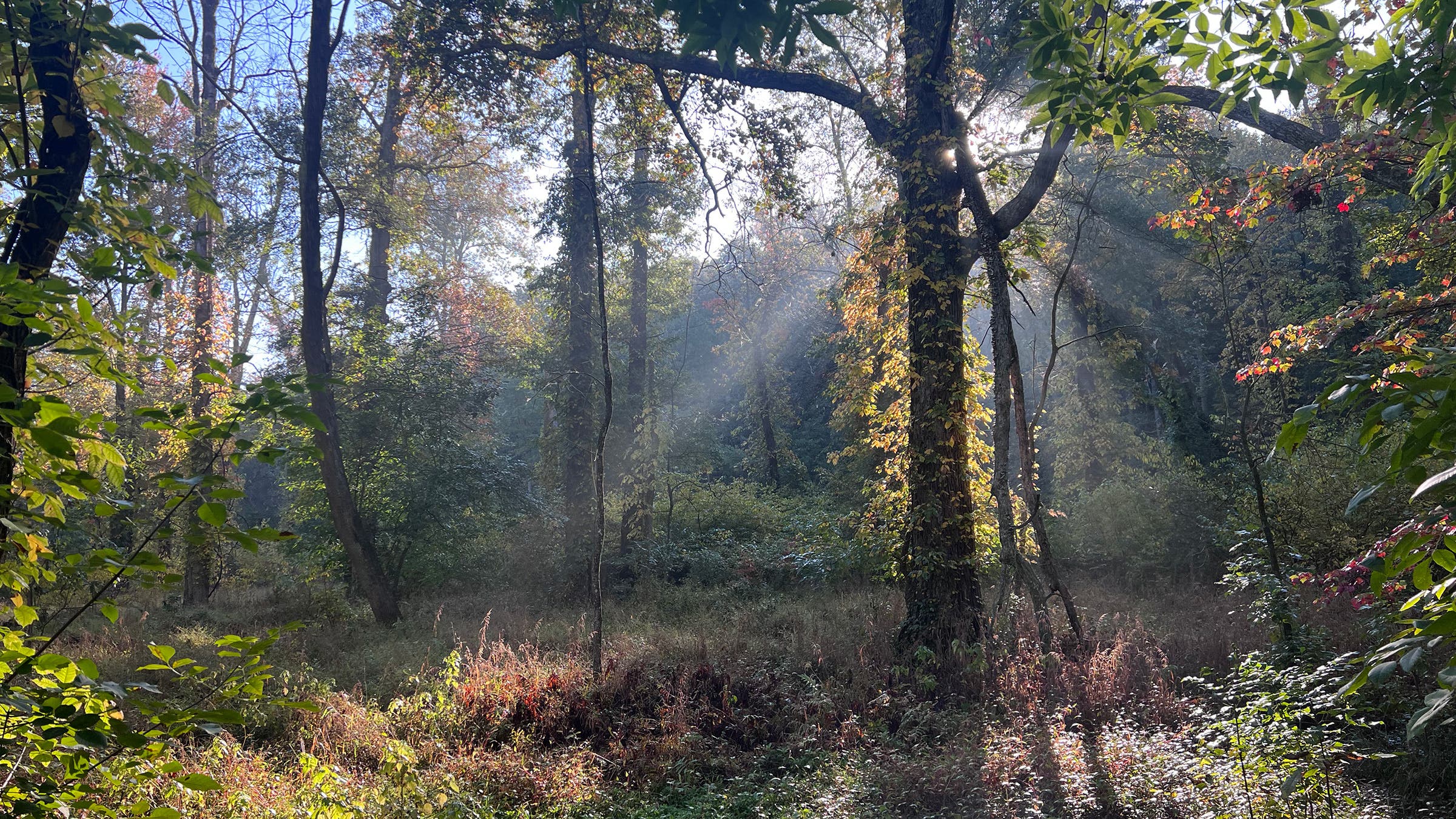
We soon picked up the Patriot’s Path, a trail network that winds through various counties, and walked the outskirts of the Frelinghuysen Arboretum, a sylvan 124-acre tract that I’d never visited. There were dewy glades, foggy fields, burbling creeks. This still being New Jersey, however, the path would sometimes bump up against a highway, or emerge into the back corner of a parking lot of a suburban office complex, where the hiker would be greeted by a dumpster and no clear idea of where to resume the path. In moments like these, we’d have to do brief reroutes or simply pause and look for faint clearings in the treeline. This elemental bushcraft, amidst the dull roar of traffic or in the view of fluorescent-lit offices, felt weird.
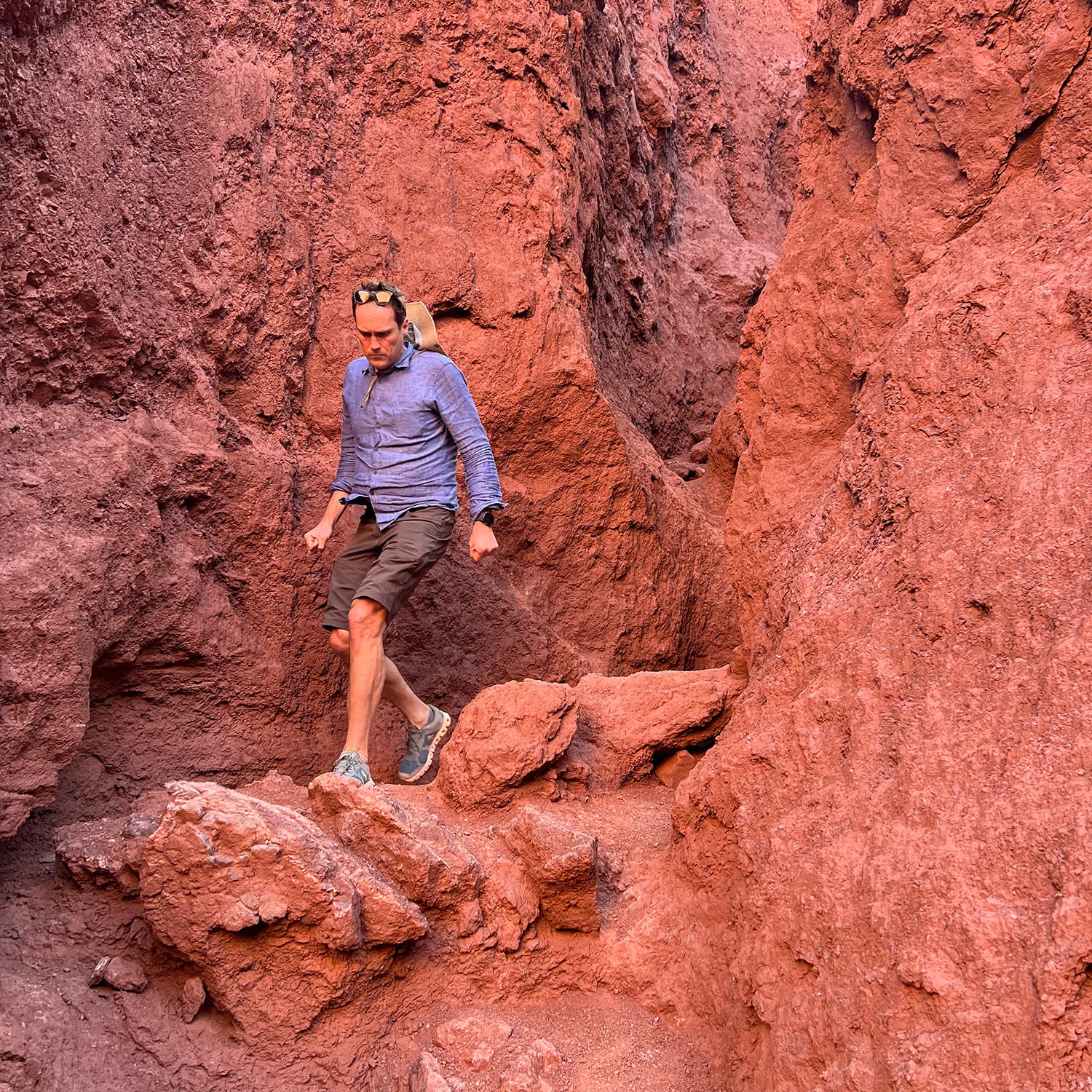
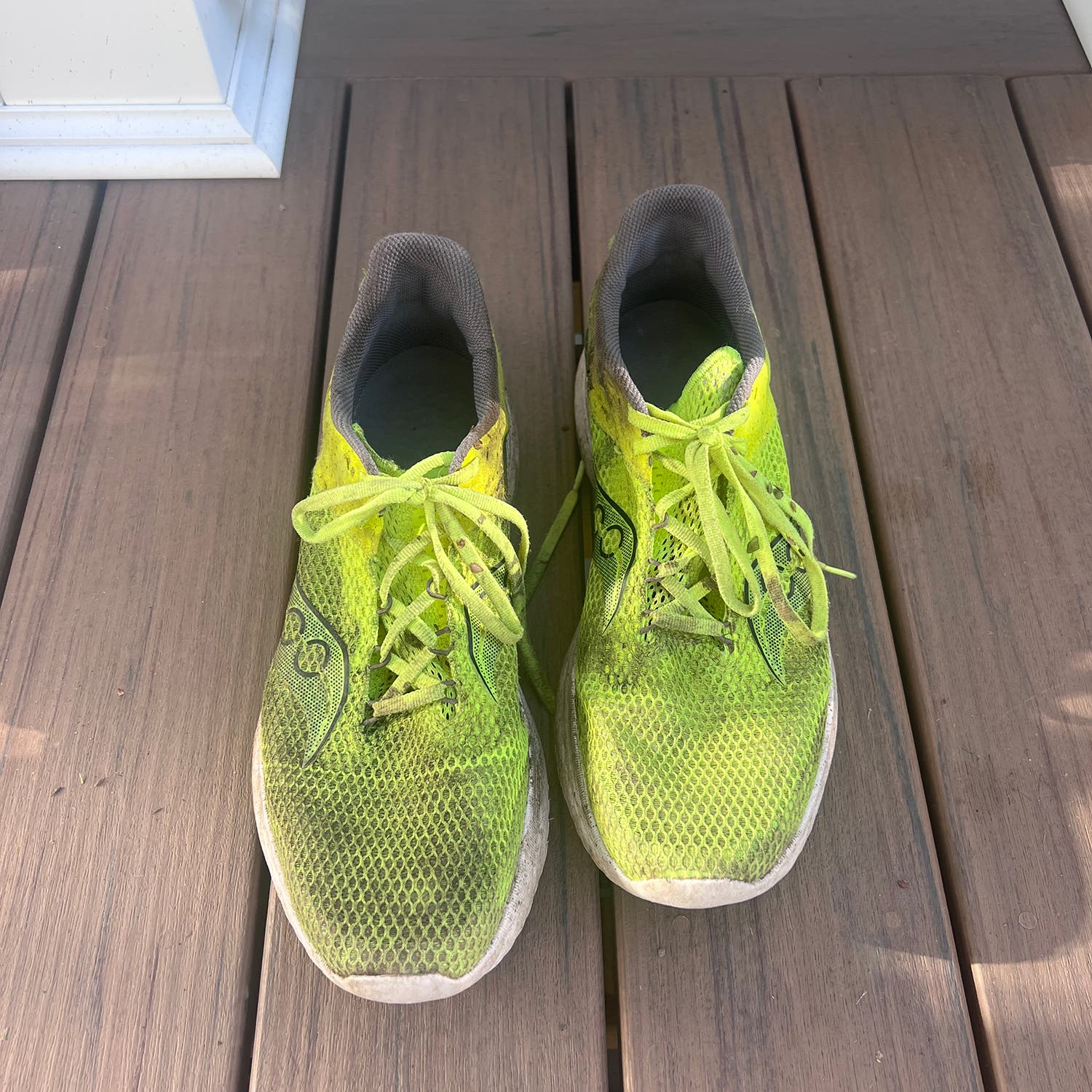
At about mile eight and just under two and a half hours in, I started to discern a difference in pace between Paul and me. (He had an old knee injury from college football.) He urged me to go ahead; I started doing the math on the day ahead and, reluctantly, did. I followed the Patriot’s Path as it wound through Lewis Morris Park, whose 2200 wooded acres I sometimes mountain bike. I began to run in some stretches, per Roosevelt’s “double time,” eventually reaching the Dismal Harmony Natural Area. (“It would be hard to imagine,” in the words of the New York-New Jersey Trail Conference, “a more inapt name for this beautiful nature preserve.”) The hike grew progressively more difficult: muddy, rocky, twisting upwards. Near the Clyde Potts Reservoir, in Mendham, the trail became increasingly faint, and overgrown with thick, thorny brambles. Ascending a hill under power lines, I stumbled from one thicket to another, thorns tearing at my legs and arms, until I finally found the path, past an old stone wall.
I stopped for lunch at Buttermilk Falls, sitting on a large boulder overlooking the small but energetic cascade. It’s a popular spot, but today I was alone. It was just after noon, and I was keeping a decent pace, having hit the 20-mile mark. If I ran more, I might even be done by 7 P.M. What I didn’t realize is that the trail was about to essentially disappear, instead becoming a grueling, interminable scramble along the rock strewn and muddy banks of a river (per hikemendham.org: “one of the most challenging hikes in Mendham Township”). My ankles, and my spirit, were taking a pounding. My average pace dwindled from somewhere around four miles per hour to just two.
ADVERTISEMENT
The most remarkable thing about the route, which I’d gleaned before the hike, was that despite wending its way through the country’s most densely populated state, it passed not a single gas station or convenience store. I had noticed, on the map, the Ralston Fire Station, and I’d devised a plan to stop there to refill water—envisioning the jovial scene as I told the firefighters of my epic quest as they pushed some hearty firehouse fare my way.
But the firehouse, clearly a volunteer affair, was shuttered. A twinge of concern crept in: For moderate hikes in moderate weather, half a liter per hour of hydration is recommended. I’d already passed that, with more than 20 miles to go, and neither the hike nor the weather was moderate. I climbed through the Schiff Nature Preserve, a 700-acre tract said to have once housed a Revolutionary War outpost, then faced the one section of the hike that was dominated by roads. Out in the open sun and heat, on a road with fast traffic, blind curves, and no shoulders, I could feel my muscles beginning to cramp, my energy sagging. I looked in vain at the huge houses, old and new, along Bernardsville Road, but there was little sign of life behind their iron fences besides landscaping crews. And what would a homeowner make of me, dirty, sweaty, looking half-crazed, walking up their driveway? Like Cheever’s swimmer, standing on Route 434, “you might have wondered if he was the victim of foul play, or had his car broken down, or was he merely a fool?”
I kept trudging on, my water down to some drops in the tube. Paul, who’d called it quits at mile 23 and gotten a ride home, texted and offered to bring fluids. By the time I phoned him, around mile 34, after just under ten and a half hours’ walking, I knew I was done. I went home, shivering in bed with the tremors of dehydration, downing an entire pitcher of chocolate milkshake. The next day, I banged out another ten in about two and a half hours during the day on trails closer to home, before pausing to pick my daughter up from school. I finished the last 5.77 in an hour and 45 minutes that night, accompanied by my wife. We hit the Stop and Shop on the way home, so I completed Roosevelt’s challenge, in about 15 hours, somewhere in the cereal aisle, as U2’s “Sweetest Thing” played overhead.
I spent the next day sore, scratched, bitten, and burned, reflecting on the hike. It was, by the standards of Roosevelt’s Executive Order, not a failure. I’d completed the 50 with time to spare, across some pretty gnarly terrain, with elevation. But I’d wanted to do it all in one go, like Roosevelt had on his horse, and I have no way of knowing what’s harder, 50 miles on foot or 100 on a horse. (If anyone has a pair of steeds and wants to show me, please drop a line.) Maybe if I’d been better prepared, better trained. In retrospect, I could have just done 16 or so loops of the two-miles-and-change circular walking path near my house, stopping off for hydration, rest, and moral support. But part of me wanted to get lost, to encounter problems, to face the unknown—isn’t misadventure often what we’re really talking about when we talk about adventure?
Teddy would have approved, I like to think. “Roosevelt was very much about get out there, make it happen, don’t train first,” Swanson says. He was the consummate dabbler, fencing, boxing, hunting, hiking, and riding. “I was never a champion at anything,” Roosevelt notes in a letter to Pierre de Coubertin, the founder of the modern Olympics. Instead, he says, “I have always felt that I might serve as an object lesson as to the benefit of good hard bodily exercise to the ordinary man.”
ADVERTISEMENT
Roosevelt was, Swanson suggests, trying to point a way forward for a society that was undergoing a massive lifestyle change (Americans’ body mass indexes were already increasing at the turn of the century). “Before Roosevelt, everyday life was very different. Most Americans were working in some kind of agricultural context,” Swanson notes. Roosevelt is the first president to say, “Hey, you know, we need to take time out of our day to do something physically strenuous. That would be a crazy thought pre-20th century, because our whole day was strenuous.”
More than 100 years later, I just wanted, like Roosevelt (if a few years older, at 55, than his 51), to go out my front door and blow off steam in the woods; not to compete, but to test myself against the unknown, to carve out a whole hidden world of adventure at the drop of a hat.
ADVERTISEMENT
As Swanson notes, Roosevelt spoke about two kinds of success. The first kind comes in momentous athletic achievements—the free-climbing of Alex Honnold, the tennis prowess of Serena Williams—that, as Roosevelt wrote, “no amount of training or body or mind would enable any good ordinary man to perform.” But a second, “more common” form of success, Roosevelt said, comes to the person who squeezes as much out of the “aptitudes that he does possess.” Call it talent versus grit. If you can walk, there is no special skill in walking 50 miles in 20 hours, just the determination to do it.
In a silent 1912 newsreel shot at his home in Oyster Bay, Long Island, the old Bull Moose is shown vigorously chopping down a tree, wearing shirtsleeves and a vest. “Any of you can do that,” Roosevelt says, via titles. “But the thing is—will you?”
