Published March 10, 2010 12:00AM
Game Changers
The ten greatest adventurers since 1900.
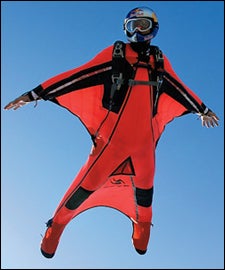
Loic Jean-Albert
10. Loïc Jean-Albert
1978–
WHAT HE DID: In 2003, the Réunion Island native donned a wingsuit, leapt from a heli, and made like a super squirrel, skimming 15 feet above the rock and snow of Verbier, clocking 100 miles per hour. He covered half a mile before pulling the rip cord on his chute.
LEGACY: Jean-Albert didn’t invent the wingsuit, but he works it like no one else. Sure, it’s mostly a stunt—but it’s also the closest humans have come to Superman-style flight.
CLOSING ARGUMENT: The Wright brothers, Chuck Yeager, John Glenn—they all had good stuff. But watch their old flight reels, then punch up Loïc on YouTube. You’ll see.
9. Robyn Davidson
1950–
WHAT SHE DID: In 1977, at age 27, the Australian set out from Alice Springs with her mutt, Diggity, and four wild camels she’d trained herself. Six months and 1,700 miles later, she reached the Indian Ocean, becoming the first woman to cross the punishing outback.
LEGACY: Alice Springs was just a big boys’ club when Davidson arrived. Her 1980 book Tracks sent a generation of young women in search of their own fresh tracks.
CLOSING ARGUMENT: In the 1920s, Alexandra David-Néel crossed the Himalayas in winter and snuck into Tibet. But her yak was pre-trained, and she had a guide.
8. Greg Noll
1937–
WHAT HE DID: Cajoled his haole buddies into making the first drops at then-taboo Waimea Bay in November 1957. His career culminated with the biggest wave ever ridden at the time (30 feet), in 1969 at Oahu’s Makaha Point. Noll wiped, survived, and retired.
LEGACY: The Makaha wave got big play in Stacy Peralta’s Riding Giants, but opening Waimea ignited the modern surf era.
CLOSING ARGUMENT: Laird Hamilton has gone bigger and scarier, but Noll was the first to make us realize that there’s no upper limit to what you can surf—only what you dare to try.
ADVERTISEMENT
: 7-5
ADVERTISEMENT
7. Doug Ammons
1957–
WHAT HE DID:
In 1990, Ammons snagged the second descent of British Columbia’s Grand Canyon of the Stikine, a roiling, 60-mile Class V canyon that’s the pinnacle of expedition kayaking. Two years later, he came back to do it solo—a feat that’s never been repeated.
LEGACY:
What Reinhold Messner (see No. 2) did for alpinism, Ammons did for paddling. The Montanan’s solo on the Stikine still stands as the sport’s ultimate test of commitment and perseverance. “I tried to do the hardest thing I could conceive of, in the purest style possible,” Ammons later wrote.
CLOSING ARGUMENT:
Piotr Chmielinski, hero of Joe Kane’s Running the Amazon, shepherded the author down the first full descent of the world’s longest river, in 1986, after seven of the 11 expedition members had given up and gone home. But there were still four of them.
6. Yvon Chouinard
1938–
WHAT HE DID:
A keystone member of Yosemite’s rocklegends from the fifties and sixties, who pioneered big-wall climbing and ground-up style, Chouinard put up major first ascents (including El Cap’s North American and Muir walls), invented gear (reusable pitons and chocks), then built an iconic brand (Patagonia).
LEGACY:
From how to release a fish to how to turn a business into a vehicle for environmental change to how to treat your employees, Chouinard spawned a new spirit of outdoor ethics. (And amassed a fortune.)
CLOSING ARGUMENT:
Yes, you can find a more creative wall climber (Tom Frost), equipment inventor (Jacques Cousteau), or tycoon (Oakley and Red camera’s Jim Jannard), but nobody’s a triple threat like Chouinard.
5. Lynn Hill
1961–
WHAT SHE DID:
After dominating sport climbing’s World Cup circuit for the latter half of the eighties, the Detroit native returned to her trad-climbing roots in Yosemite and in 1993 claimed the first free ascent (i.e., using only her hands and feet and a rope) of El Cap’s 2,900-foot Nose route.
LEGACY:
Hill’s stunning Nose ascent was like Billie Jean King defeating Bobby Riggs—if Riggs was Roger Federer. The climb made its way into pop culture (see Jerry Maguire‘s breakup scene) and went unrepeated until Tommy Caldwell matched it in 2005.
CLOSING ARGUMENT:
Kit DesLauriers’s ski descents of the Seven Summits were just as daring—but not as surprising.
: 4-2
WHAT HE DID:
The Norwegian was the first to sail the Northwest Passage, in 1903, trek to the South Pole, in 1911, and definitively see the North Pole (from a zeppelin), in 1926. Trifecta!
LEGACY:
The greatest explorer of the modern era, Amundsen was bagging the monolithic firsts—across disciplines—while everyone else was merely chasing them.
CLOSING ARGUMENT:
Ernest Shackleton is better known, but his fame is the result of failure—both in 1909, when he turned back less than 100 miles from the South Pole, and in 1914, when his miraculous self-rescue in Antarctica overshadowed the fact that he’d gotten his crew trapped in the ice in the first place.
These are our picks. What are yours? Cast your vote at outsideonline.com/adventuresmackdown
.