Updated March 15, 2026 04:50PM
From the Rubble to the Peaks, the Incredible Journey of Haiti’s First-Ever Winter Paralympian
After losing his leg in the country's 2010 earthquake, Ralf Etienne has become the first Haitian Winter Paralympian, and the first Caribbean standing Para-alpine skier in the history of the Games.

Haitian's Ralf Etienne competes during the 1st run of the men's giant slalom on 13th March 2026 in Cortina, Italy. (Photo: © Gabriel Monnet)
There is a well-known Haitian proverb “Dèyè mòn, gen mòn,” which translates to “beyond mountains, there are mountains.” No one knows this struggle—or opportunity—more than Ralf Etienne. While Haiti is the most mountainous country in the Caribbean, the saying is often used to reflect the immense and constant obstacles Haiti has had to overcome. Etienne is a survivor of one of Haiti’s biggest “mountains”: the 36-year-old Haitian lost his left leg in the country’s 7.0 magnitude earthquake in 2010, a devastating disaster that claimed more than 300,000 lives.
Now, 16 years later after that life-altering day, Etienne made history as Haiti’s first-ever Winter Paralympian, and the first standing Para-alpine skier to represent a Caribbean nation at the Winter Paralympics. After learning to ski a few years ago—and only having skied about 80 days in his life—Etienne’s journey to the 2026 Winter Games is a success he said “represents what Haiti can do.”
“My story starts as one of sadness, but now it’s a story of victory. It’s a story of Haitian resilience and Haitian strength,” Etienne tells Outside. “I want to show the world a different version of Haiti: not chaos, gangs, and political instability, but sophistication, discipline, resilience, and hard work.”

Mountains Beyond Mountains
Born and raised just outside of Port-au-Prince, Haiti’s capital city, Etienne said he is “about as Haitian as it gets.” He calls himself a natural-born entrepreneur. At 16, he started a magazine, and by the time he was 20 he was publishing a national magazine in Haiti, working with some of the country’s most famous musicians. He thought he had “made it” but said the success was going to his head.
ADVERTISEMENT
“When the earthquake happened it changed my life; a complete 180-degree turn. I was 20 years old, overlooking the wealthiest neighborhood in Haiti on the top of this building and talking about buying a property there,” recalls Etienne. “And then the building starts shaking. I ran downstairs. By the time I got to the second floor, the building collapsed, and I was buried inside.”
Etienne was trapped under the concrete rubble during Haiti’s devastating earthquake, hanging upside down for 8 hours. Right in front of him, he remembers seeing a crushed 13-year-old boy.
“I was buried, literally buried alive. So my first thought was, I’m gonna die,” Etienne said. “When I was dying in that building, I realized I can’t take my fame with me. I can’t take my magazine with me. I realized there is more to life than me, me, me. So I decided that day, if I survive this, I’m gonna live my life to serve people.”
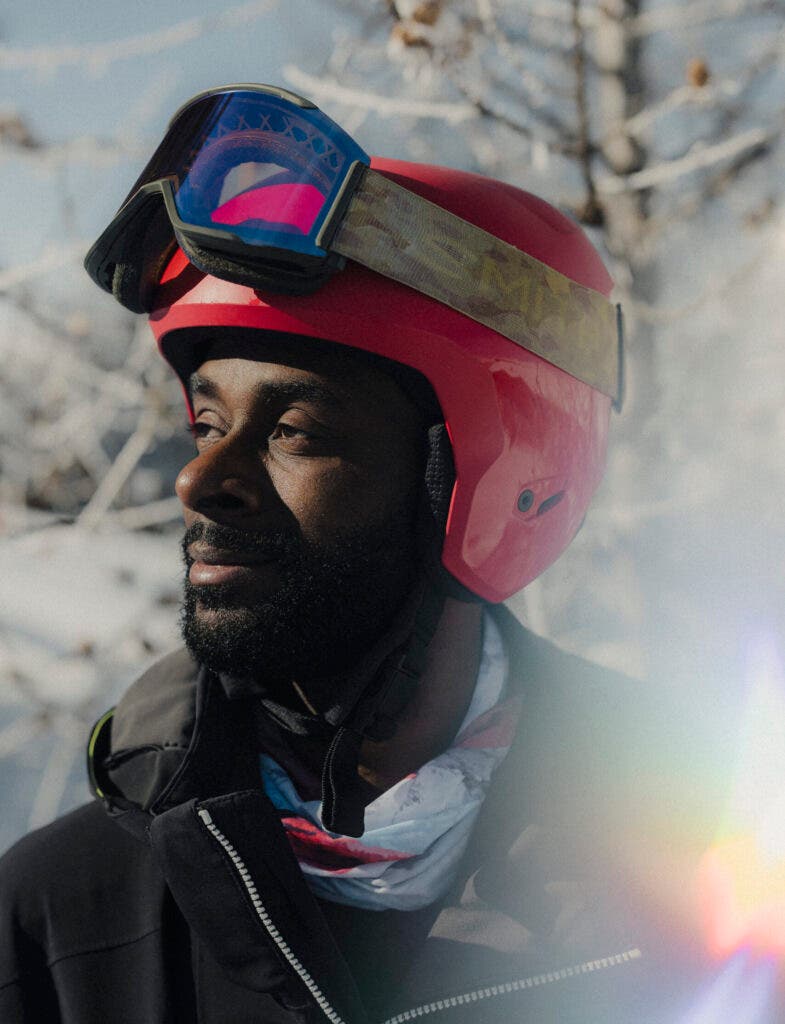
After Etienne was rescued, it took days to see a doctor for the first time. This was the biggest earthquake the region had seen in 200 years, resulting in a catastrophic humanitarian crisis.
ADVERTISEMENT
Despite losing his leg, Etienne overcame suicidal thoughts and found a newfound purpose in serving others. In Haiti, he met Dr. Gregory Adamson, an American orthopedic surgeon, who he said would not only help him receive a prosthetic leg, but become one of the most significant people in his life over the years.
After traveling to the U.S. to get his prosthetic leg, Etienne enrolled at college in Indiana, inspired to study pre-med so he could help others. He also frequently returned to Haiti, where he carried out humanitarian aid, including distributing 40,000 pairs of glasses for those who could not access eye care, and helping to repair roofing on homes destroyed by Hurricane Matthew in 2016 with Rebuilding Haiti, a non-profit he founded.
His entrepreneurial spirit was still calling him, said Etienne. He wanted to help Haitians help themselves, a thread that would be woven into all his future endeavors, too. Back in the U.S., he received his MBA and trained as an investment banker, with a new focus on impact investments, helping those in underserved communities especially.
Learning to Ski for the First Time
It wasn’t until a friend’s ski trip two years ago that Etienne even thought of skiing. But immediately, he felt a freedom he hadn’t since losing his leg. It might not snow in the Caribbean, but Etienne has always had a fondness for mountains, which cover 75 percent of Haiti.
ADVERTISEMENT
It was his love of mountains and a newfound freedom that drew Etienne to skiing. “To get to the top of the mountain, I need to have my prosthetic. I walk with the help of an artificial leg,” he said. “But when I’m skiing, I don’t need my prosthetic. I sit on one leg, and I go. I run 60, 80 kilometers.”
This is Haiti. Haiti is resilience. Haiti is leadership. Haiti is hard work. I’m now a global banker and an elite skier; that’s what Haiti produced. People just need opportunity.
Beyond the freedom he felt, Etienne realized how his precedence on the slopes inspired others. “Whenever people see me skiing casually, they always say how inspiring it is to see me doing this. So it’s not just something I like [to do], but it’s something that gives me a chance to inspire people.
I’m out there on one leg, and a lot of the time the only black guy there, too. They see that. And it means something to them.”
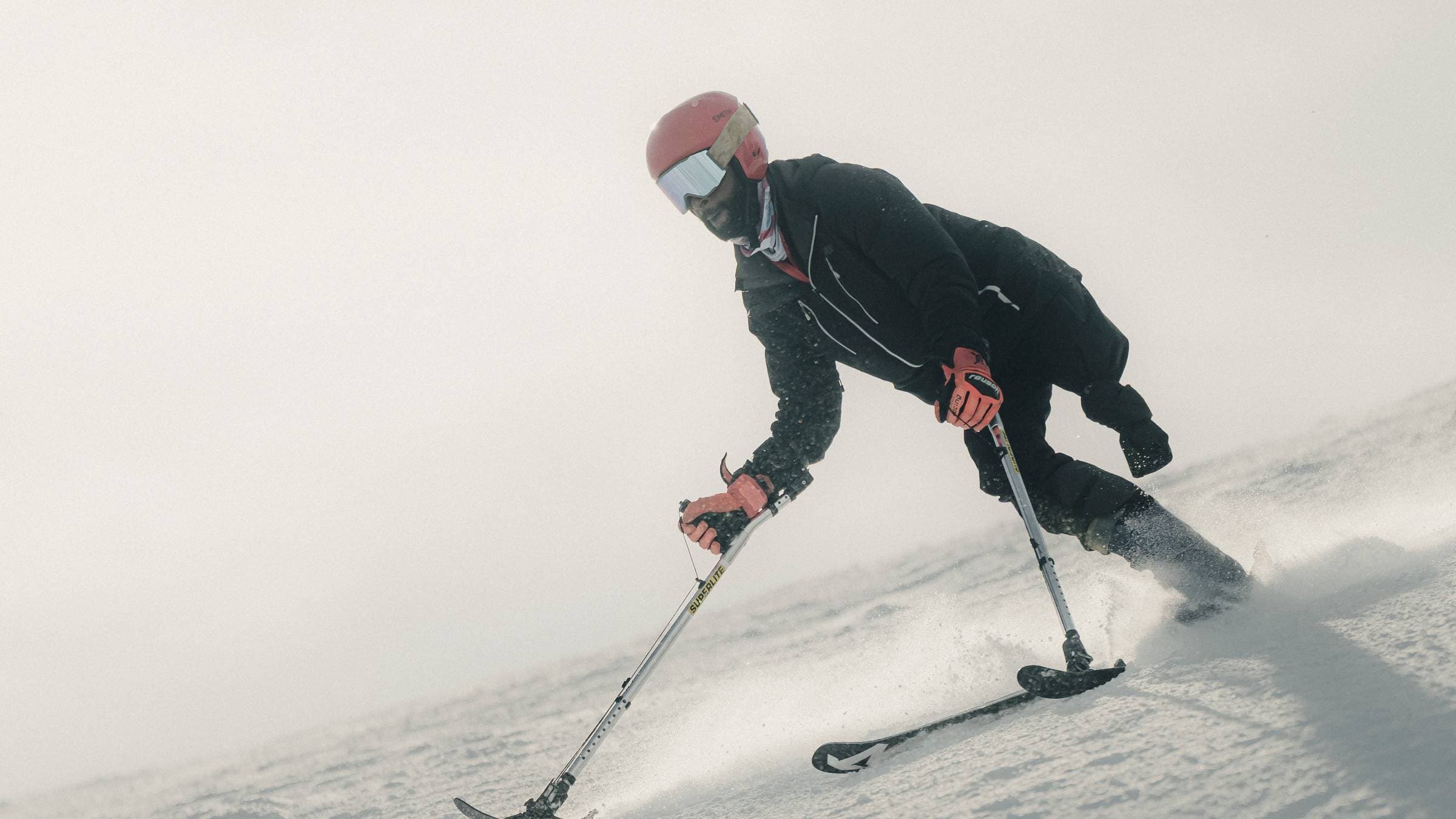
It was only a year ago that the thought of what being a Para skier could represent on a bigger stage first occurred to him. Etienne traveled to Park City to get lessons at Park City’s National Ability Center, one of the top adaptive ski centers in the world, with the largest adaptive winter sports program in the U.S. One of the instructors happened to be a neighbor with Monte Meier, a five-time Paralympic skier, and they asked Meier to ski with Etienne for a day.
“Meier took a liking to me and told me, “Go out with me for a second day,” said Etienne. “Then I joked about being a Paralympian, and he looked at me and said, ’I think you have a shot.’ And that’s all I needed to hear.'”
ADVERTISEMENT
Representing Haiti at the 2026 Winter Paralympic Games
Meier agrees to be his coach, but very quickly Etienne realizes how costly skiing is—especially competitive skiing. And there was another major setback. President Trump’s U.S. restrictions on Haitian immigration rights made it difficult for Etienne to travel and train. So he relocated from New York to London to be closer to the European racing circuit while continuing his career in finance.
Despite the significant costs and challenges, Etienne knew this was an avenue for him to inspire the youth in Haiti right now, his ultimate goal. Etienne said he wants the youth of Haiti to see him, and think, “I’m not limited by my geographic location. Ralf was born and raised in Haiti. He is a a disabled man. Now he is doing one of the most elite sports in the world, one of the most precise sports in the world, at the top of the Alps, where he’s one of the only black skiers.”
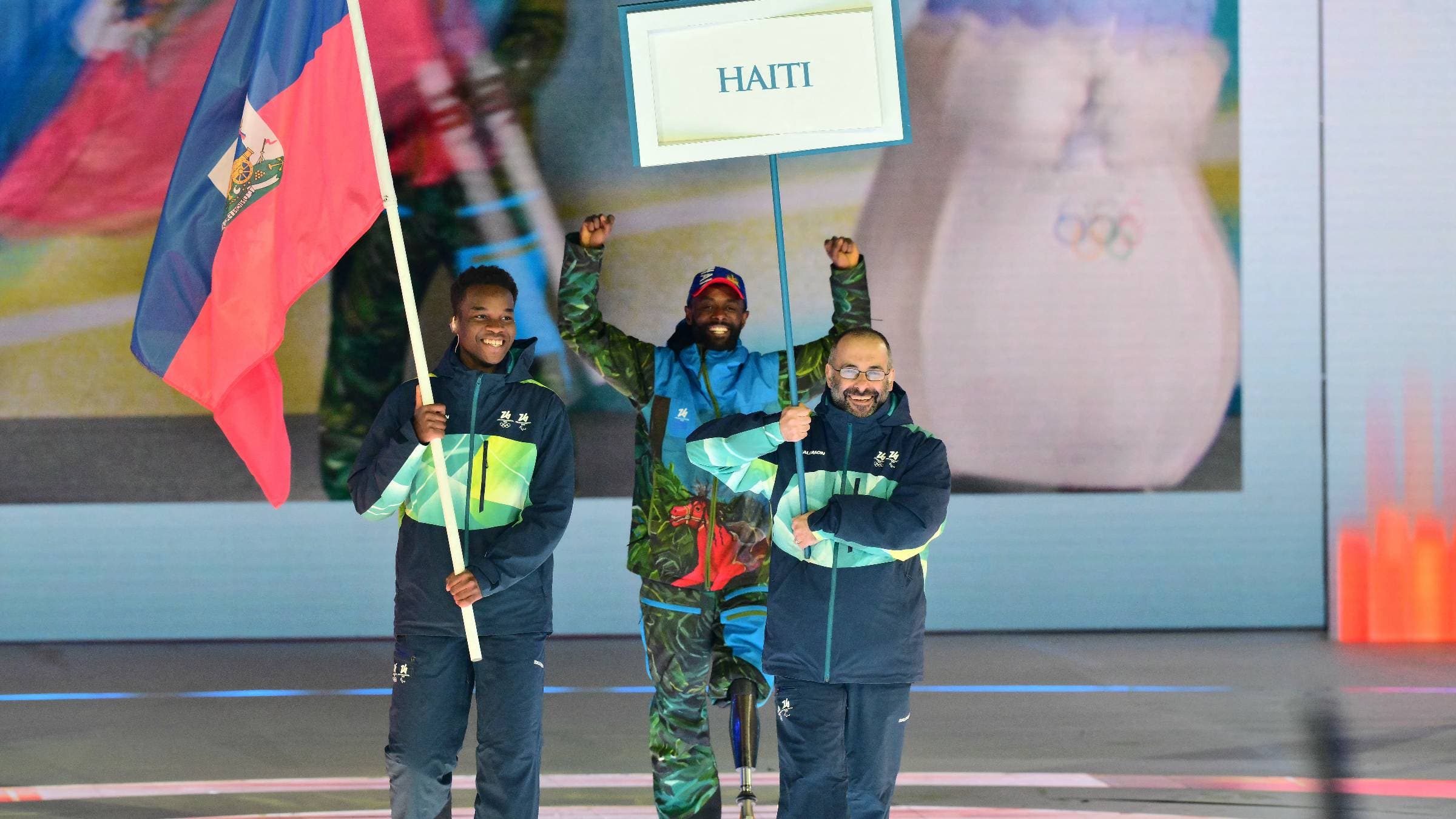
It was more firsts for Haiti at the 2026 Winter Games. Two athletes represented Haiti: Richardson Viano, Haiti’s first Olympic alpine skier, and Stevenson Savart, Haiti’s first Olympic cross-country skier. Italian-Haitian designer Stella Jean also put Haiti in the spotlight with her stunning Olympic uniforms. She also designed the team’s uniforms for the Paris 2024 Summer Olympic Games.
ADVERTISEMENT
Inspiring Haiti’s Youth: “Geography is Not Destiny”
“Inspiring the youth is very important to me, but I also get to be an ambassador, to wash off the image of Haiti,” Etienne said. “Look at me. This is Haiti. Haiti is resilience. Haiti is leadership. Haiti is hard work. I’m now a global banker. I’m an elite skier, and that’s what Haiti produced. People just need opportunity.”
Etienne credits the Haitian diaspora with helping making his journey to the Paralympics a reality. While he says his journey was almost entirely self-funded, he received significant support from the Haitian diaspora, including a $25,000 donation from a Haitian business leader, to help carry the qualification phase across the finish line.
ADVERTISEMENT
“The world is often shown a version of Haiti defined by chaos. I’m showing the youth all over Haiti that geography is not destiny. If I can conquer the boardroom and the mountains in a single year, one’s potential is limitless,” he adds.
“I will say 10 times over, losing my leg is the very best thing that has ever happened to me because it changed my heart. It’s changed the trajectory of my life, to live to serve people instead of just for myself.”
Kathleen Rellihan is the Senior Travel and Culture Editor at Outside. She has visited Haiti numerous times and traveled all over the country. Since 2013, she has been an ambassador for EIM Haiti, a Haitian-led non-profit organization that provides affordable English education, vocational training, and job placement to adult Haitians.


