Published January 21, 2024 09:00AM
If you buy through our links, we may earn an affiliate commission. This supports our mission to get more people active and outside.Learn about Outside Online's affiliate link policy
The Weird Origin Story of Your Favorite Patagonia Jacket
The Patagonia Retro Pile fleece, which has been in the line for 36 years, continues to be popular from city streets to mountain peaks
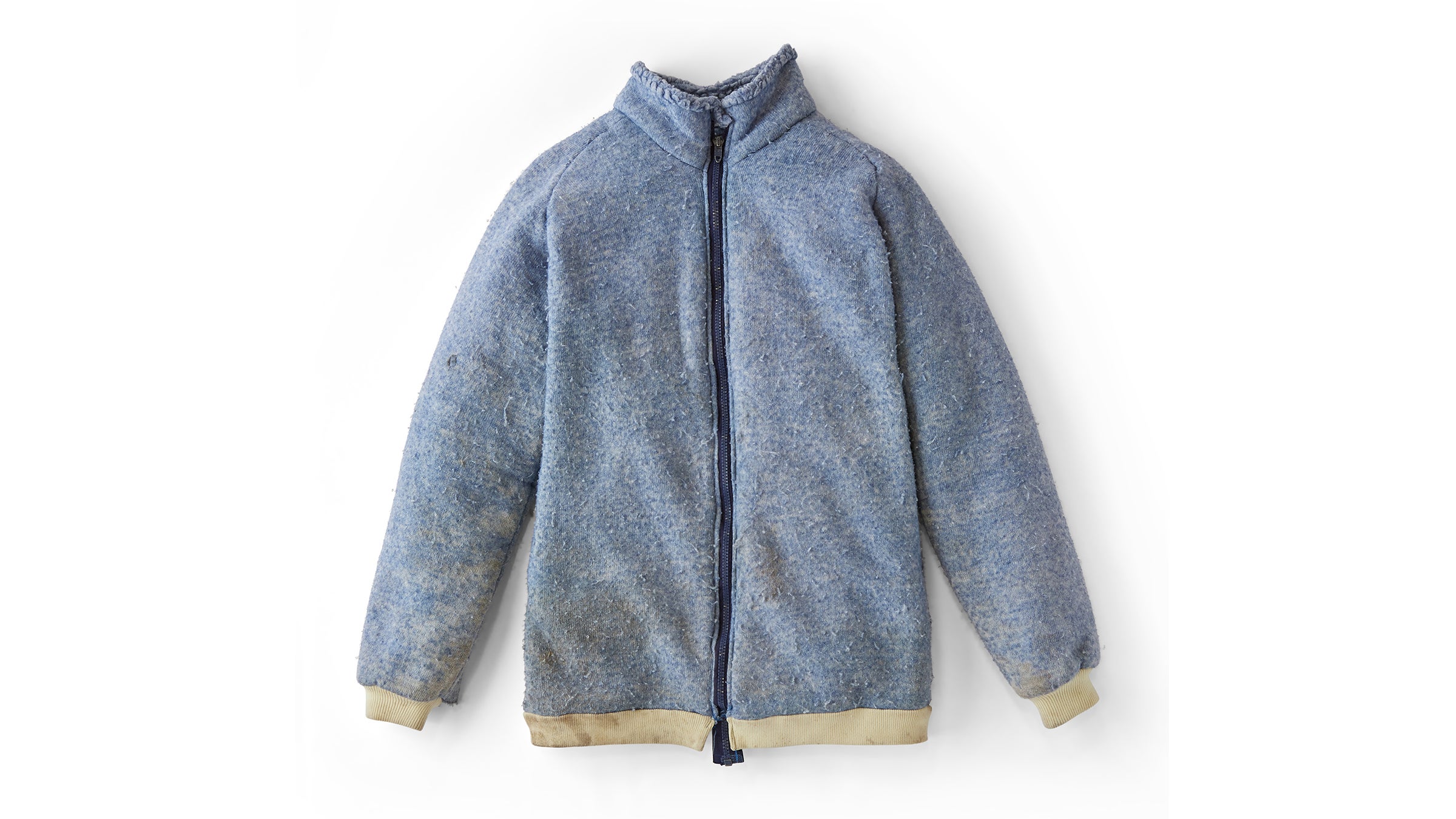
The original 1975 prototype Patagonia fleece, made from toilet seat cover fabric, is showing wear but could still keep you warm. (Photo: Courtesy Patagonia)
Earlier this month, I was in New York City on vacation. As my wife and I walked up and down Manhattan and through Brooklyn it was clear that this fashion-forward city has an enduring love affair with Patagonia’s Retro Pile and Retro-X fleece jackets. Everywhere we looked, New Yorkers—from young Gen Zers to old-time city stalwarts—were sporting the fleece fashion. The Patagonia store on the Upper West Side was well stocked with these jackets, but other stores were also packed to the gills with Patagonia-like pile fleece knockoffs. Fast fashion brands from around the world that line Fifth Avenue all offered their own version.
The ubiquity and endurance of these fleeces got me wondering about the origin of the jackets, so when I got home, I called Patagonia. I learned that the company has an entire archives team that’s in charge of preserving the company’s history. Corey Simpson, Patagonia’s head of product communication, put me in touch with archivists Darcey Moore and Terri Laine and they walked me through the development story, which turns out to be better than I could have ever imagined. Here are the highlights:
- During his early adventures, Patagonia founder Yvon Chouinard used to wear lots of wool. But wool was heavy and didn’t pack well, so Chouinard started looking for the next best material.
- In the early ’70s, Chouinard came across an acrylic pile fabric that was warm and shedded water, which approached what he wanted. Later, his wife, Malinda, found a roll of fuzzy polyester fabric intended for toilet seat covers like your grandparents used to keep their seats warm. The fleecy fabric looked even more promising as lightweight insulation, so she brought it back to the company.
- In 1975, Patagonia built a prototype jacket using the toilet seat cover fabric. It had a smooth face fabric and the fluffy piling was on the inside. The jacket did not hold up well—the outer fabric pilled after one wash—but it was warm, insulated even when wet, dried quickly, and was significantly lighter than wool, so Chouinard knew the company was onto something.
- To create a similar fabric that was more durable and could be manufactured for his purposes, Chouinard approached Malden Mills, now Polartec, in 1981, and fleece as we know it was officially born. Synchilla, the thinner fleece that’s used for jackets like the famous Snap-T, launched in 1985. The first Retro Pile fleece jacket, with the thicker pile fleece on the outside, launched in 1988.
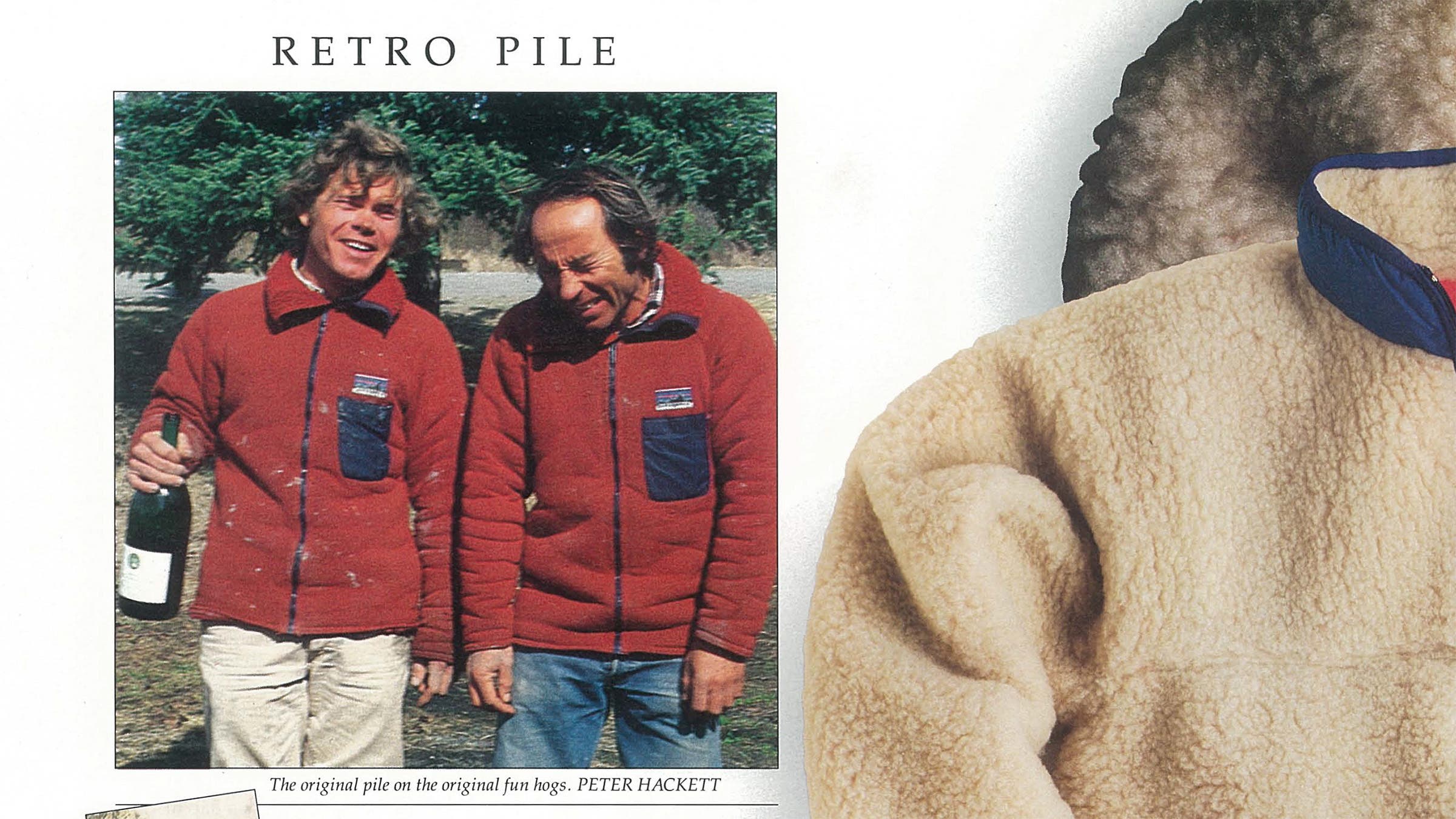
- In the catalog page from that year, there’s a now-famous photo of Chouinard and Rick Ridgeway holding a magnum wine bottle and belly laughing while wearing fleece jackets with the pile on the inside like the 1975 prototype. The copy from the catalog explained why the company moved the pile to the outside: “The new Retro Pile is laminated on the inside to Capilene tricot which will wick moisture off the skin and allow it to spread out over the tricot. Heat from the body then pushes the water vapor out onto the pile fibers where, acting as water acts on hair, it will ‘climb’ them and eventually evaporate in the air.” The catalog went on to describe one of their early tests of the new fleece construction: “We thought this all sounded very theoretical until we tried it in the Canadian Rockies in November on a climbing trip—it was about 50 below outside the hut with wind chill, and freezing inside. Outside, we wore the RetroPile with two layers of Capilene underwear and a Storm Gear Shell; we stayed dry and warm. In fact, if you touched the pile after exertion, you could feel the dampness on the outside.”
- The Retro-X fleece, which has an even chunkier fleece on the outside, first launched in 1993 with the Retro-X Cardigan.
- 1993 was also the first year Patagonia offered a windproof pile fleece jacket. According to the catalog, the Retro-X is composed of three elements: “1⁄4” polyester pile, Silkweight Capilene® fabric, and (in-between the two) a windproof P.E.F. barrier. Though this barrier stops the wind completely, it does not reduce breathability. Retro-X has the same breathability as Retro Pile.”
- When I asked the archives team about the shorter cut on a jacket like the Retro Pile, which sat right at the waist line and still does to this day, they said the original prototype for testing was made for Chouinards’s physique. The design and fit worked, so it was kept for production.
Today, Patagonia offers Retro Pile and Retro-X jackets, vests, and pullovers for men, women, children, and babies. My anecdotal data from New York City, backed up by stats from Simpson, confirm that these jackets continue to be staples for the brand.
ADVERTISEMENT
“These pieces have proven themselves for decades. We see surges in certain areas or at certain times, and otherwise those jackets are always in third gear just chugging along for us,” Simpson says.
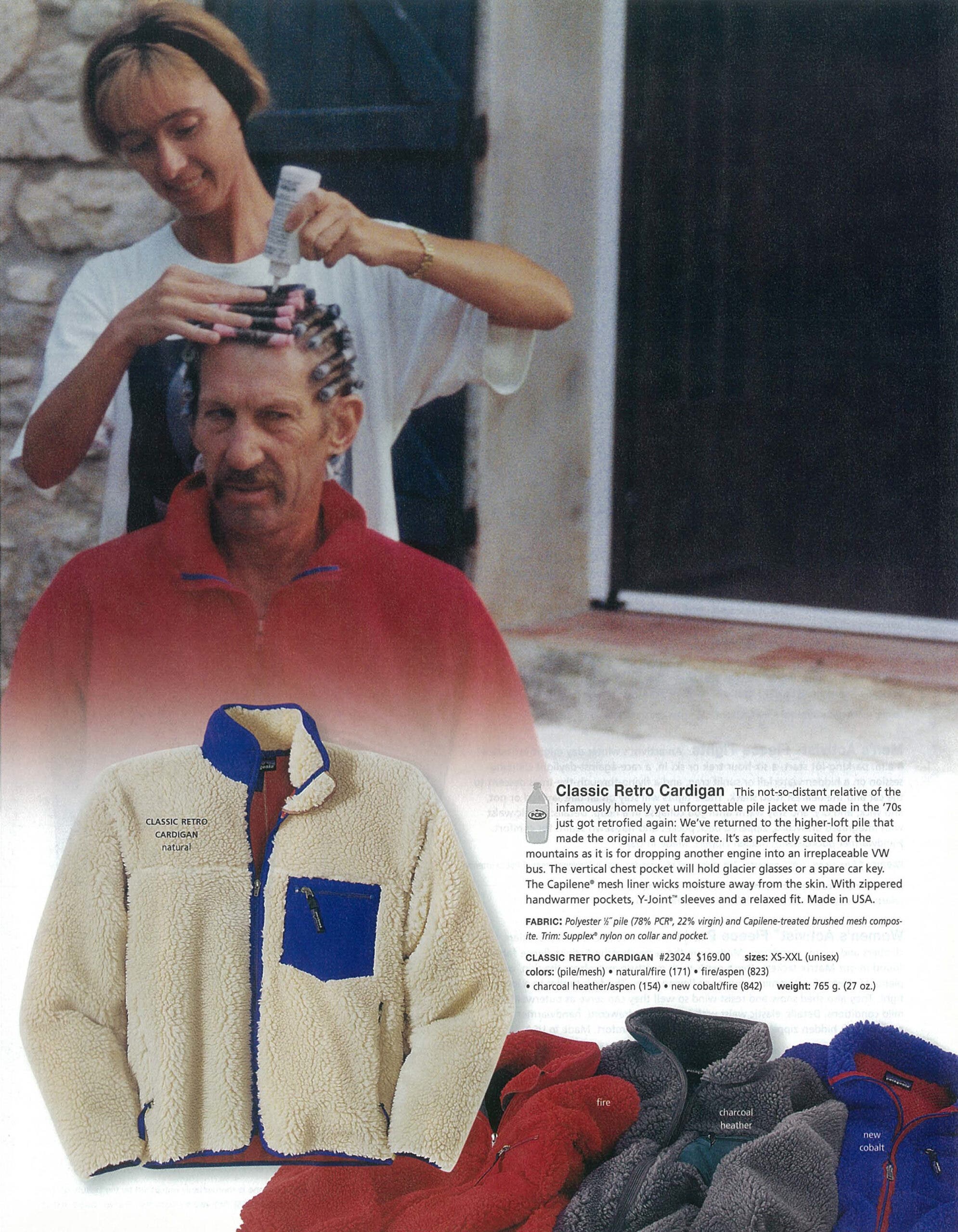
In terms of updates, there have been little design tweaks here and there, but the current design is surprisingly similar to the original. Simpson says, “We always have that tinkering mindset where we fine-tune and iterate and change, but why would we completely change an icon that’s really performing?”
The environmental footprint, however, has completely changed. It’s fleece, so Patagonia, like everyone else, struggles with the microplastics issue. In response, the company has launched several initiatives including new engineering that cuts down on shedding and a campaign asking buyers to wash their fleeces less frequently, in cold water (which also reduces shedding) and, ideally, in a special washing-machine bag that traps the fibers. Working with Samsung, the company also developed a washing machine filter that can cut microplastic shedding in half. On the production side, every Retro Pile and Retro-X is made from 100-percent recycled polyester in a Fair Trade-certified factory.
Simpson and the archives team pointed out that quality and longevity are also an important environmental aspect. Patagonia has always touted its garment toughness and that clearly seems to hold true given the robust online market for old Patagonia fleece jackets that have been worn for two or three decades and still have life. And as we talked on the phone, Moore noted that she was wearing a Snap-T from the ’90s.
ADVERTISEMENT
It’s flattering to see fast-fashion brands recreating something Patagonia thought up nearly 50 years ago, but Simpson isn’t surprised, pointing out that Patagonia has always taken the long road and never wants to chase trends but builds products that are both functional and fashionable for years.
“The Retro Pile and Retro-X have been and will continue to be the little engines that could,” Simpson says.
