Published November 11, 2018 12:00AM
If you buy through our links, we may earn an affiliate commission. This supports our mission to get more people active and outside.Learn about Outside Online's affiliate link policy
Review: Spot X Satellite Messenger
A solid budget-minded option, so long as you can tolerate the infuriating keyboard
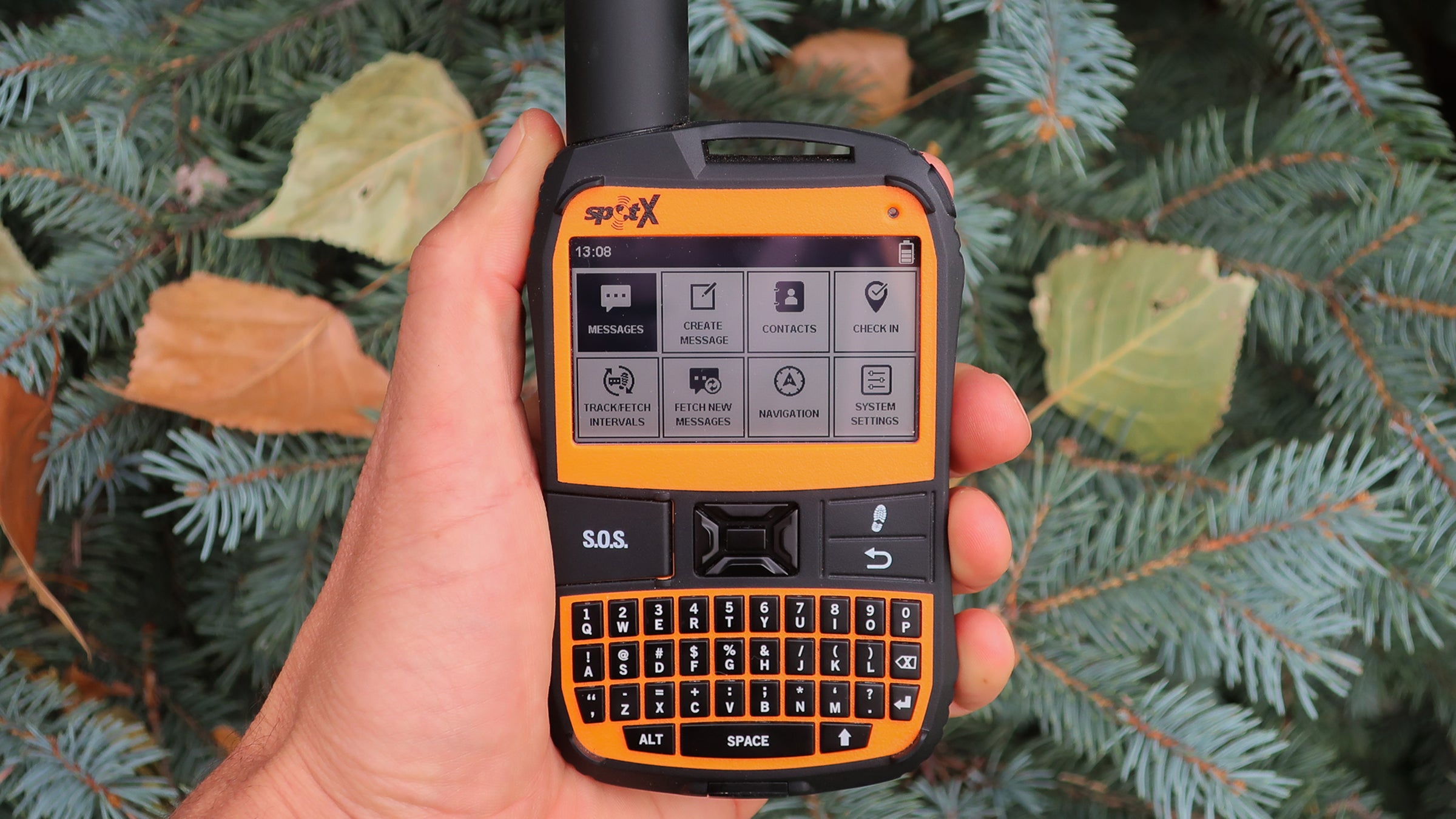
The SPOT X retails for $250, weighs 6.7 oz, and features a 2.7-inch dot matrix illuminated screen and physical QWERTY keyboard. It looks like an orange Blackberry with an over-sized antenna.
Last May, exactly one week after Garmin announced the InReach Mini, Spot released its first new device in five years. It’s also the company’s first device with two-way satellite messaging.
The Spot X retails for $250, weighs 6.7 ounces, and features a 2.7-inch dot matrix screen and physical QWERTY keyboard. It looks like an orange BlackBerry with an oversized antenna.
I used the Spot X this summer while guiding trips in the Colorado Rockies and High Sierra.
Review: Spot X
To break into the two-way messaging market, the Spot X needed to be somehow better than the category-leading InReach units. In some respects, it is.
- The Spot X is simpler, designed to be fully functional as a standalone device.
- Each unit has a dedicated U.S. mobile phone number, so it’s easier to send messages to it from cellphones or other two-way satellite messengers.
- It has twice the battery life of the InReach SE+ and Explorer+ (in ten-minute tracking mode).
- Both the device and comparable service plans are less expensive.
Since the initial Spot X launch, the company has released several firmware updates to eliminate coding bugs and improve the user interface. Spot is listening to customers and seems to be invested in the Spot X.
But currently, the Spot X still falls short:
- The keyboard and control pad lack touch sensitivity and responsiveness.
- It’s twice as heavy as the InReach Mini.
- It lacks smartphone connectivity, which could allow users to share contacts, sync wireless settings, and use the phone’s keyboard and touchscreen.
- There are minimal navigation features and no weather reporting function.
- The online portal needs to be aesthetically refreshed and more user friendly.
Barring significant improvements to the Spot X and its platform, the two-way satellite messenger I recommend for most users remains the Garmin InReach Mini, which is slightly more expensive but is more pleasant to use, has more features, and weighs less. That said, I can think of two scenarios in which the Spot X would be the better device:
- If your budget does not include an extra $50 to buy the Mini.
- If you don’t have a smartphone or don’t carry one into the backcountry, in which case, you can send messages more efficiently with the Spot X.
ADVERTISEMENT
Key Product Specs
- 6.7 ounces (verified)
- 2.7-inch dot matrix display
- Integrated physical QWERTY keyboard
- Optional illumination of the display and keyboard
- Nonreplaceable lithium battery, chargeable via USB
- Resistant to impact, dust, and water
- $250 MSRP
The Damn Keyboard
The Spot X has a major flaw: its physical keyboard. Even if the Spot X were perfect in every other way, the keyboard makes me not want to use it.
ADVERTISEMENT
In fairness, the “virtual keyboard” on the InReach units is annoyingly tedious. But at least there’s a workaround: using the Earthmate app on my smartphone.
The Spot X keyboard has three problems:
- The keys are small and flat-topped, so it’s difficult to feel individual keys or press a single key without also pressing adjacent keys.
- The three lowermost keys—alt, space, and uppercase—require pressing with excessive force.
- The select button isn’t tall enough. It should be higher than the surrounding directional keys so it’s easier to press.
If you can get beyond the keyboard, here’s the rest of what you need to know.
ADVERTISEMENT
What Does the Spot X Do?
The Spot X has four capabilities.
1. Messaging
The Spot X can send and receive text messages and short emails. This makes it fundamentally different than other Spot devices like the Gen3, which can only send messages. Messages can be predefined, custom, or posted to social media (Facebook, Twitter, or both).
Each Spot X has a personal U.S. mobile number, which makes sending messages to the device much easier. The process of sending messages to an InReach device is less straightforward.
ADVERTISEMENT
2. Tracking
The Spot X can broadcast its location at intervals of 2.5, five, ten, 30, and 60 minutes. The basic service plans do not include the 2.5- and/or five-minute intervals.
3. Emergency
If life or limb are in danger, the Spot X can send an SOS message directly to the GEOS International Emergency Response Coordination Center, which will notify the appropriate emergency responders.
4. Navigation
The Spot X has a digital compass and allows you to create waypoints. (You can create waypoints more efficiently in the online portal, but still only one at a time.) It does not support maps—neither a simple grid map nor image-based maps (such as USGS 7.5-minute tiles or proprietary data).
ADVERTISEMENT
Its navigation capabilities are comparable to a standalone inReach Mini, but the Mini pairs with the Earthmate app, which gives your smartphone similar (or even greater) functionality to a conventional handheld GPS unit.
What Doesn’t the Spot X Do?
Compared to existing two-way messaging devices, what features are lacking in the Spot X?
ADVERTISEMENT
1. Phone Connectivity
The Spot X is a standalone unit and cannot be paired with a phone. If it could connect to your phone, you could share your contacts with the Spot X instead of having to enter them in the online portal before your trip. You could use your phone’s touchscreen to navigate the Spot X’s user interface and to type messages (preferable to the crappy keyboard on the Spot X). You could also update settings like your check-in recipients list and predefined messages without requiring a hard-wire computer sync with the Spot X Device Updater.
2. Weather
Before I leave for a trip, I always check the backcountry weather forecast. But on longer trips, receiving an updated forecast can be extremely helpful. Unlike the InReach, the Spot X cannot pull down a forecast for current or user-specified locations.
Cost of Ownership
The long-term cost of a Spot X includes the initial purchase price plus your chosen service plan.
ADVERTISEMENT
Initial Purchase
The Spot X retails for $250, which is $50 to $100 less than competing units.
Service Plan
You’ll need a service plan to operate the Spot X. Currently, three tiers are available in either annual or month-to-month subscriptions.
- Basic: $12 per month if you pay for a year up-front; $15 per month for a month-to-month subscription
- Advanced: $20/$30
- Unlimited: $30/$40
Annual plans are charged a one-time $20 activation fee. The month-to-month plans are charged $25 annually.
ADVERTISEMENT
All plans provide unlimited check-in and SOS messages but vary in the number of included custom messages and frequency of the shortest tracking intervals.
Spot vs. Garmin Subscription Costs
Service plans for Spot X and InReach devices do not match up perfectly, but overall Spot charges less for service. For example:
- For $15 per month, Spot includes 20 custom messages; Garmin’s plan includes ten.
- For $30 per month, Spot includes 100 custom messages; Garmin charges $35 for 40.
- Spot charges 25 cents per message over the limit; Garmin charges $1.
The lower retail price and service plan costs should make the Spot X more attractive to those who are on a tight budget and willing to overlook its other shortcomings.
