Updated March 7, 2024 03:18PM
If you buy through our links, we may earn an affiliate commission. This supports our mission to get more people active and outside.Learn about Outside Online's affiliate link policy
The Best PFAS-Free Running Jackets
We tested 15 running jackets that provide all-weather protection without containing forever chemicals. These three were our favorites.

These running jackets will keep you dry on rainy mornings without using forever chemicals. (Photo: Courtesy Ciele)
There’s a problem with a lot of waterproof garments—they contain per- and polyfluoroalkyl substances (PFAS). Also known as forever chemicals, PFAS are linked to cancer, liver and kidney damage, and other health problems.
But forever chemicals’ time may be limited. A California law that will go into effect on January 1, 2025 bans the manufacture, sale, and distribution of textiles containing PFAS levels of more than 100 parts per million. Given that California’s economy is the fifth largest in the world, the law will force apparel manufacturers to phase out PFAS. The California legislation does provide a reprieve until 2028 for “outdoor apparel for severe wet conditions,” which presumably includes the subject of this article: running jackets. Still, expect companies to act sooner rather than later.
If you’re in the market for a waterproof PFAS-free running jacket, however, you don’t have to wait. There are many good options available now. Over the past few months I’ve tested 16 PFAS-free jackets during more than 300 miles of running. I sought a just-right combination of water repellency, breathability, and ease of movement (neither so tight that my arm swing feels constricted nor so loose that the jacket billowed). I’ve rounded up my top three jackets below. But first, a little more background on PFAS in apparel.
PFAS and Protection
Today, apparel with a durable water repellent (DWR) coating containing PFAS is, on average, more effective at moisture management then PFAS-free apparel, says Kevin Golovin, Ph.D., an assistant professor of mechanical and industrial engineering at the University of Toronto and a leading researcher in textile surface engineering.
ADVERTISEMENT
“All surfaces have a characteristic energy—their ‘surface energy’—and surfaces treated with PFAS can exhibit the lowest possible surface energy of any material,” Golovin says. “This means for the same fabric construction, a textile treated with a PFAS-containing DWR will have greater resistance to getting wet than the same textile treated with a non-PFAS DWR.”
Also, as Outside’s sustainability columnist, Kristin Hostetter, notes, PFAS-free running jackets require more frequent washing and re-treating to maintain top performance.
But neither of those factors should be a deal-breaker. “If you’re only considering water repellency, many of the PFAS-free DWRs on the market today already perform quite well,” Golovin says. “The issue is really with soiling and oil repellency.”
After all, consider that runners don’t really need a jacket that will keep out all precipitation for, say, 10 hours at a time, like backpackers or industrial workers. Most of us just want to stay reasonably dry when running for 30 minutes to two hours in rain or snow. And we want that protection to be balanced with breathability and enough flexibility to not inhibit our running motion.
ADVERTISEMENT
There are related considerations: How often will you wear any running jacket? And, at what temperature does a jacket become overkill, no matter how hard it’s raining? I, for example, wear jackets much more often than I used to when I first moved to Maine 20 years ago. That’s probably because of climate change—what used to be snowy runs requiring only a merino wool outer layer are now rainy slogs in mid 30s to low 40s temperatures. Still, for me, a jacket becomes too hot around the high 40s, even the most breathable.
With that background, here are my top three out of the 15 PFAS-free running jackets I tested, from most to least expensive.
Best PFAS-Free Running Jackets, Reviewed
Very Best: Ciele FLR Jacket ($400)
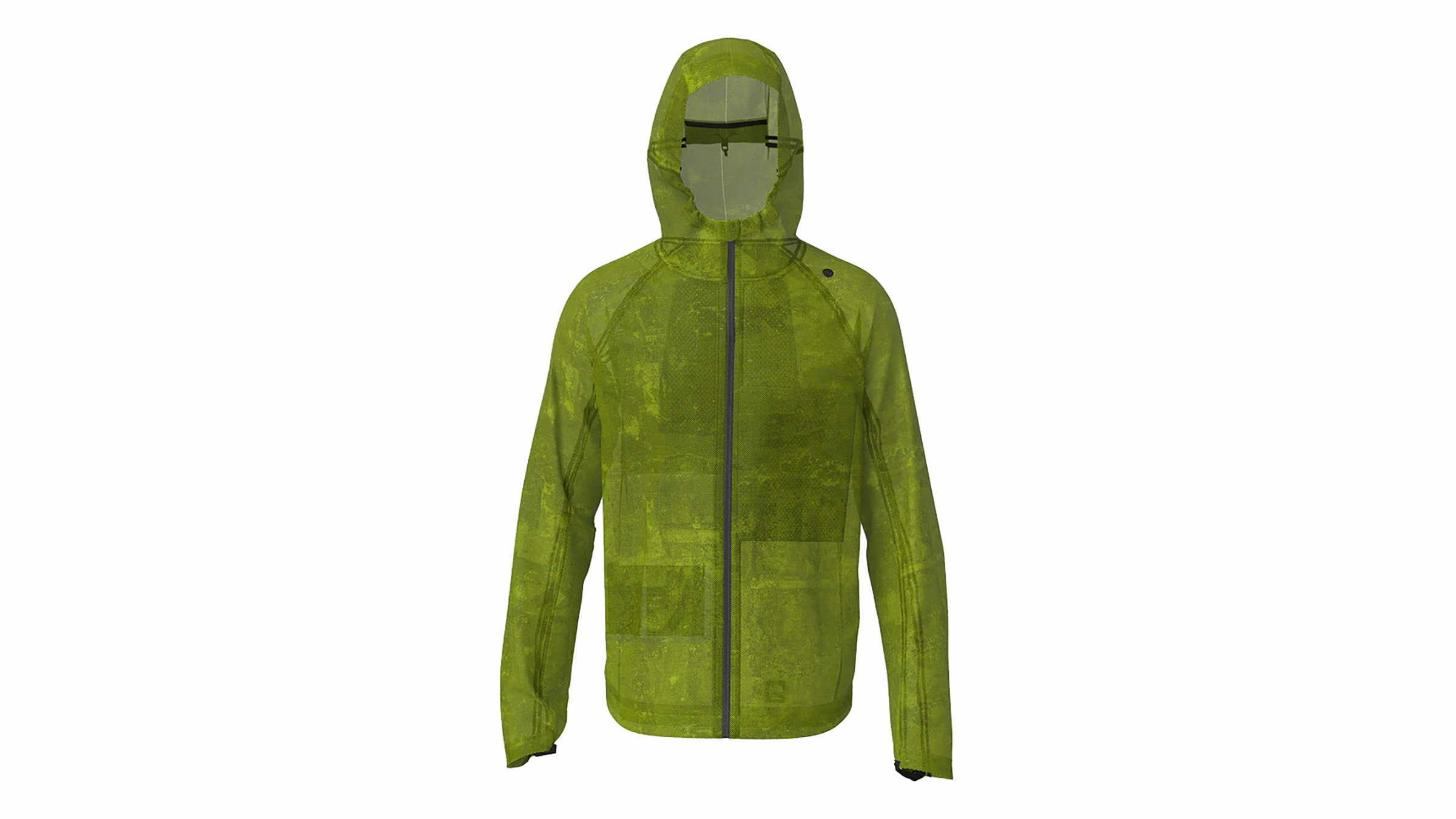
You know those days when the weather is so bad that you leave a towel and dry clothes right by the door for your return? I wore this jacket on one such day, when heavy rain fell throughout my 70-minute run. My tights and socks were wring-out wet when I got home (actually, they were sopping long before that), but the shirt I wore under this Ciele shell was as dry as when I headed out.
ADVERTISEMENT
Unlike many of the jackets I tested, the FLR delivered this performance while being super light but also plenty warm. As an experiment, I wore it over just a short sleeve tee on an hour run in hard rain and temperatures in the mid 30s. I was comfortable (and dry) the whole time. The FLR is also highly breathable, thanks in part to a back vent. On a dry, sunny day with temps in the mid 40s—a scorcher by Maine winter standards—I wore this shell over a heavy long sleeve merino top to see when I would start to overheat. I never did while out for almost 90 minutes.
All of this performance comes at a cost. The FLR was the second most expensive jacket I tested. If you regularly run in cold precipitation and can shoulder the cost, this jacket is for you. You might also justify the price if, like me, you value top-quality running gear that’s stylish enough to wear when you’re not running.
Bottom line: Premium protection and breathability, with a price tag to match
Runner-Up: Janji Rainrunner Pack Jacket 2.0 ($198)
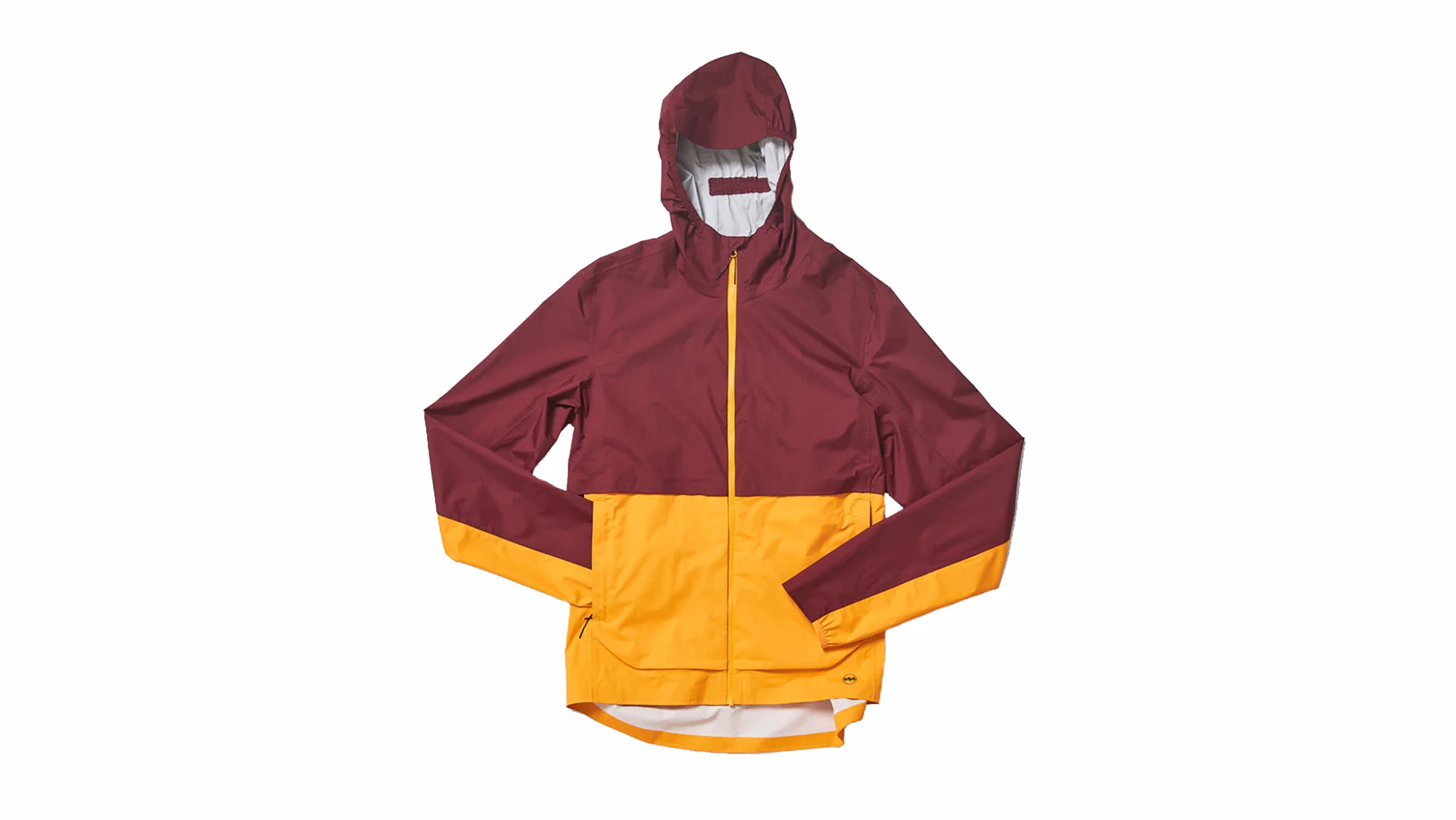
This jacket was the second-best I tested for that sweet spot of keeping precipitation out, letting sweat vent, and not interfering with my form. Pretty impressive for its approachable price, costing $100-$200 less than many of the jackets it outperformed.
ADVERTISEMENT
Its 100% ripstop nylon fabric is wind- and waterproof, breathable, and light. On one two-hour run in steady cold rain, I stayed warm up top wearing it over a short-sleeve tee. When I finished, the shirt was dry except for a small section near my sternum. It performs equally well as an outer layer in dry weather. I stayed warm but not overheated wearing it over a short-sleeve shirt in the mid 30s to mid 40s, and similarly comfortable in the high teens to low 20s with it layered over a medium-weight long-sleeve top.
I also value the sensory aspects of wearing the Rainrunner—unlike many jackets with a DWR treatment, this one is quiet and smooth, not crinkly, against the skin. The cuffs, which stay in place while allowing easy watch peeking, were obviously designed by runners. The slim-but-not-constraining fit worked well for my slight frame, especially on windy runs.
Bottom line: Exceptional performance for the price, in an athletic fit
ADVERTISEMENT
Also Good: Outdoor Research Shadow Wind Hoodie ($129)
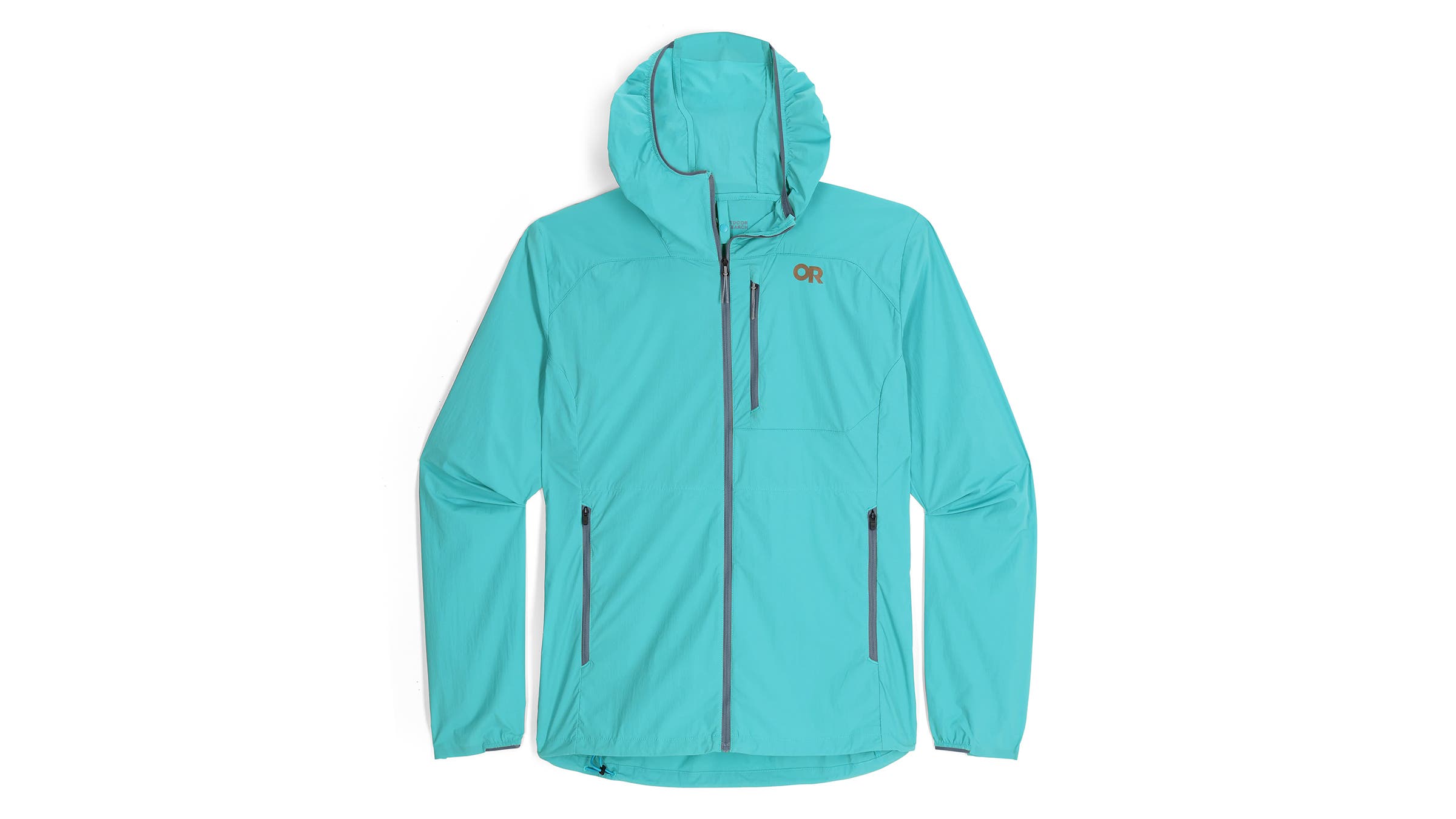
Outdoor Research says this new offering “provides light water resistance.” They’re being too modest. I wore the Shadow Wind Hoodie in a high-30s downpour just to see how long it would keep me dry. After 75 minutes, I’d had enough of such weather for the morning, but the jacket hadn’t. The little bit of moisture on the long-sleeve top I wore underneath was only from sweat, because I had pampered myself with too warm of a shirt. Also, there was a clear demarcation between the dry upper few inches of my tights that the jacket covered, and the wet remainder below.
The Shadow Wind Hoodie was also top-notch on dry runs. When worn over a light to medium long-sleeve top, it kept me comfortable down to temperatures in the low 20s. As with the Goldwin jacket, it’s more generously sized than some running-specific jackets. I never felt constrained by its slightly long, loose drape. That fit, along with a good rendering of details like the pocketing (two hand, one chest) and the stowable hood, make it a good choice for non-running activities as well.
ADVERTISEMENT
Bottom line: A surprisingly protective shell at a bargain price
Meet Our Tester
Scott Douglas
I started running as a middle schooler in 1979 and have done more than 125,000 miles since. I was pretty good decades ago—30:48 10K, 68:40 half marathon—but have always run primarily because I love it. I run every day unless I’m injured, and I always run outside, either despite or because of living in Maine. Even a slippery, sloppy, snowy run is more enjoyable to me than waiting out the time on a treadmill. Now in my late 50s, I run about 3,000 miles a year and am most drawn to trail ultras these days. I’m fortunate to be able to combine my love of running with my professional life. I’ve held senior editorial positions at Runner’s World and elsewhere, and have written or co-written several popular running books, including Advanced Marathoning, Meb for Mortals, Running is My Therapy, and Strong Minds.
ADVERTISEMENT
Correction March 7, 2024: An earlier version of this article incorrectly named the Goldwin Pertex Shield Air Mountaineering Jacket as PFAS-free. The current version is not PFAS-free, but the company says that all of its products will be PFAS-free by 2025.
