Updated February 2, 2026 12:26PM
How Did Courtney Dauwalter Get So Damn Fast?
As Dauwalter eyes a fourth win at UTMB, we're revisiting this classic from 2023 to understand how she became the greatest female ultrarunner of all time.
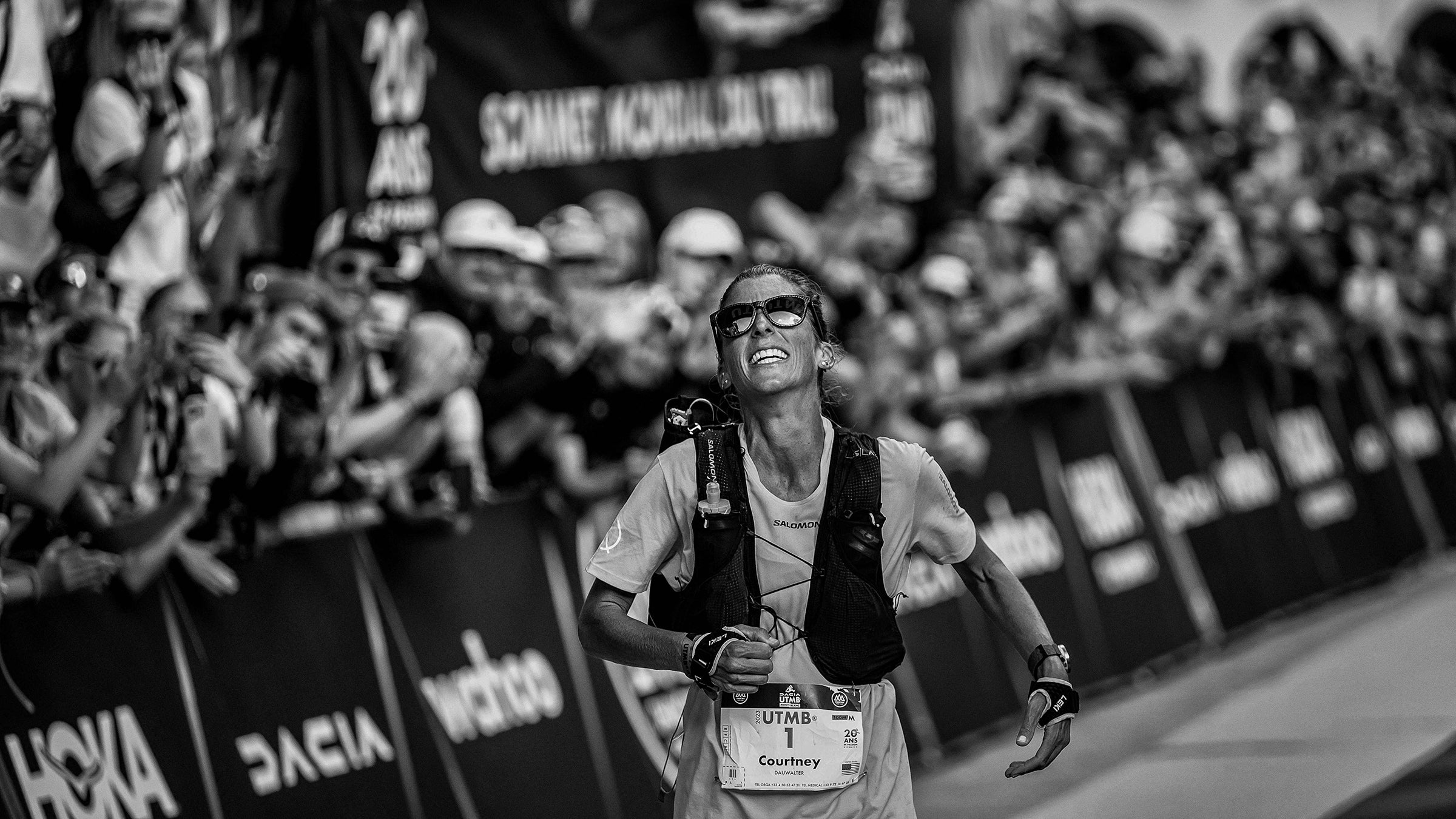
Winning the Ultra-Trail du Mont Blanc in September 2023 (Photo: Jeff Pachoud/AFP/Getty)
If Courtney Dauwalter could travel back in time, this is what she would do: She’d join a wagon train crossing the American continent, Oregon Trail-style, for a week, maybe more, just to see if she could swing it. It would be hard, and also pretty smelly, but Dauwalter wonders what type of person she’d be if she deliberately decided to take that journey. Would she stop in the plains and build a farm? Could she make it to the Rocky Mountains? How much suffering could she take, and how daunted might she be by the terrain ahead of her?
“If you get to Denver and this huge mountain range is coming out of the earth, are you the type of person who stops and thinks, ‘This is good’?” she wonders. “Or are you the person who’s like, ‘What’s on the other side?’ ”
Dauwalter is probably (definitely) the best female ultrarunner in the world—a once-in-a-generation athlete. She’s hard to miss at the sport’s most famous races, and not just because of the nineties-style basketball shorts she prefers. (Her explanation: she just likes them.) It’s because she’s often running among the leading men in the sport, smiling beneath her mirrored sunglasses. The 40-year-old is five foot seven and lean, with smile lines and hair streaked with highlights from abundant time spent in high-altitude sun.
ADVERTISEMENT
Dauwalter shared her historical daydream with me while sipping a pink sparkling water at her house in Leadville, Colorado, after a four-hour morning training run. Her cross-country wagon musings get at why she’s the best female ultrarunner ever to live: Dauwalter is curious. She’s curious about pain, about limits, about possibility. This quality is fundamental to what makes her so good.
Over the past nine years, Dauwalter has won almost everything she’s entered. In 2016, she set a course record at the Javelina Jundred—an exposed, looped route through the Sonoran Desert of Arizona. That same year she won the Run Rabbit Run 100-miler in Steamboat Springs, Colorado, by a margin of 75 minutes, despite experiencing temporary blindness for the last 12 miles (she could only see a foggy sliver of her own feet). Because of ultrarunning’s huge distances, it’s not unheard of to beat the competition by so much, but it doesn’t happen with the frequency that Dauwalter manages.
ADVERTISEMENT
In 2018, she won the extremely competitive Western States 100 in California; it was her first time on the course. A year later, she set a new course record while winning the prestigious Ultra-Trail du Mont-Blanc (UTMB), besting the second-place finisher by just under an hour. In 2022, she set the fastest known time on the 166.9-mile Collegiate Loop Trail in her backyard in Colorado, and she won (and set a new course record at) the Hardrock 100, a grueling high-altitude loop through the state’s San Juan Mountains.
Dauwalter is also one of the few runners of her caliber to seriously dabble in the really long distance races. In 2017, she won the Moab 240—yes, that’s 240 miles—in two days, nine hours, and fifty-five minutes, ten hours ahead of the second-place finisher. She ran even farther at Big’s Backyard Ultra in 2020, a quirky test of wills where athletes complete a 4.167-mile course every hour on the hour until only one runner is left. Dauwalter set a women’s course record of just over 283 miles.
Given everything she’s accomplished, it’s hard to believe that the past two summers have been her most successful yet. In 2023, she returned to Western States, where she smashed the women’s course record by more than an hour and finished sixth overall. When she passed Jeff Colt, who finished ninth, he remembers how calm and collected she looked, running all alone. “My pacer looked back at me and said, ‘Jeff, I can’t even keep up with her right now,’ ” he says. Less than three weeks later, she won Hardrock again, taking fourth place overall and setting a new women’s course record. The race changes direction on the looped course each year, and she broke both the clockwise and counterclockwise records.
ADVERTISEMENT
In the interest of testing herself one more time, in late August she traveled to France to run UTMB again. She won that race too, becoming the first person in history to win all three races in a single summer. “She’s one of those humans who defy even the concept of an outlier,” says Clare Gallagher, a former Western States winner who has raced against Dauwalter. “I look at her summer and I have no words. It’s truly hard to conceptualize.”
Dauwalter led UTMB from the start, and she finished more than an hour ahead of the woman in second place. As she descended the final stretch of trail, she was followed by a barrage of cameras and a handful of people who looked like they just wanted a bit of her magic to rub off on them. As crowds roared on either side of the finish line in Chamonix, she looked back at the spectators and clapped in their direction, never raising her hands above her head or pumping her fists in the air. After hugging her parents and her husband, 40-year-old Kevin Schmidt, she jogged back in the direction she’d just come to high-five hundreds of fans.
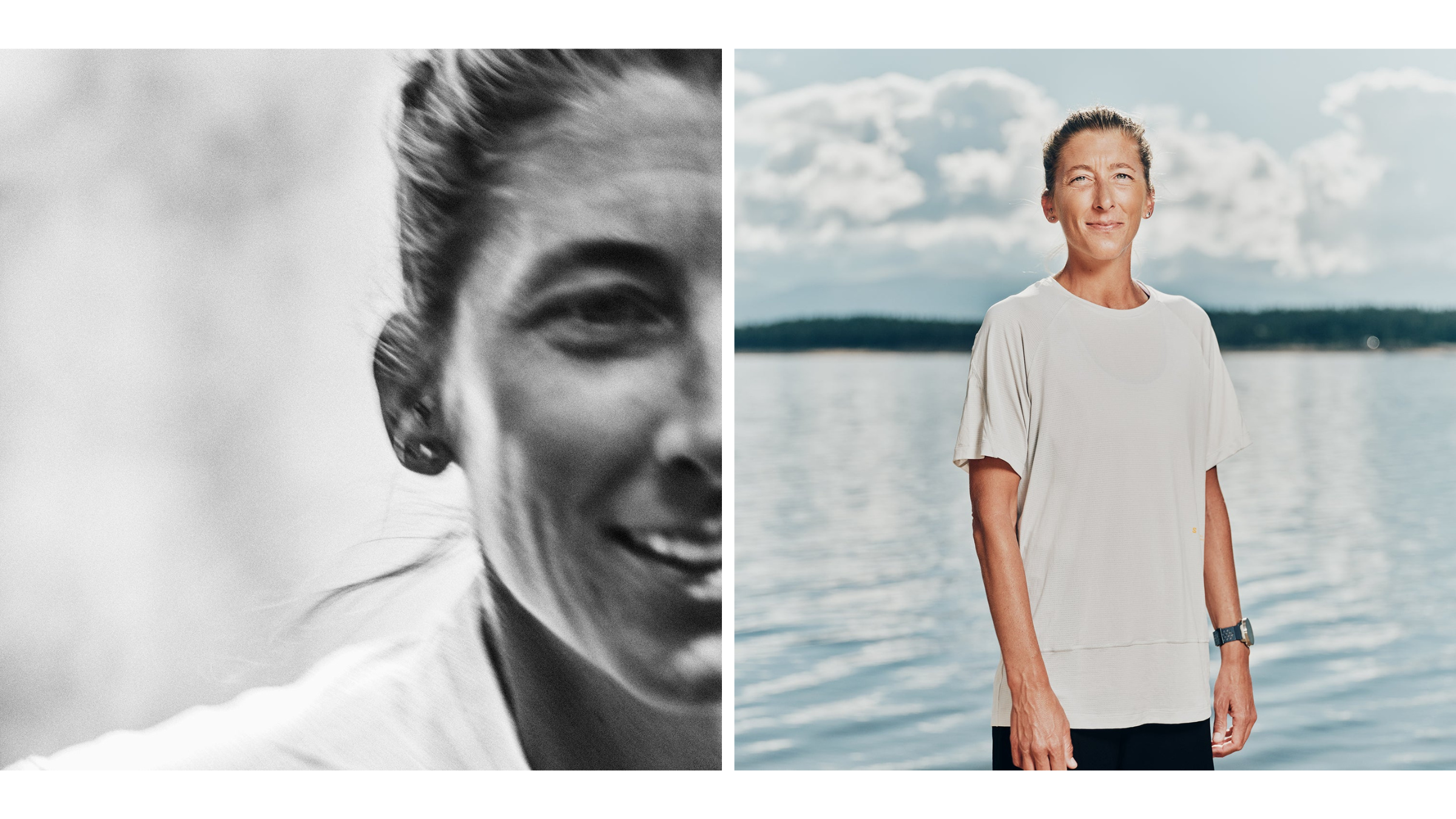
Dauwalter grew up in the suburbs of Minneapolis, in a tight-knit family that was always active. The kids all played soccer, and when they weren’t at practice they were busy building tree forts or making up games at the local park. In seventh grade, she started running cross-country, and in eighth grade she joined the nordic ski team. She claims to have spent the first years just trying to stay upright, but in high school she went on to be a four-time state nordic ski champion and attended the University of Denver on a cross-country-skiing scholarship. She says that her parents, who now frequently crew and support her at races, led by example. “You work hard, you give everything you’ve got, you don’t forget to have fun,” she says.
Minnesota winters are notoriously cold, and she credits her ability to dig deep within herself to the unforgiving conditions. “Growing up there, you just learn to do stuff, regardless of the weather,” she says. She also points to a cross-country coach who taught her to think differently about pain. “He laid the groundwork for understanding that our bodies are capable of so much,” she says. “We can push past those initial signals saying that’s all I have and turn the knob, and there’s always one more gear.”
Dauwalter seems to have a rare capacity to push against her own limits without tipping over the edge.
After college, Dauwalter taught middle and high school science in Denver, which is where she met Schmidt. “A woman I worked with and a guy he worked with were married, and they just kept putting us in the same places,” she says. “I didn’t know they were meddling!” Schmidt, who works as a software engineer, is also a competitive runner. He and Dauwalter train together—sometimes he’ll join in for her second run of the day—and they trade off supporting each other during races. When I met up with them in Leadville, Dauwalter had just finished crewing for Schmidt at a 100-miler in Switzerland. During her races, he maps her splits, takes care of her aid-station needs, and serves as crew captain. He’s the “spreadsheet brain” to her “tie-dye brain,” as he puts it, and he provides emotional support too.
ADVERTISEMENT
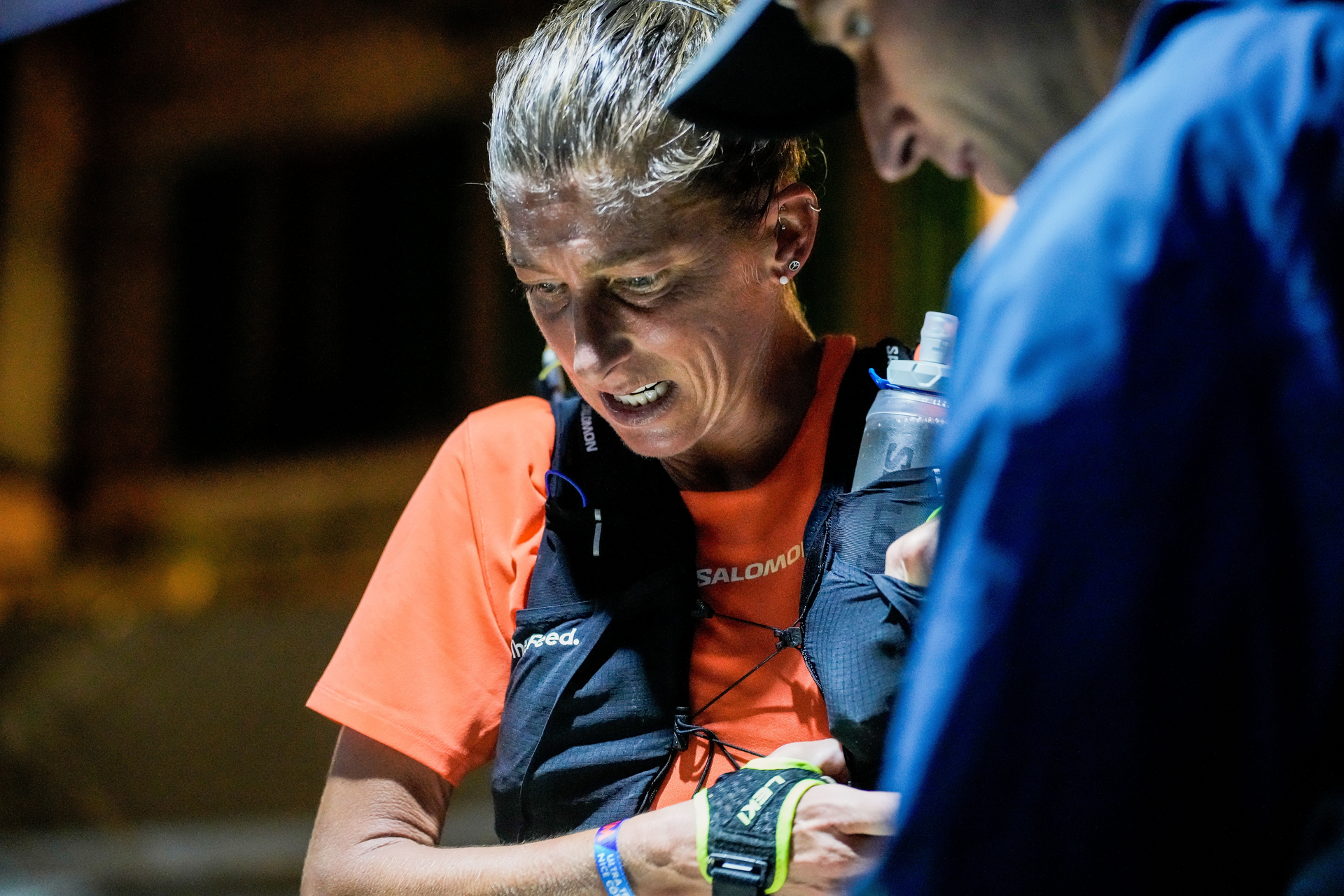
“Its clear to me when she has taken up residence in the pain cave, so I try my best to fill it with snacks and encouragement,” says Schmidt. One time, while driving to an aid station during a race, Schmidt got a flat tire while carrying everything Dauwalter needed for the night. He wound up sprinting the final three miles to catch her in time.
When Dauwalter started racing more competitively and winning, she and Schmidt had a series of discussions about what they wanted their lives to look like. Ultimately, they decided that she should try to give professional running a shot. In 2017, without a sponsor and with a lot of unknowns still ahead, she left teaching to run full-time. “What we wanted was to look back when we were 90 years old and not wonder what if? about anything,” she says.
Mike Ambrose, the former team manager at Salomon, offered Dauwalter her first sponsorship as a trail runner that same year. She was still new on the scene, but Ambrose could see that she was driven, and the talent was there. “She’s super curious about pushing herself,” he says. “She had this huge engine coming from nordic skiing, and her 24-hour time was really crazy. I thought, well, if she just figures it out and gets more trail experience, she obviously has the mental and physical capacity.”
ADVERTISEMENT
Despite her nearly superhuman athleticism and mental fortitude, Dauwalter is also very normal. She likes nachos, candy, and beer. She watches sports (the Vikings are her NFL team, even though she’s been in Broncos territory for years), and she wants to spend time with the people she loves, including her parents, and the friends who often crew for her.
Ultrarunning frequently sees short-lived stars, runners who dominate for a couple of years before burning out or slowing down, either from overtraining or simply from the passage of time and the wear on their bodies. Dauwalter, however, seems to have a rare capacity to push against her own limits without tipping over the edge. She’s been running long distances at an elite level for seven years now. Gallagher wonders how she’s managed to avoid injury, given Dauwalter’s volume of physically demanding races.
Mike Wolfe, an ultrarunner who owns a gym for mountain athletes in Montana, thinks that Dauwalter has been smart about building to be the next-level runner she is. “Some athletes experience quick success and then try to go big, with a huge volume of training and racing,” he says.
“It seems she’s been more thoughtful over the years and allowed herself to develop to her current level.” Schmidt, who knows her better than almost anyone, says he thinks this ability comes largely from intuition: “She trains based on what she feels she needs on a given day. That carries over into racing, allowing her to get the most out of herself.”
ADVERTISEMENT
Two weeks before she left for the UTMB, Dauwalter and I went for a run together outside Leadville. She pulled up to the trailhead with her shoes and pack already on. This is typical—she usually gets up early, answers a few emails, drinks some coffee, and heads out for a run. Often she’ll have a rough idea of how long or how far she’ll go and adjust that based on how she’s feeling. Some days she’ll do a big workout or run twice; other days she’ll take it easy or ride her bike. In the winter she skis.
Ultrarunners can be quirky, sometimes resorting to running very long distances on treadmills while stuck on a boat, for instance, or jogging circles around an airport parking garage during a long layover. Dauwalter doesn’t do anything like that, but she will get up at 2 A.M. the morning before an early flight because she doesn’t think of travel days as rest days. However, she’s good at rest days. Her ideal vacation—though she doesn’t take them often—is sitting on a beach with a lawn chair and a book, no running allowed.
ADVERTISEMENT
Before a race, Dauwalter doesn’t eat—she just drinks a cup of coffee. She calls her parents before every competition, to see what they’re up to and what their plans are for the day. It’s something she can think about while running, she says. During her second 100-mile attempt, her mom gave her a small peace-sign coin that Dauwalter now carries in her pack every race. Sometimes she recites mantras to keep going, like “Be right here, stay right here.” She says that finish lines never feel guaranteed, and during the race she won’t allow herself to think about the end. “Getting to one always feels special,” she says. Afterward, she recovers by eating something cheesy and drinking a beer.
As we climb steadily through pine trees with views of 14,429-foot Mount Massive, we talk about her experience with pain. “I don’t think pain is a bad thing,” Dauwalter says. “I think things can be fun and painful at the same time. I think having fun doesn’t have to look like laughing and smiling the whole time. When I’m in the pain cave, that’s fun for me. Exploring that is really cool.”
ADVERTISEMENT
I ask her if the pain cave she refers to so often actually feels like a cave. “That’s just the visual I’ve built in my head,” she says. “I picture putting on a hard hat and grabbing a chisel and seeing what happens. I don’t know if eventually I’ll reach an end of chiseling, or if I won’t be able to mentally convince myself to go chisel more, but for now it just keeps getting bigger.” She doesn’t know where the limits are or what they’ll feel like. But when it stops being fun, she won’t go back anymore.
A few miles in, a cool breeze blows through the subalpine forest and Dauwalter spreads her arms wide, as if she can’t contain how great it is to be here. She loves fall. “Sweatshirt and shorts season? That combo is my favorite.” She lists with genuine delight her favorite fall snacks: pumpkin beer, black IPAs, pumpkin spice lattes, candy corn. When I agree that candy corn is in fact great, along with the jumbo-size candy pumpkins, she exclaims, “Yes! Oh, my God! People either love it or hate it. I love it. And the pumpkins? So good. A bigger candy corn? Perfect!”
Dauwalter’s positivity is one of the things the trail-running community loves her for. At mile 78 of the 2023 Western States, at the checkpoint called Rucky Chucky, runners had to cross the river in a raft, because the water was too high to go on foot. Dauwalter jumped into the boat, asked the volunteer raft guide how he was doing, thanked him and everyone else for being out there, and waved to the crowd gathered on the opposite shore. Not like a queen, but like a kid waving to her parents from onstage at a school play. Her enthusiasm is magnetic. She’s genuinely having fun.