Published September 14, 2019 10:18PM
Woody Kincaid Opens Up
The newest sub-13:00 5K runner talks about how and why the Portland race happened, his teammates, his training, and how he handles critics.
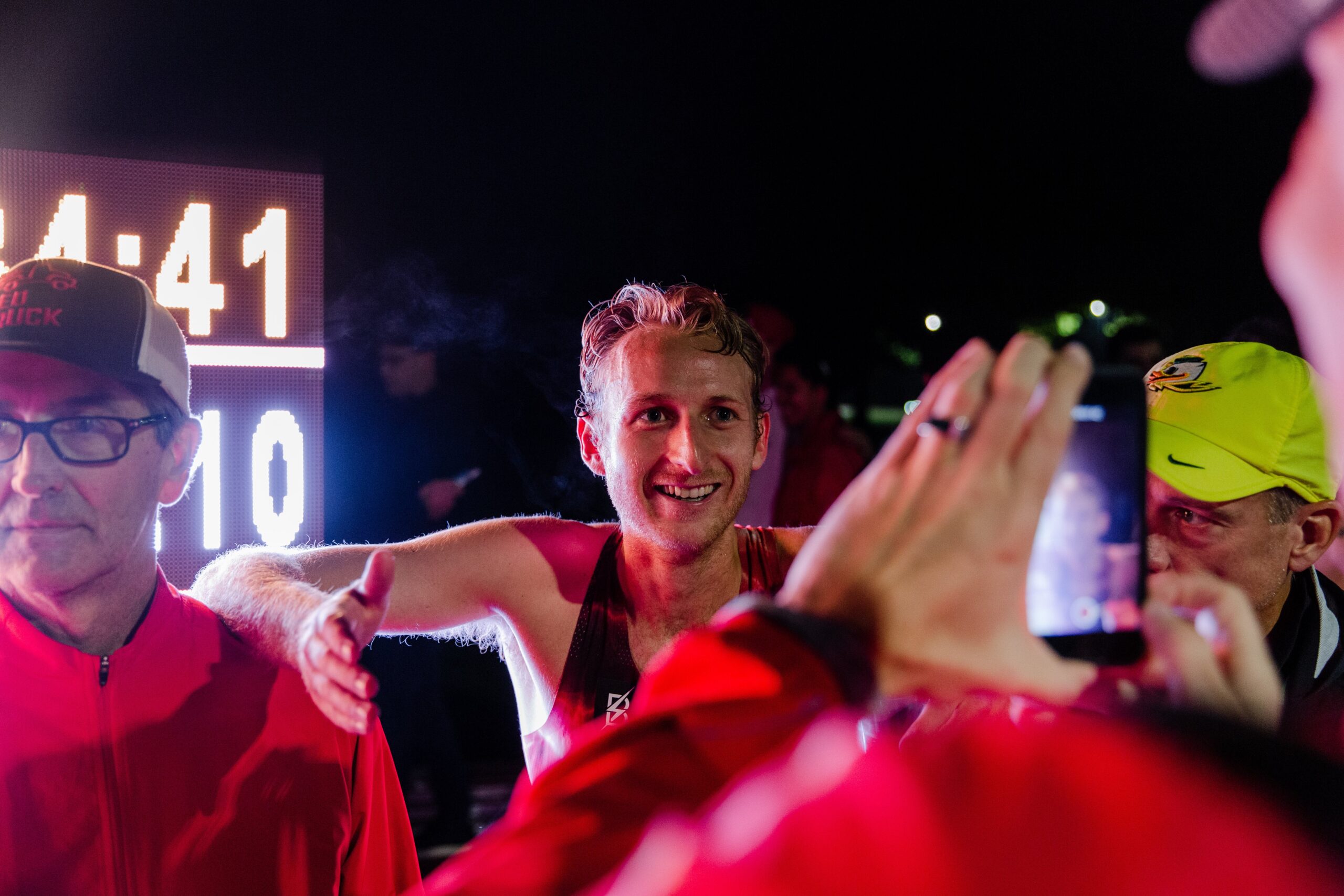
photo: Luke Webster
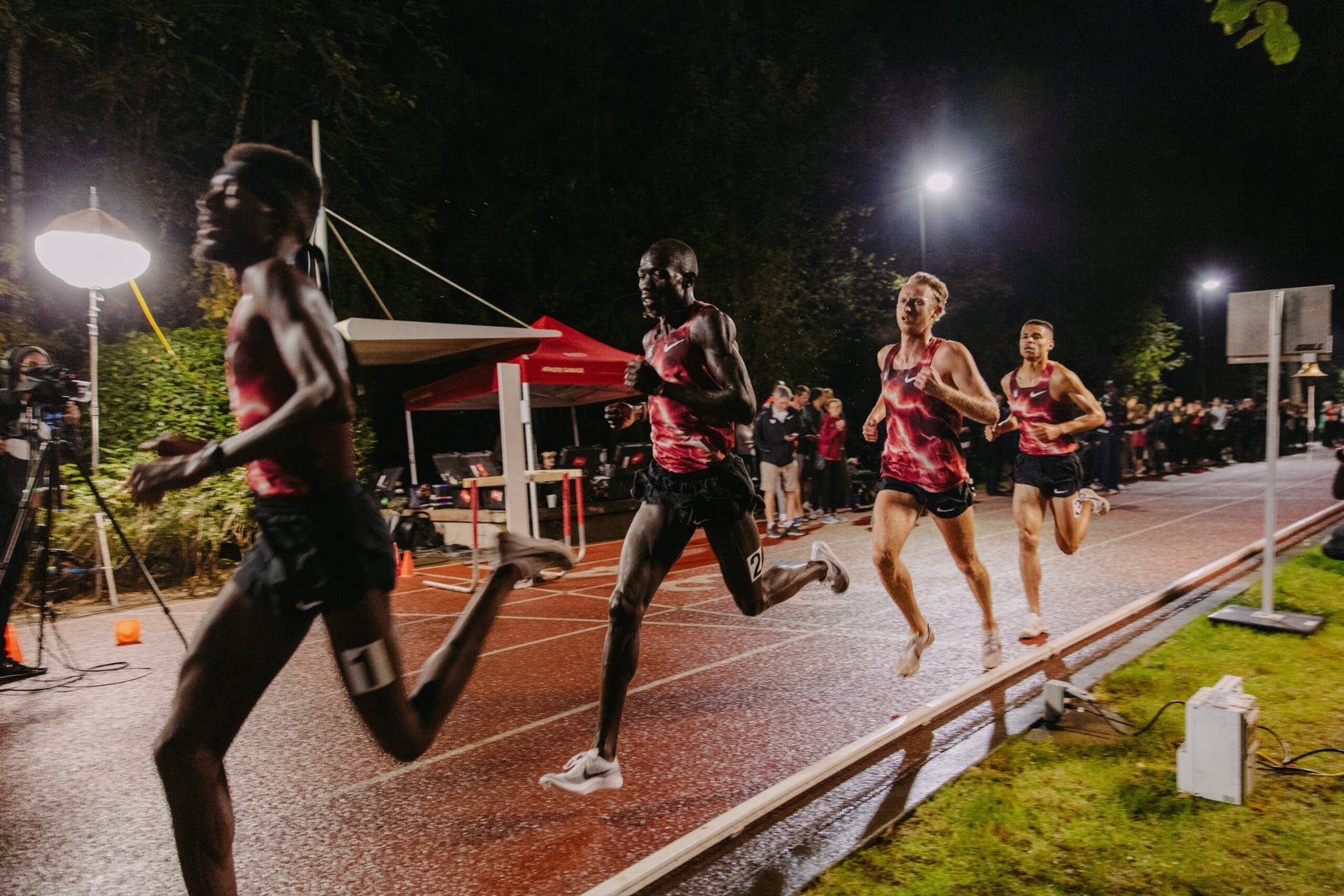
At 9:00 p.m. on September 10 eight runners toed the line at a mystical track in Oregon with a forest growing in the middle. By 9:13 p.m. on September 10, one of the lower profile members of Bowerman Track Club had taken 14 seconds off his PB, dipped below the 13-minute mark, easily notched the 2020 Olympic standard, and rocketed up to fifth on the US all-time list for 5000 meters.
All while enjoying the magic of running the perfect race under the lights on the fairyland track at Nike HQ in Beaverton in front of his people and his mom and adoring teens—all hopping around on the track, giddy and shiny. So, a productive 12 minutes 58 seconds for Woody Kincaid. Prior to Tuesday night, Kincaid’s limited instances in the limelight involved his crowd-pleasing kick and unconventional race tactics, not necessarily in that order.
That brisk 12:58.10 vaults Kincaid, a guy who’s never raced in Europe—who didn’t have the performances to race in Europe—smack dab into the middle of that world classy crowd. I caught up with him by phone, three days after the run, his second interview of the day.
PodiumRunner: First, why did that 5000 happen? Why now? And why just the three of you in your backyard?
Woody Kincaid: It never would have happened if all of us had made it to Doha. Immediately after USAs, we were all in great shape, so we thought we should try to get the Olympic standard. We wanted to run a race somewhere; we didn’t know where or how. Originally we were going to do it ten days out from USAs but some of the guys didn’t feel recovered.
PR: So it was just you guys with this idea? Where was Jerry Schumacher in all of this?
WK: Jerry was the mastermind. We all wanted the [Olympic] standard so he said, ‘Let’s do it.’ It was probably set up for me because Jerry said he couldn’t get me in a race that would go under 13:13 for sure. I didn’t have the resume. Maybe I do now. So we thought, we’ll have to do it ourselves. We have a 12:58 guy [Canadian Mo Ahmed, a Bowerman TC teammate, ran 12:58 in Rome this past summer]. We invited some other guys but they wanted to run in Europe…
PR: What other guys?
WK: Hassan Mead was one. And some others. Frankly, it’s kind of an awkward time for a race, so it ended up just us. That’s the really cool thing about this team, the support, that they made this happen. It’s impressive that Mo was willing to pace, and all these people showed up.
PR: It looked like there were eight people on the start line— you, Lopez Lomong, Matt Centrowitz, Mo Ahmed pacing, and who else? It was open to the public—what else has to happen to make it legit with USATF?
KW: Yeah, there was another pacer, Amos [Bartlesmeyer]—he’s a Nike guy—and then three guys from Bowerman Elite who just wanted to improve their 5K. I don’t really know the rules [about making a race USATF certified]. I think 50% of the field has to finish.

PR: Are you surprised to find yourself in this exalted company? Fifth on the US all-time list?
WK: Dude, I can’t believe it. Still, three days out, it hasn’t settled in. No one else gets this opportunity. To have somebody pacing me, essentially on my home field, in front of my friends—my mom was there too. I mean, so many things had to go right. I can’t believe it all did. I’m happy that it did. That’s what you dream of, isn’t it? Things working out the way you want at just the right time? Actually it almost didn’t. I felt kind of sick before the race. I thought about not doing it, but Jerry was like, I don’t care how you feel, we’re doing this. Internally, I wasn’t feeling great.
PR: There are those—okay, not me, but others—who are saying that the time trial-ish format was cheap, not like a real race.
WK: Okay, the narrative is always… my personality is… it seems like this guy’s not serious. Because I don’t vocalize. But to be honest, I was always pretty serious about running. I was under-performing because I was staying up all night to write essays. I’d like to say I was messing around—okay, there was some partying—but I was struggling to balance everything in my life.
When I became pro, all I had to do was focus on one goal. I had my girlfriend, my family, support from my team. I had stability. I can see how people would say he’s performing so much better than he should, where did this guy come from. But that’s how you get good. You focus on running.
ADVERTISEMENT
Looking back on Kenya, I was accumulating fitness in Kenya. I was always serious about running. In Kenya, I could turn my brain off to other things. It’s a blessing and a curse as a pro. When I was injured, I had to find other ways to channel my energy. When I was healthy, I took those lessons from when I was injured and applied them to running.
PR: Do you think your coming late to high-level competition has helped you because you’re mentally fresh, or hindered you due to lack of experience?
WK: That’s hard to say. I’ve really only had one season of success going into an Olympic year. Mentally, it’s good because I think I can make the team and actually do pretty well in the Olympics. I think I can run with any of those guys. The confidence is there, but there’s some doubt too. I’ve never run in the Olympics, I’ve never run in Europe, in Diamond League races. I haven’t had those experiences. I hope I’m ready for anything. Time will tell.
PR: Part of your under-the-radarness is that you don’t race very often. How many times have you raced in 2019?
WK: It maybe seems like I didn’t race much, but if you were paying attention—which, I guess, why would you—but if you were paying attention, I raced once in January and then at USAs indoors. I was second-to-last in the 3K in 7:56.
A year ago today I was laying on a couch watching television. I had surgery for a hernia on September 5, 2018. I wanted to take it slow coming back but Jerry was not super happy. He wanted me to race indoors. Anyway, I was not in great shape and then a few days before, I tweaked my hamstring. The fitness wasn’t there, confidence wasn’t there, and I finished second to last.
ADVERTISEMENT
Anyway, I ran a 1500 at the Oxy Sunset meet, a 1500 at Payton Jordan, the 5K at Azusa, 5K at USAs outdoor, and now this one. So seven races over nine months. That’s plenty for me.
WK: We spent 90 days in Park City between May and August. After Stanford, we went to altitude for two months to get ready for USAs. We did a workout twice a week and a long run once a week. It was not incredibly hard; we weren’t in World Championship mode yet.
PR: So give me an example of a workout.
WK: We are on these cycles. We do a strength session and a speed session, and some elements of both…what’s that diagram with the circles that overlap?
PR: A Venn diagram?
WK: Right. So like a Venn diagram, there’s some overlap. We might do strength but touch on speed.
PR: Can you give a specific example of that workout?
WK: [sighs] Okay, on a strength day, we might do hard miles on short rest, then a longer rest and some race-specific things, maybe a hard ladder at the end.
PR: And did you do two-a-days?
WK: Yes, I doubled most days.
PR: How many miles a week?
WK: Shhuh, I don’t know. Not many. Maybe mid-70s. I mean, people post stuff about their workouts and their mileage. Media asks me about mileage… doesn’t matter. What matters is the race. A few years ago I ran 13:12. It’s not like I wasn’t working out. I was training, but what mattered was performing in the race. I was hurt in the fall so I didn’t have those races that people see.
PR: Right. So when you run 12:58, people, the media, wonder about your workouts. How were you able to run 12:58? Because only four other Americans have done so. So patronize me, make something up. Tell me about that long run.
WK: People are critical of my race tactics but I’ve never finished lower than fourth since turning pro.
PR: Well, except for that second-to-last at USA indoors.
WK: Oh yeah, but that was not due to race tactics. That was lack of fitness and injury and other things. Actually, Jerry believed I ran the best championship race he’d seen in his life [at outdoors]. He’s a great coach. Paul [Chelimo] was never going to trade off laps with me. I mean, what I did was tactically smart—I miscalculated, and made a mistake in running a second 70 [-second lap], and I missed the [World Championship] standard by three seconds. It all worked out.
PR: What’s next? Are you done for the season?
WK: Completely done. We shut it down. I won’t run at all for four or five days. Then I’m going to visit my girlfriend, and we’re going to Greece for two weeks. I recorded a Price Of The Mile podcast; want to get that going. And I’m moving to Beaverton. It’s not like living in Kenya; even in the off season, there’s still bills to pay, people to meet.
ADVERTISEMENT