Published November 20, 2023 03:12PM
You Don’t Need to Earn Your Thanksgiving Feast with Exercise
Turkey trots are supposed to be fun—not punishment for eating
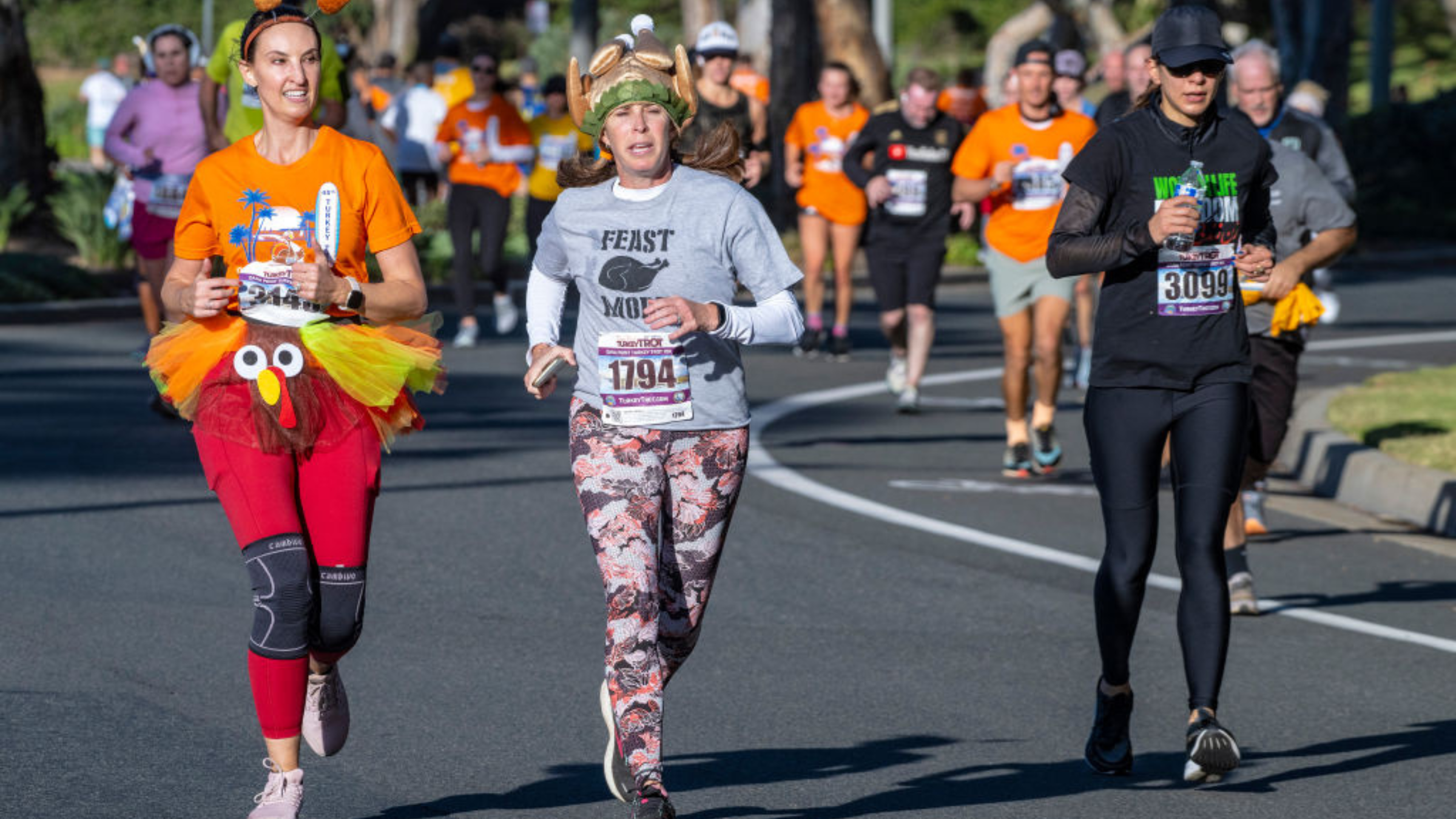
Festively dressed runners near the finish line as they run in the 45th annual Dana Point Turkey Trot in Dana Point on Thursday, November 24, 2022. (Photo: LOS ANGELES TIMES OUT, SAN DIEGO UNION TRIBUNE OUT, Getty)
In my book, there are two types of people: those who do turkey trots, and those who vehemently do not.
Turkey trots, annual races (generally 5K to 10K) that most commonly take place in the United States on Thanksgiving morning, have been a well-kept tradition since 1896. The very first trot was held in Buffalo, New York, and only six runners participated in the five miles along downtown Buffalo’s dirt roads. Since then, the tradition has skyrocketed in popularity. A survey from 2022 reported that 756,894 people ran or walked in 730 turkey trots across the country.
Trotting a Fine Line with Food Anxiety
Much like any race, there are plenty of good reasons why people run on Thanksgiving morning. But one not-so-good reason? Running a turkey trot because you feel like you need to “justify” the Thanksgiving feast you’ll eat later. A study of 2,000 Americans found that 88 percent feel anxious around the holidays, with 85 percent reporting that they overeat to the point of being uncomfortable.
Thus, the idea of “punishing” yourself with a run before you enjoy pumpkin pie, mashed potatoes and gravy, green bean casserole, and mom’s famous jello pudding can seem like a good way to balance the scales. However, not only is this not effective nutritionally-speaking, but it’s damaging to your mental and emotional health. Mental endurance and life coach Vanessa Foerster says that, though this way of coping with Thanksgiving is harmful, she’s not surprised people do so.
“It’s all centered around these narratives about diet culture in our marketing,” she says. “Half of the time the holidays are shown to us as a time to indulge and cook all these delicious things, and the other half is marketed to us as a time to watch our weight and be thinking about races coming up in 2024.”
ADVERTISEMENT
The Problem with “Earning” Your Meal
Just as it has been that using food as a reward in a child’s adolescence often leads to overeating, unhealthy relationships to food, and lost hunger cues, adults can also feel the negative implications of “earning” your food with exercise.
“Food is a basic human need, not a reward,” says professor of sport and exercise psychology, Jessyca Arthur-Cameselle. “In general, people feel better about their bodies and eating when they consider food to be necessary fuel rather than a reward.”
Even avid runners may use the turkey trot as an excuse to eat more than usual—that’s the “reward.” You might not even sign up with the intention of using it to burn calories before your feast, but subconsciously, you might already feel guilty about what’s to come and are trying to get ahead of it by overcorrecting.
“If exercise is viewed as a means to an end or as something one must do to earn food, feelings of guilt, pressure, or even punishment begin to be associated with exercise,” says Arthur-Cameselle.
If runners have this mindset, they should really question if this is the relationship they want to have with food and exercise.
“When you are willing to question the narratives fed to you and decide whether or not they serve you and your goals, it gives you ownership of the mental space you want to be in around the holidays,” Foerster says.
So if you feel like you might be running for the wrong reasons, is it better to avoid a turkey trot altogether? Not necessarily.
ADVERTISEMENT
Know Your Why
“It depends on the person, but most of the time, it’s worth the effort to manage your perspective and mindset so you’re not missing out on an experience,” Foerster says. “If you avoid it this year, you’re not really coming up against the problem of your mindset—you’re just avoiding it.”
She suggests coming up with better reasons to run the turkey trot, like having it be a tradition to do with your family members or using it as time for yourself before all the holiday hecticness.
“My overall suggestion is to run the turkey trot if you enjoy running, if you like the social aspect of the race, or if you notice positive mental benefits like improved mood after you’re done,” Arthur-Cameselle says. “If you don’t enjoy any of those aspects or gain that type of experience from running, find a different form or exercise or sport that makes you feel how you want to feel. If exercise feels like play, you are more likely to stick with it.”
Though changing your mindset around the turkey trot is healthy, it might not help your unhealthy relationship with Thanksgiving dinner. For that, Foerster recommends mindfulness.
“All that stress, guilt, and shame you might feel around a holiday meal actually have a more negative effect than the food would,” she says. “So you might as well eat the food and actually enjoy it and be present, and then move on. Sort of like failing a workout. You experience it that day, and you’re not going to carry it with you moving forward. Your goals aren’t ruined because of it.”
You heard her, folks. Run Thanksgiving morning because you’re hot for the trot, not because you feel bad about eating a lot.
