Published August 10, 2020 03:05PM
Ask Pete: What are the Best Home Exercises to Strengthen My Hamstrings?
5 Equipment-free exercises to strengthen the hamstring, one of the most important and injury-prone muscles for running.
(Photo: Diana Hernandez)
Have a question for Pete? Shoot us a note.
QUESTION
My PT said I should do hamstring curls on a Swiss Ball, but I don’t have a Swiss Ball and can’t go to the gym. What hamstring exercises do you recommend that don’t require a gym? – JB
ANSWER
Runners should choose hamstring exercises that strengthen the muscle group in a way that’s directly applicable to running. The hamstrings endure enormous eccentric and concentric loads during each stride, so both types of muscle contractions should be targeted. The goal is to strengthen the hamstrings in a way that improves performance and reduces injury risk.
Your hamstrings might be your most important running muscle group. While most muscles flash on and off during the course of your stride, your hamstrings work feverishly from the moment your knee reaches its highest point in front of your body until your foot finally leaves the ground behind your body. During that stretch, your hammies endure an eccentric load of up to 10 times body weight just before your foot touches down and a concentric load of up to 8 times body weight immediately after touch-down. That makes hamstrings both the key to powering your running stride and an injury-risk like no other muscle.
ADVERTISEMENT
Okay, I can already see your eyes glazing over. Eccentric-concentric, tomato-tomahto, let’s call the whole thing off! That’s a reference to a 1937 film, in case those of you under 80 missed it. But bear with me, because understanding how your hammies function is the foundation for planning exercises to strengthen them.
Concentric and eccentric contractions
When you think of muscle contractions, you probably think of flexed biceps, Mr. Universe flashing six-pack abs, or ESPN’s World’s Strongest Man heaving the Atlas Stones atop tall platforms. Those are examples of “concentric” contractions, but there are actually three types of contractions:
- Concentric contractions: Your muscle shortens during contraction, producing force as it overcomes resistance (e.g., your flexed biceps when you curl a heavy dumbbell).
- Eccentric contractions: Your muscle lengthens (stretches) during contraction, producing force without being able to match or overcome an external force (e.g., you slowly lower that curled dumbbell, contracting your biceps but without enough force to overcome the weight).
- Isometric contraction: Your muscle’s length doesn’t change during contraction, producing force without altering the angle of adjacent joints — not relevant to our hammy training.
Let’s look at how your hamstrings’ concentric and eccentric contractions drive your stride.
Hamstring contractions during each stride
Your hammies first spring into action as your knee reaches its highest point in front of your body (known as “knee lift position”). At that moment, your glutes contract concentrically, pulling your thigh toward the ground. Your hamstrings simultaneously contract eccentrically, both to help your glutes extend your hip (i.e., straighten the angle where your thigh meets your front pelvis) and to prevent your lower leg from snapping forward at the knee as a result of this downward force — otherwise, you’d perform the goose step. If all goes well, your hammies will align your lower leg for a 90°landing. But right before your foot touches down, your hammies switch to a concentric contraction, pawing your foot back into the ground and exerting more force to extend your hip. As your body passes over your foot, your glutes shut off, leaving your hammies to finish extending and hyperextending your hip until your foot leaves the ground.
The faster you run, the more force your hamstrings contribute — while the contribution from muscle groups like your quadriceps and calves either remains constant or decreases. This makes strong hammies the key to faster running.
ADVERTISEMENT
Hamstring injuries
Of course, producing all that force leaves your hammies susceptible to injury. A 1980 study identified the moment after your foot touches the ground as the riskiest. But a 2011 study refuted that, placing the blame on the eccentric load your hammies experience just before touch-down. Finally, a 2017 study declared both previous studies to be correct — labeling this entire transition period from air to ground as a danger zone.
Most concerning to runners, studies show that between 30-40% of athletes who suffer a hamstring injury will re-injure the hamstring within a year. And, in fact, a 2010 study declared the only significant risk factor for predicting hamstring injury is this: prior hamstring injury. That makes hamstring injury-prevention a Catch 22 proposition: Avoid injuring your hamstring by not injuring your hamstring in the first place. Luckily, the way to avoid that loop is simple. Strengthen your hamstrings.
Hamstring strengthening
And now for the moment you’ve been waiting for: non-gym exercises to strengthen your hamstrings both concentrically and eccentrically. The eccentric exercises are given first, because these are the most important for both injury-prevention and improved performance. Photo-instruction is available for all these exercises, and many more, in my book, SpeedRunner.

ADVERTISEMENT
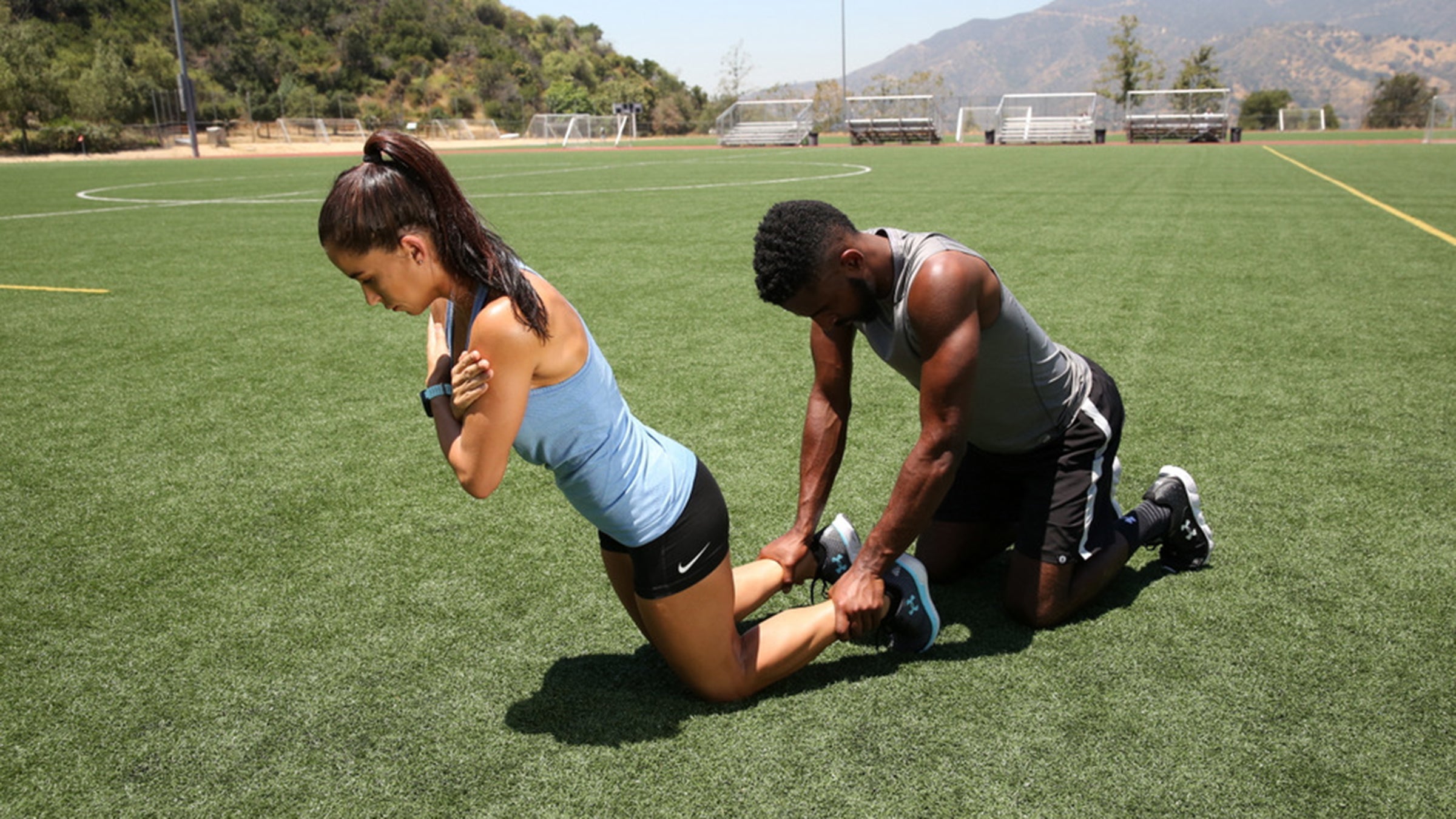
Nordic Curls
Muscle Targeted: Hamstrings (especially lower hamstrings)
Type of Contraction: Eccentric
- Kneel, with your hands in front of your chest, palms facing out (safer than the arm posture in above photo). You’ll need either a partner to pin your ankles or something to hold them in place (e.g., hook them beneath a bedframe).
- Bend forward from the knees (not the waist!), slowly lowering yourself toward the ground. Keep a straight line from your spine through your knees. If you start to fall, use your hands to stop your descent.
- Use your arms to thrust yourself back up to the start position (i.e., do not work this exercise in reverse). Start with 1 set of 2-3 reps. Build to 2 sets of 6-10 reps.

Single-Leg Deadlift
Muscle Targeted: Hamstrings (especially upper hamstrings)
ADVERTISEMENT
Type of Contraction: Eccentric
- Stand with your feet hip-width apart.
- Lift your right foot off the ground by bending your knee; your left knee should also have a slight bend.
- Bend forward from your hips, reaching your right hand toward the ground. Simultaneously lift and extend your right leg behind you. Maintain a slight bend in both knees.
- Return to your start position. Do 1 set of 5-10 reps, then switch legs. Build to 2 sets of 8-12 reps.

Hip Thrust
Muscle Targeted: Glutes, Hamstrings
Type of Contraction: Concentric
- Lie on your back, knees bent, feet flat (hip-width apart), arms extended at your sides with your hands at about waist level. Your heels should be positioned close to your glutes, with your feet angled slightly outward.
- Use your glutes to lift your pelvis, forming a straight line from your knees to your shoulders. Your knees should form a 90° angle.
- Don’t hold the position; drop back to the start. Then repeat using a steady rhythm. Start with 1 set of 5 reps, build to multiple sets of 10-15 reps.

Single-Leg Squat
Muscle Targeted: Quads, Glutes, Hamstrings
Type of Contraction: Concentric
- Begin from a standing position, feet hip-width apart, with arms straight out in front of you.
- Lift your left leg, with the thigh at 45° and the knee bent. Your right leg should be slightly bent at the knee (for balance). Lower yourself into a squat — one-quarter to one-half squat, no deeper.
- Press down on your heel as you return to your starting position. Start with a few reps. Build to two sets of as many as you can comfortably control. Make sure to work both legs.
*If single-leg squats are too difficult, do bilateral air squats.

ADVERTISEMENT
Crab Walk
Muscle Targeted: Shoulders, Triceps, Core, Glutes, Hamstrings
Type of Contraction: Concentric
- Begin in a supine position (face up), while resting on your hands and heels. Your hands should be shoulder-width apart, and your butt should clear the ground by only a few inches. Angle your fingers away from your body or find a position that reduces strain on your wrists.
- Lift your right hand and left foot and move in the direction that lies behind your head.
- Put your hand and foot down, and then move your left hand and right foot. Don’t worry if you get a little out of sync. Try 5–10 yards, then lengthen as your strength improves.
Have a question for Pete? Shoot us a note.
ADVERTISEMENT
Pete Magill is a running coach, world-class runner, and author. As a coach, Magill has led his masters clubs to 19 USATF National Masters Championships in cross country and road racing and has worked with athletes of all ages and abilities. He holds multiple American and world age-group records and is a 5-time USA Masters Cross Country Runner of the Year. Magill is author of Fast 5K, SpeedRunner, Build Your Running Body, and The Born Again Runner.
