Published June 15, 2020 09:10PM
Ask Pete: Why Do I Bonk When It Gets Hot?
Here’s how to adjust your training in the heat, and help your body adapt so it can handle more.

(Photo: Getty Images)
QUESTION
On the first hot day of the year, midway through my six-mile run I turned back, into the wind, and both my heart rate and fatigue level skyrocketed, even as I was barely sweating—then, after the run, I sweated profusely. How can I stop that from happening again? – Charles
ANSWER
The only way to avoid bonking on the first hot day of the year is to slow down, hydrate, wear cool clothes, and pick a time of day when you won’t need shades. That said, a transition period of 7–14 days will not only acclimate you to the heat, it will leave you a stronger runner.
ADVERTISEMENT
This happens every year—and in the age of climate change, sometimes multiple times per year. The weather shifts from cold to hot in the blink of an eye. Our bodies, not so much. The good news is a brief transition period of 7–14 days will prepare you for intense summer running. The bad news is your Strava posts are going to be a little underwhelming in the interim.
Understanding how heat affects your body begins with understanding how your body handles heat. When you run, your muscles produce energy. But your muscles aren’t very efficient at capturing this energy, using only 20%–25% and losing the rest as heat. The result is a rising core temperature. You can run effectively with a core temperature of about 100–102°F. Higher than that can become uncomfortable and even dangerous. So to avoid overheating, your muscles export lost heat energy by transferring it to your blood, which then carries it to your skin. Once at the skin, heat is offloaded through several ways, the two major ones being:
- Convection: If the outside air temperature is less than your body temperature, heat is diffused into the air—if the air temperature is hotter, you’ll gain heat.
- Sweating: More than two million sweat glands offload heat by secreting sweat. You lose heat energy when your sweat evaporates—sweating by itself doesn’t cool you down.
So far, so good. But what happens when the outside temperature soars? Well, on the first hot day of the year, you quickly reach a point where your body can’t offload heat quickly enough to offset your rising core temperature. During moderate effort runs, this effect kicks in at about 75°F. For more intense efforts, the outside temperature only needs to reach 65–70°F. At that point, this happens:
- Your core temperature spikes: You blast through the “prescriptive zone” (i.e., 100–102°F), and as your temperature rises, your performance declines—and you begin to flirt with heat illness. If you reach 105°F, you’re basically cooking from the inside out.
- Blood flow to your skin increases: To combat rising core temperature, more blood—hence, more heat—is shunted away from your muscles to your skin.
- Your sweat rate increases: You’ll sweat up to 2 liters per hour (sometimes more!) as your body relies more and more upon sweat evaporation for cooling.
- Your plasma volume decreases: All that sweating leads to dehydration, which leads to a decrease in plasma volume (the liquid part of your blood).
- Your stroke volume decreases: This reduction in blood volume leads to decreased stroke volume (the amount of blood your heart pumps with each beat).
- Your heart rate increases: To maintain overall cardiac output (the amount of blood your heart pumps in a minute), your heart must now pump faster to make up for the decreased stroke volume. A 2010 study recorded an extra 6 beats per minute for every 1% of body mass lost through dehydration.
- Your perceived effort increases: The above-listed physiological responses trigger a near-universal psychological one—you feel like you’re working harder than you are.
When all that occurs during a hard run on the first hot day of the year, you bonk. And don’t be misled if you seem to sweat less during the run than after you finish. That’s an illusion. During the run, air movement—a combination of your motion plus any wind—spurs faster evaporation. Once you stop running, the air movement stops (or slows), and ta-da!, you’re drenched.
So how do we avoid the misery described above? It begins with acknowledging you aren’t ready for the heat, then following these guidelines during a 1–2 week transition period:
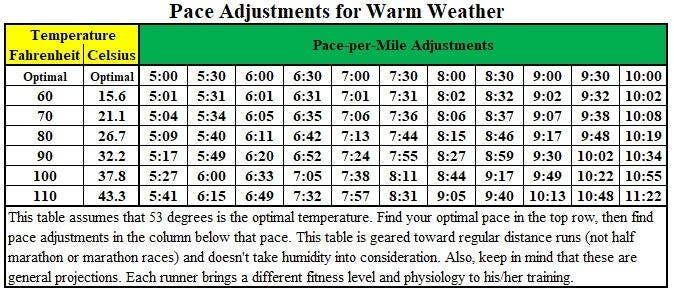
- Adjust your pace: See the “Pace Adjustments for Warm Weather” table, but keep in mind that we’re all Dr. George Sheehan’s “experiment of one”—the pace should be comfortable, even if that means running slower than the table suggests.
- Stay hydrated: Start your run hydrated and either carry water or plan drink stops along the way.
- Wear light clothing: Pick modern fabrics that allow heat to escape and avoid dark colors.
- Run early or late: “Mad dogs and Englishmen…”—run when the sun is low.
- Wear a visor or shades: Looking into the sun increases perceived effort.
- Avoid humidity: If it’s humid, sweat has a hard time evaporating—you stay hotter.
- Make your runs last 60 to 90 minutes: A 2018 review targets 60 minutes as the minimum run duration required to trigger full heat adaptation, although super-fit runners can sometimes squeak by on 30–45 minutes.
- Cool down after your run: Air conditioning and shade will help your body recover, and they won’t short-circuit your body’s adaptation to the heat.
And now for the best part. After a couple weeks of heat acclimatization, your body will undergo adaptations that make you a better runner! According to an Australian review, your blood plasma will increase by up to 12%, your heart rate will go down, your ventilation will go up, you’ll sweat more, and your energy requirements will be reduced.
With a few runs a week, your acclimatization should hold through the summer, during which you’ll be able to push yourself at will without ever re-experiencing that Day One bonk.
