Published December 13, 2023 09:00AM
Can Running to Holiday Music Improve Your Splits?
It’s the most wonderful time of the year for ‘music doping.’ Feliz Navi-dash your way to happier, faster runs with Christmas carols.

(Photo: Deagreez, Getty)
There are countless studies surrounding the impact of holiday music on our mental health, with both positive and negative effects proven. While you may enjoy bopping along to The Jackson 5’s “Santa Claus is Coming to Town” when it plays on the car radio, or always crank up the volume when Mariah Carey’s “All I Want For Christmas Is You” comes on at your holiday party, these classic carols may actually be most useful when you’re out dashing through the snow, if you know what I mean.
Indres Viskontas, a neuroscientist, professor at the University of San Francisco, and author of How Music Can Make You Better, has analyzed and compiled copious amounts of research pertaining to music and psychological impact. For example, one study had 20 male participants perform two six minute running tests, one with and one without music. Researchers measured mean running speed, blood lactate, total distance covered, heart rate, and rate of perceived exertion. The results concluded that runners who listened to their music of choice were significantly faster and had lower blood-lactate concentrations.
Viskontas says amateur athletes specifically will benefit from running to music they enjoy—emphasis on the word “enjoy”. It might be obvious to some, but benefits like improved mood, release of endorphins, and overall performance won’t be as strong if you’re listening to songs that you don’t enjoy.
All that to say, elite athletes won’t necessarily improve by listening to music.
“This is where the studies split and stop showing results,” Viskontas says. “When you’re at the far end of the spectrum of skill, it’s sort of moot. For example, a marathoner who sits at the front of the pack is probably not going to run faster if they are listening to music—they’re already going as fast as they can. For the average runner, however, there are significant benefits.”
ADVERTISEMENT
How ‘Music Doping’ Works
Music affects the brain on a chemical level. Viskontas cites a few mechanisms surrounding music and how we perceive it. The first is that music raises the arousal levels in the brain. An example of this can be seen in dementia patients who, according to their CT scans, don’t show much brain activity due to the disease. But studies show that if you play music that a patient loves, their brain “comes online,” as Viskontas describes it. This is the arousal boost to the brain, much like a sip of caffeine, jolting you into attention.
“Music is also a tool that’s often used to synchronize brain regions,” Viskontas says. “It can pull our thoughts together and make us focused.”
Erin Hannon, director of the University of Nevada Las Vegas Music Lab, (and also an active runner) says, “You may not realize this, but when you listen to music, the part of your brain that you’re using doesn’t just process sound. It’s also the part that controls movement, so you’re actually engaging the motor system of the body when you listen to music.”
Another mechanism is called the analgesic effect, or the endorphin effect. This is when music raises levels of neurochemicals, like dopamine and hormones,that play important roles motivation, especially when it comes to movement.
“Music can wake us up, synchronize our brain activity and movements, and raise neurochemicals that allow us to run faster and stronger with less pain,” Viskontas says.
ADVERTISEMENT
‘Run Rudolph Run’
Given all this research about the correlation between endurance performance and music, we wondered how Christmas carols, one of the most polarizing genres, fit into these studies. For some people, holiday tunes can have a lot of negative associations, while others experience heightened senses of happiness.
“One of the reasons Christmas music has such an emotional impact is because it comes at a time when we either celebrate with family, or are reminded of family we lost,” Viskontas says. “We only hear it during one part of the year, and that happens to be a time where we’re making a lot of memories, either happy or sad.”
She adds that, as humans, we are highly influenced by sounds in the world. It’s why, for example, we shy away from abrupt noises like a car backfiring or a thunderclap. Have you ever been startled awake by something (say, a cat knocking a vase off a table—darn you, Mittens)? That’s because hearing is one of the only senses we maintain even when we’re sleeping, because it’s so sensitive.
“We like soothing sounds that make us feel safe,” Viskontas reasons. “And if you take the top 100 most played Christmas songs on the radio and compare them to the top Billboard songs, you’d probably see more upbeat, joyful, happy sounds, which is why people might feel a certain comfort and happiness when listening to carols.”
Those who have positive feelings around the holiday season will benefit from listening to carols while running, as the brain becomes stimulated (or, aroused), hyper-focused, and releases endorphins that can not only create that “runner’s high,” but can promote short-term psychoactive effects like feelings of calm and elevated mood. Excess endorphin release has also been studied for its pain-relieving properties, which can be extremely beneficial during a run, like a natural ibuprofen.
Hannon is of the opinion that the research regarding music—jolly or not—can be divided into two schools of thought: It enhances your running performance or it alleviates pain, making you feel better overall during your workout but not necessarily producing better results.
“There isn’t actually as much research as you’d think on this,” she says. “It’s hard to get a whole bunch of people to show the same effects because there are so many factors that influence your performance on any given day.”
In any case, there’s a short window of opportunity for these benefits, if you reap them. Listening to Christmas music before the 25th can spur excitement of what’s to come, whereas hearing your favorite merry tunes in January can seem sort of…depressing.
As for Viskontas, she says she grew up singing in the choir in school, so there’s some Christmas music she can’t listen to without crying—a sort of melancholy nostalgia. But other carols, more modern tunes, bring about more positive associations.
“I listen to them while I’m trimming the tree or doing something else holiday-related,” she says. “But going for a run while listening? I’ve never tried. But, you know what? I might have to test that out.”
ADVERTISEMENT
Holiday Music That Decks My Halls
Below is a playlist of Christmas songs (with a few Hanukkah and Kwanzaa tunes, too!) that make us merry and bright while on our daily runs. Try sprinkling them into your own Spotify exercise playlist and see if they make you go ho, ho, ho or no, no, no.
Holiday Running Playlist
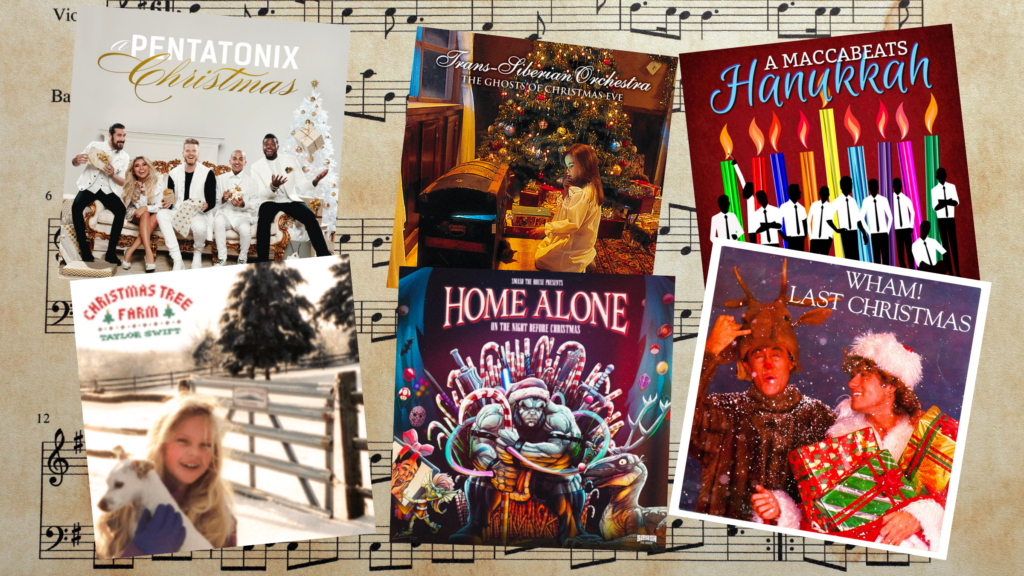
O Come, All Ye Faithful, Pentatonix
Carol of the Bells, Mykola Dmytrovych and John Williams
Christmas Eve / Sarajevo 12/24, Trans-Siberian Orchestra
Santa Tell Me, Ariana Grande
Underneath the Tree, Kelly Clarkson
Last Christmas, Wham!
Santa Claus is Coming to Town, Dimitri Vegas & Like Mike, R3HAB
Christmas Tree Farm, Taylor Swift
Little Saint Nick (1991 Remix), The Beach Boys
Light Up the Nights, Maccabeats
Oh Hanukkah, Maccabeats
Kwanzaa-Umoja-Uhuru, Sounds Of Blackness
Matunda Ya Kwanzaa, Rockapella
