Published April 4, 2026 03:30AM
If you buy through our links, we may earn an affiliate commission. This supports our mission to get more people active and outside.Learn about Outside Online's affiliate link policy
Originally posted onRUN | Powered by Outside
Dark Sky Running Is a Growing Movement to See the Stars
More runners are trading headlamps for the natural glow of the stars, turning a run into a meditative journey through the galaxy. Here are the best dark sky trails to hit after the sun goes down.
(Photo: Getty)
In early December I flew to Palm Springs, California, to rendezvous with Rickey and Ian, my co-authors“Fifty Classic Trails”, for our book’s capstone run, the Joshua Tree Traverse. This 37-mile point-to-point crosses the entire national park, winding its way through the Mojave Desert past spiny cholla cactus, Creosote bush scrub, and, of course, iconic Joshua trees.
To make the run a celestial celebration instead of a sunny sufferfest, we decided to run at night, under a full moon. Although I packed a headlamp and spare batteries, I ended up never turning it on. With no clouds between us and the star-filled ether, the sandy trail was crystal clear. This allowed us to jog the entire trail at a comfortable pace, the perfect way to wrap up a 2,000-mile, three-year process.
That sparked a new curiosity in me: Is nighttime running a thing? Like, outside of compulsory night running in races like UTMB, do lots of people do it? If so, where and how and what rock was I living under?
These questions led me down a rabbit hole which eventually became the story in front of you. Sure enough, nighttime runs—sometimes called dark sky runs—are a specialized form of adventure running that prioritize celestial visibility and the preservation of the nocturnal environment. The best places to do so are International Dark Sky Parks, where “Bortle 1” skies, the darkest on earth, provide enough clarity for the Milky Way to cast a shadow.
To run a dark sky trail without disrupting the darkness, runners use red-light mode on their headlamps or run, like we did, without artificial light at all, preserving our night vision and protecting the circadian rhythm of wildlife. Just before our halfway point at Ryan Mountain, we spotted an owl perched high in a tree and watched it dive to snag a small varmint—one of the coolest wildlife sightings of the book.
ADVERTISEMENT
Preparing for a dark sky run requires a shift in both gear and strategy. The goal is a sensory-rich experience where the sound of the wind and the glow of the cosmos replace the distractions of the daytime, turning a run into a meditative journey through the galaxy. Here’s how to get started.
Where to Dark Sky Run
Finding the perfect dark sky run requires two things: avoiding city glow and sticking to trails that allow safe celestial movement. The easiest places are where humidity is close to zero and there is little to no forest canopy, namely the high desert of the Southwest. Nevada’s Great Basin National Park, Big Bend in Texas, and the Amphitheater of Bryce Canyon in Utah are all prime. Further west, the salt flats in California’s Death Valley act as a giant reflector for the stars, while the Seuss-ian silhouettes of Joshua Tree are fun at night, too.
ADVERTISEMENT
On the East Coast, where light pollution is more common and humidity more abundant, you have to get creative. The 100-Mile Wilderness in Maine is the rare International Dark Sky Park where the boreal forest lets in enough moonlight to see the trail. If you’re looking for a coastal vibe, Cape Lookout National Seashore in North Carolina offers miles of undeveloped beach running where, on a calm night, stars reflect off the Atlantic.
The Midwest has dark sky spots as well, like Newport State Park at the tip of Wisconsin’s Door Peninsula and Keweenaw Dark Sky Park in the Upper Peninsula of Michigan. Here, the Great Lakes act as a darkness buffer to nearby metro areas. The Boundary Waters in Minnesota is one of the darkest places in the country, with ample trails to explore, even if most of them are rocky and quite remote.
If you’re looking to push further into the void, head for the Gila National Forest in New Mexico, which is home to the Cosmic Campground, an International Dark Sky Sanctuary. For a lunar experience, look toward the black basalt lava flows of Craters of the Moon in Idaho, which suck up the light. If you prefer darkness with a side of swamp, Big Cypress National Preserve has the Florida National Scenic Trail and is just far enough from Miami to be a Dark Sky Park as well.
When and How to Night Run
Timing is everything when you’re trading the screen glow of a Netflix binge for the cosmos glow of a dark sky run. For the best experience, plan your running trip around the new moon or the full moon, aiming for a day or two buffer on either side. The new noon offers the best views of the Milky Way, but requires a good headlamp, especially with a forest canopy above you. The full moon washes out some subtle textures of the cosmos, but allows you to sometimes run sans-headlamp, a surreal experience.
ADVERTISEMENT
Seasonality matters too, with the crisp, dry air of winter offering the best atmospheric transparency, but also colder weather that you need to be prepared for. Temperatures in dark-sky havens like the high desert can swing 40 degrees in just minutes, so bringing extra layers is essential. Depth perception always takes a hit at night, so don’t worry about pace on dark sky runs and use the red-light setting on your headlamp when possible, to preserve your night vision and to not disrupt the nocturnal wildlife.
Safety in the night requires a shift in mindset—this isn’t the time to send it on a technical descent. Since you’ll likely be in remote areas without cell service, make sure to download offline maps beforehand and carry a satellite messenger for worst case scenarios. Ideally, you’ll arrive early enough to scout some of the trail in the daylight, to see if it has much loose scree, roots, rocks, or technical sections.
What to Bring On a Night Run
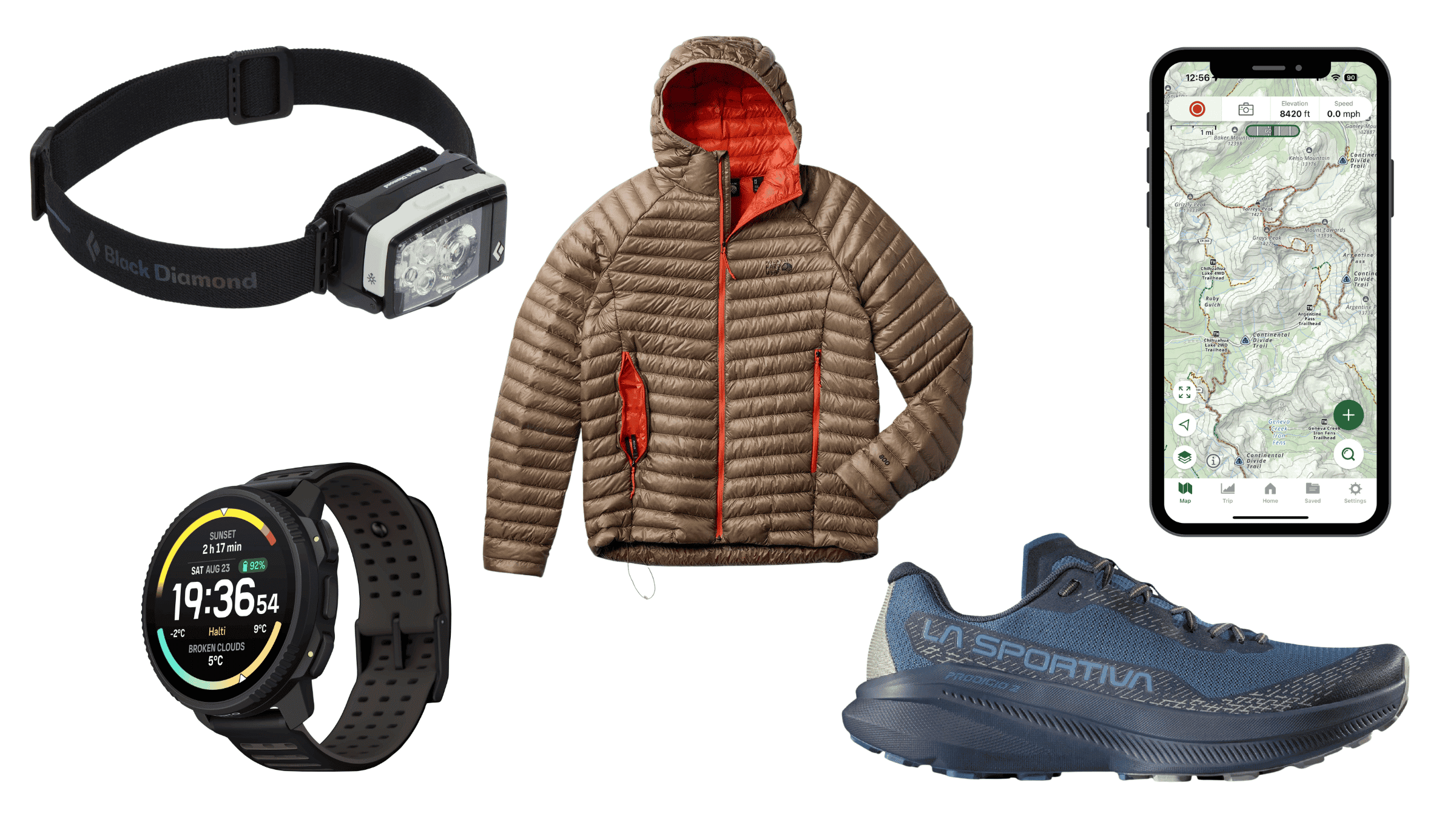
When the sun drops in a Dark Sky Park, the margin for error shrinks and your standard daytime kit isn’t going to cut it. Here are the essentials to keep you moving with the moon and stars as your lights.
Distance LT 1100 Headlamp
Even though the Distance LT is larger than most running headlamps, I’ve found it to be bounce-free if I tighten it well. The light angle is quick and easy to pivot on the go, and the battery is fast to recharge, too. While in use it automatically dims after 10 seconds to conserve the battery life, which lasts around 4 hours on the max setting.
ADVERTISEMENT
Mountain Hardwear Ghost Whisperer
Even in the summer, the high desert, alpine, and upper Midwest all get cold once the sun sets. The Ghost Whisperer is the gold standard of light, packable jackets that will keep you warm even when sweaty. It compresses to the size of my fist and easily fits in a standard running pack, which leaves almost no excuse not to bring it.
Suunto Vertical 2 GPS Watch
While dark sky runs are never a race, it’s nice to keep track of your progress on longer adventures, to make sure you’re fueling properly and not going to miss your pickup. With a bright screen, a built-in LED flashlight that’s a great backup light, and high detail offline maps, the Vertical 2 is the ideal running watch for nighttime adventures on two feet.
ADVERTISEMENT
La Sportiva Prodigio 2
The update to the popular Prodigio makes it one of the most versatile trail trainers on the market and great for night runs. The latest version is lightweight, durable, and most importantly, stable on technical terrain. This gives me a lot more confidence and sure-footedness, a nice security blanket when the trails get more challenging at night.
Gaia GPS Subscription
Starlight can make even familiar trails look like a different planet, so it’s nice to have high-res maps as a backup. To ensure I know the right way at each junction, I download all my maps on Gaia before I head out. Also, on long runs carry a small external battery, because cold temps and constant GPS tracking drain electronics a lot faster than a morning jog.
ADVERTISEMENT
(Editor’s Note: Like Outside Run, Gaia GPS is part of the Outside network, but we did not ask Andy to write that. You can also subscribe to Gaia GPS Premium and Outside Run together with an Outside Plus membership.)


