Published June 1, 2023 12:26PM
Prioritizing the Humble Clam
The effort to reseed mollusks along Maine’s shorelines
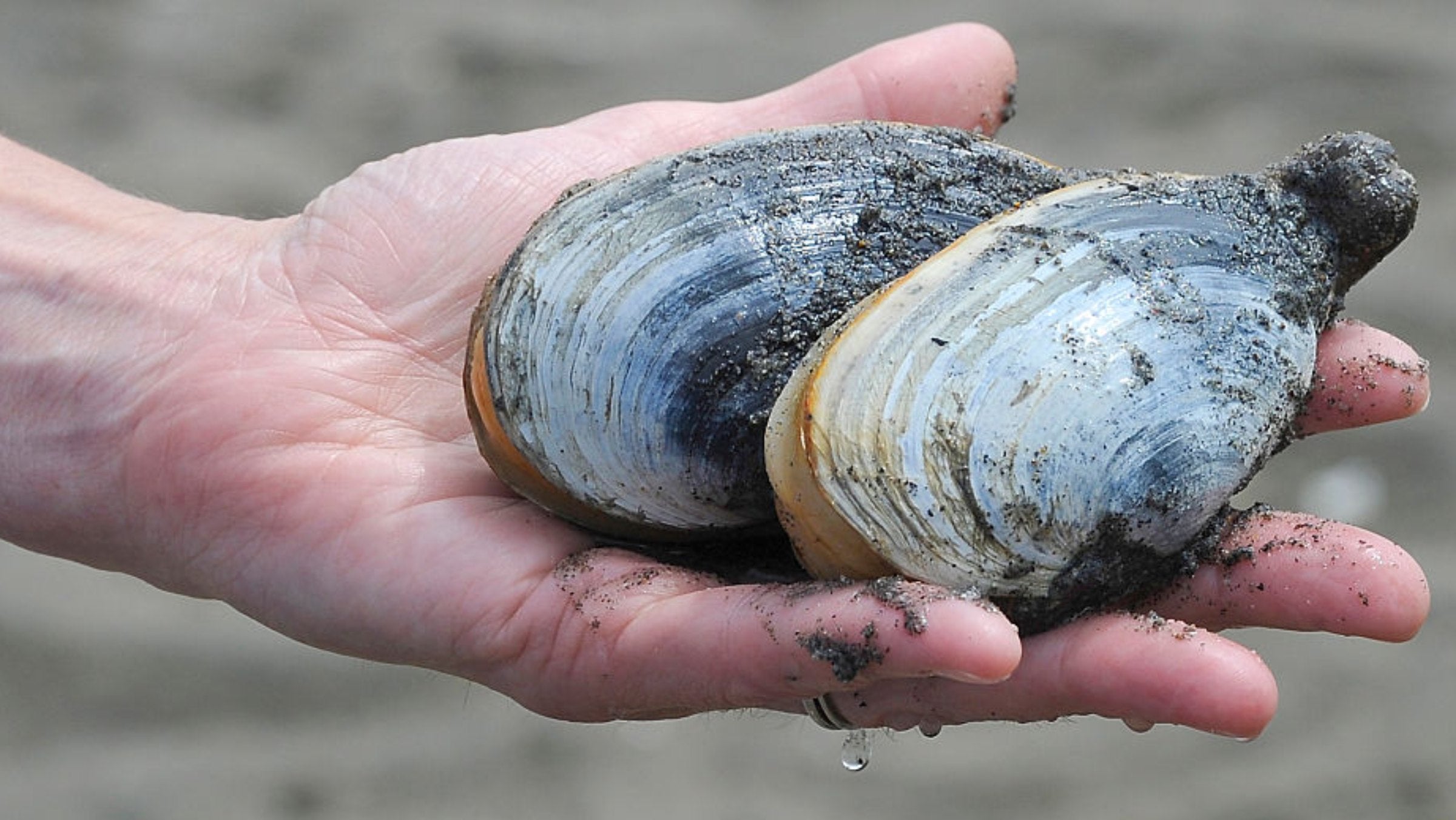
A couple of large clams are show by a clammer to Jon Hentz, the local Shellfish Warden, who was giving a class to nearly 50 novice clammers at Reid State Park. (Photo: Gordon Chibroski, Getty)
Justin and Danielle Walker, owners and operators of Walkers Maine, a seafood restaurant in Cape Neddick, Maine, know clams. Several months ago, as part of the Ogunquit Soft Shell Clam Commission’s clam flat re-seeding program (which has taken place every year since 2008 under the supervision of Shellfish Warden Everett Leach and other local wardens) Danielle arranged for some of her guests to go clamming on Ogunquit Beach.
“We went down and brought a group of our guests—about 30 of them—to the last day of clamming,” Walker says. “We showed them how to harvest clams, how to find them, how to clean them, work with the product, and then, later in the evening they came back at 5 o’clock to the restaurant to have dinner.”
The day was a success, and Danielle soon received a call from Everett Leach, the Shellfish Warden for the towns of Wells and Ogunquit, asking her if she would drum up some volunteers to help reseed the clam flats, part of an existing program that typically takes place in early spring.
The Whys and Hows of Reseeding Clams
Reseeding clams means just what it sounds like: these fingernail-sized mollusks are buried in mud in order to create pressure so the clams grow thicker, stronger shells.
The process begins with volunteers digging numerous shallow trenches in the sand, where a net can be installed. Baby clams, also known as seed clams, are placed directly into muddy sand and then covered with the net. Reseeding plots are often denoted by buoys or flags, which can help clam farmers and marine biologists chart how many clams have dug into the sand, and how many have survived through the year. Clams naturally find a soft, muddy plot and attach to it for years at a time; netting simply helps these bivalves have a longer lifespan in a world filled with predators, tidal variation, and other natural variables.
ADVERTISEMENT
A Community Passionate About Clams
Drawing attention to the reseed through social media, Danielle got about a dozen people to congregate in April. “The request was: Bring your garden weasel and bring your strength, we are going to rough up areas,” she explains. The Downeast Institute, based in Machias—about four hours north—provided close to 50,000 clam babies for seeding, and the conservation committee flew a drone overhead to take photographs, recording how many clams had been seeded. Next year, conservation will return to these same spots to gauge the success of the program, and to make a plan of action for next year’s seeding.
Ultimately, Danielle, who hopes to be part of the future of reseeding at Ogunquit Beach, sees clam re-seeding as part of preemptive ecological work that can help to tackle a problem before it becomes endemic. “It’s ahead of being endangered,” she says. “It’s inspiration to do something before you can’t have it. It’s the Maine shrimp. That’s my analogy. It was here. It was cheap. And then it was gone. There was no in between. It’s something that everyone misses.”
