Published March 8, 2020 12:00AM
If you buy through our links, we may earn an affiliate commission. This supports our mission to get more people active and outside.Learn about Outside Online's affiliate link policy
What We Can Learn from Studying Older Marathoners
New lab data from a record-setting 59-year-old offers insights on how we age—and, potentially, how to avoid it
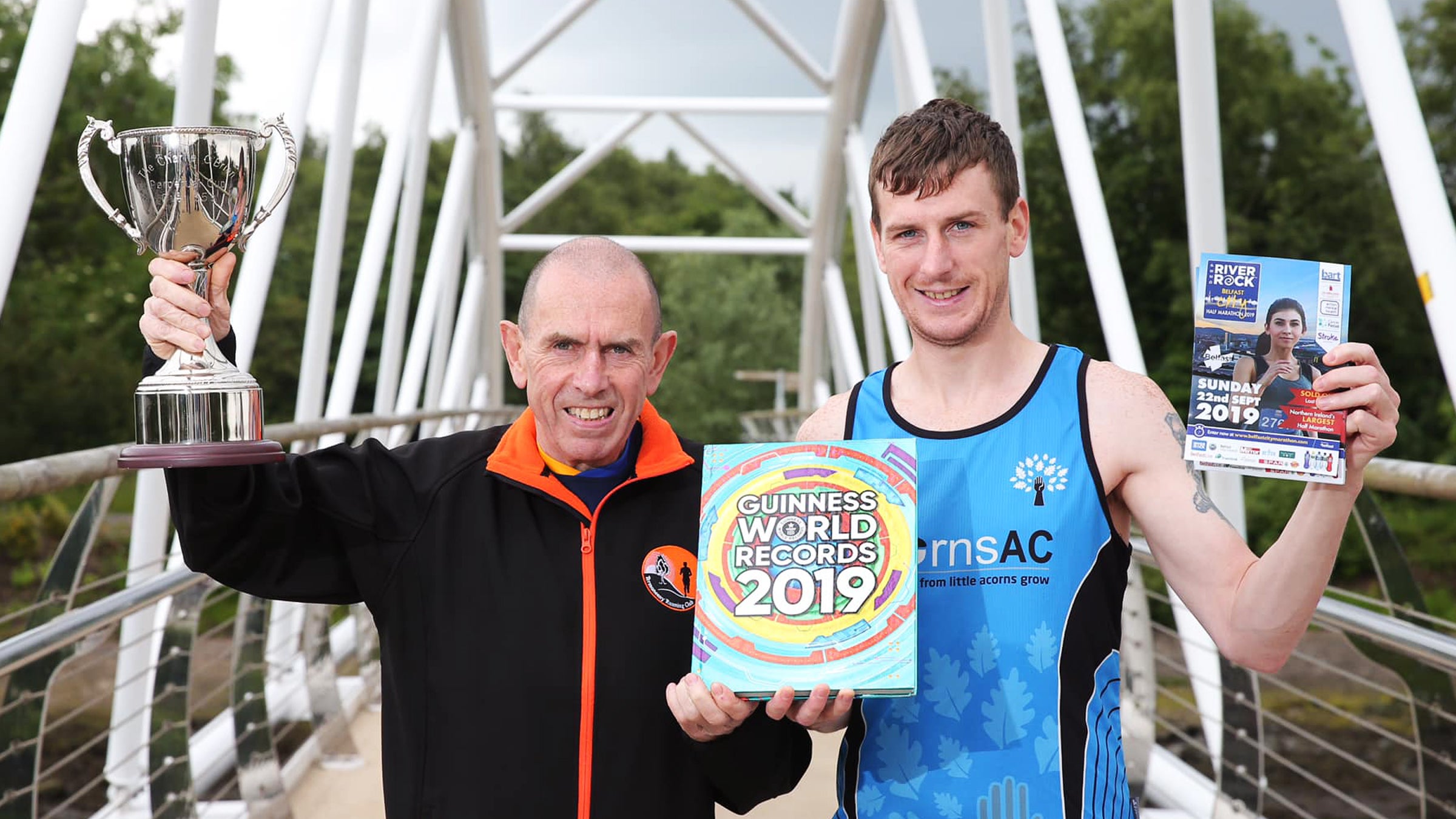
Tommy and Eoin completed the 7th Deep RiverRock Belfast City Half Marathon on Sunday 22nd September 2019, just missing out on a world record.
At the Frankfurt Marathon last October, a 59-year-old Irishman named Tommy Hughes threw down a stunning 2:27:52. The time was a single-age world record—and when Hughes’s 34-year-old son Eoin crossed the line a few minutes later, in 2:31:30, their combined time of 4:59:22 earned them a spot in the Guinness World Records book for fastest father-son duo.
Their performances also got them into the Journal of Applied Physiology, which last month published the results of a series of physiological tests on them by a research team led by Romuald Lepers of the University of Bourgogne Franche-Comté in France, working with colleagues at the University of Toulon and Liverpool John Moores University in Britain. The data yields some insights into what makes the elder Hughes unique, and perhaps offers a note of optimism for the rest of us.
The Lab Data
The classic physiological model of marathon performance involves three parameters: VO2 max, which is basically the size of your engine; running economy, which is the efficiency of your engine; and lactate threshold, which determines what fraction of your VO2 max you can sustain over the course of 26.2 miles.
The two Hugheses are remarkably similar in VO2 max: Tommy recorded a 65.4 ml/kg/min, while Eoin came in at 66.9. Tommy’s is the more remarkable result: a typical value for a sedentary 59-year-old would be somewhere around 30. They also both have very good but not out-of-this-world running economy at marathon pace: Tommy’s was 209.6 ml/kg/km and Eoin’s 199.6. In this case, a lower number is better, meaning you’re burning less energy to maintain a given pace. Those values are typical for good marathon runners, though some top East African runners have values as low as 185.
The most interesting detail is the sustainable fraction of VO2 max. Tommy’s average marathon pace required him to be working at 91 percent of his VO2 max, while Eoin was at 85 percent. Back in 1991, when Mayo Clinic physiologist Michael Joyner was trying to calculate the theoretical limits of marathon performance, he estimated that marathon pace is typically between 75 and 85 percent of VO2 max, though he noted anecdotal reports of elite runners who were able to sustain 90 percent for a marathon.
As it happens, that very point was the subject of debate recently when researchers at the University of Delaware tested another record-setting marathoner, Gene Dykes, who ran 2:54:23 at age 70 in late 2018. Dykes’s VO2 max of 46.9 ml/kg/min suggested that he had run his entire marathon at about 95 percent of VO2 max, a seemingly preposterous conclusion that elicited a disbelieving letter to the editor in the New England Journal of Medicine.
With Hughes now also registering a value of greater than 90 percent, it may be worth considering whether one of the superpowers that distinguishes great masters marathoners is the ability to run entire marathons very close to their VO2 max. Alternatively, Lepers points out, we may simply be underestimating the true VO2 max of older runners because they have trouble reaching their absolute limits in treadmill tests to exhaustion. In support of that idea, Tommy’s lactate levels when he stepped off the treadmill at the end of the VO2 max test only reached 5.7 mmol/L, while Eoin got up to 11.5 mmol/L. Since lactate is a marker of distress from high-intensity exercise, that suggests there may be some factor—certainly not mental toughness, given his race results—that forces Tommy off the treadmill earlier than his son.
ADVERTISEMENT
