Published May 22, 2014 12:00AM
The Gadgets You Need for Your Next Run
New running tech to help you score a personal best—or just make your jog more fun.
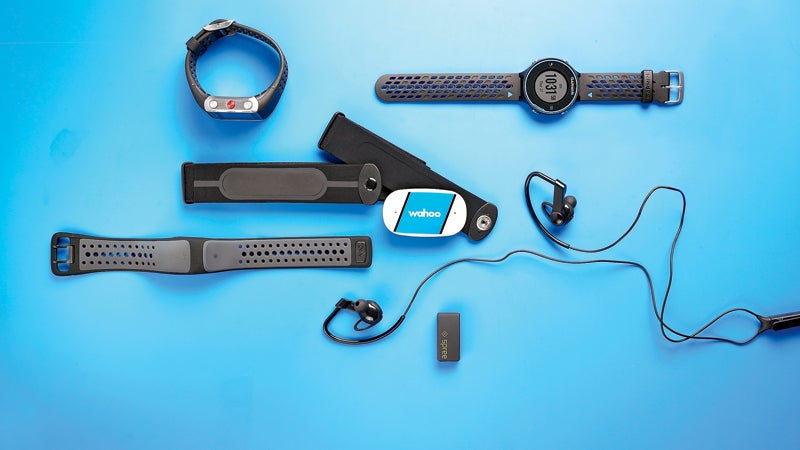
Your run just got wired. Clockwise from top left: Polar V800 watch, Garmin 620 watch, LG HRM headphones, Spree headband, Mio Link heart-rate band, and Wahoo Fitness Tickr Run chest strap. (Photo: Inga Hendrickson)
Garmin 620 watch
Plenty of watches track pace and distance. The 620 ($400) also does advanced analytics such as cadence, ground-contact time, and VO2 max. All the data is sifted to give you recovery estimates and race-time predictions on the easy-to-read screen.
LG HRM headphones
By measuring blood-flow signals from the auricle of the ear, LG’s HRM headphones not only track your heart rate but also estimate your VO2 max, and all the data is sent via Bluetooth to your iPhone or Android device. The audio is good, too. Available this spring.
Spree headband
The Spree ($300) measures your body temperature: that means it can alert you when you’re fully warmed up and, more important, tell you when you’re overheating. The headband also tracks heart rate and calories burned and records your route via GPS and an Android or iOS app.
ADVERTISEMENT
Mio Link heart-rate band
The streamlined Link wristband ($100), with a heart-rate monitor built right in, pairs via Bluetooth or ANT+ to beam workout data to a range of fitness apps and devices. You can also set a heart-rate zone to dial in your training efficiency.
Polar V800 watch
The V800 ($400) features lap counting, speed and distance tracking via integrated GPS, and a waterproof heart-rate monitor. But it also functions as an activity tracker even when you’re not training, so you know how well you’re recovering.
Wahoo Fitness Tickr Run chest strap
There are plenty of chest straps that track your heart rate. But only the Tickr ($80) has a built-in accelerometer that, when paired with an iOS app, can monitor the bounce in your stride and coach you to a smoother, more efficient run.
