Published December 12, 2023 11:42AM
Why Running Brands Are Signing College Athletes Who Can’t Race in Their Gear
Growing numbers of NCAA athletes are inking NIL deals. For some companies, it’s a marketing “lightbulb moment.”
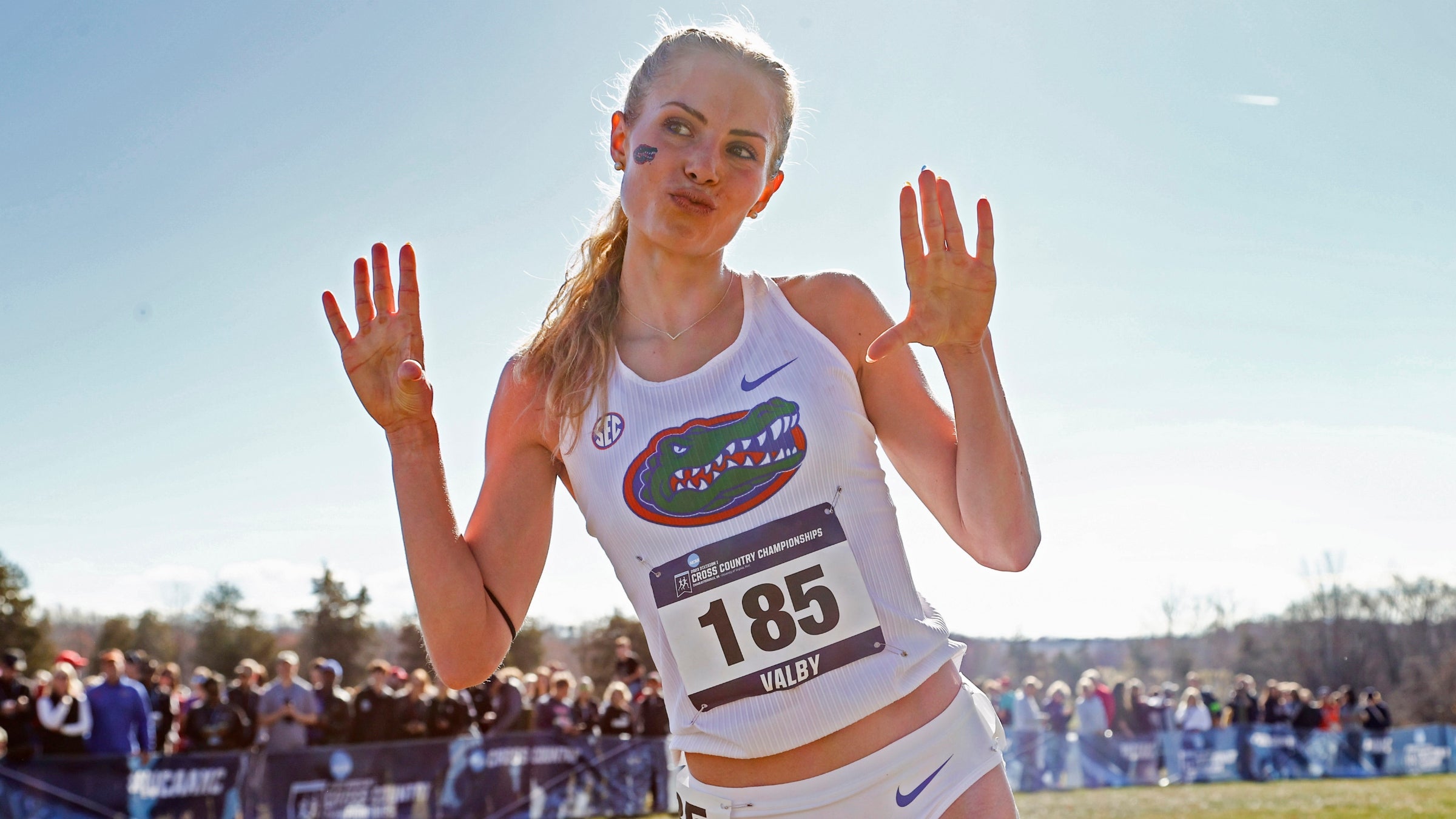
The University of Florida’s Parker Valby, the women’s NCAA cross-country champ, signed an NIL deal with Nike earlier this year. (Photo: amie Schwaberow/NCAA Photos via Getty Images)
It’s been a long time coming, but with an estimated 17 percent of all NCAA Division I athletes signing promotional deals to profit off their “name, image, and likeness” (NIL) in 2022, the era of stringently enforced amateurism in college sports seems to finally be over. To be fair, with a few notable exceptions, the splashiest NIL deals are going to football and basketball players, who have been anointed by the lords of high capitalism to sell us everything Tampax to Dr. Pepper. But athletes from some of the NCAA’s non-revenue sports have gotten in on the action as well. In November 2022, just days after winning the individual title at the NCAA cross country championships, North Carolina State’s Katelyn Tuohy announced that she signed an NIL partnership with Adidas. (Touhy recently signed a professional contract with the brand.) Earlier this year, the University of Florida’s Parker Valby, who succeeded Touhy as the women’s NCAA cross-country champ last month, signed an NIL deal with Nike. In addition to their athletic prowess and social media clout, both women seemed like logical choices for their respective brands: since North Carolina State has an apparel contract with Adidas, and Florida is sponsored by Nike, Tuohy and Valby are in a position to simultaneously represent their school and their individual sponsor. They can do this without running afoul of the NCAA’s NIL regulations, which prohibit student athletes from promoting their sponsor while “on call,” i.e. in competitions, practices, or press conferences.
But not all NIL arrangements feature such a convenient overlap. Two weeks ago, Leo and Lex Young, twin brothers and alumni of Newbury Park’s storied high school cross-country program who are now freshman runners at Stanford University, announced their NIL partnership with On. As Stanford athletes, the Youngs are required to race and train in Nike gear, which means that they will effectively be promoting a rival brand every time they compete in an NCAA race. Roisin Willis, who won the NCAA indoor title in the 800-meters as a freshman and who also competes for Stanford, recently signed an NIL deal with New Balance. Earlier this year, Shawnti Jackson, the 18-year-old phenom from North Carolina who has broken several national high school sprint records, signed a deal with Brooks while also committing to the University of Arkansas, another Nike school. Meanwhile, the apparel company Tracksmith just unveiled its “Varsity Club Project”—an NIL-style sponsorship of ten college runners—despite the fact that the brand doesn’t currently outfit any university running teams.
This issue has, of course, long affected the professional side of the sport; the only time track and field gets mainstream exposure is during the Olympics and World Championships, where all athletes who represent Team USA have to wear the official Nike-sponsored kit. But, for the pros, footwear is exempt from the uniform rule. When Brooks athlete Josh Kerr pulled off an improbable upset over Jakob Ingebrigtsen to win the 1,500-meters at this year’s World Champs in Budapest, he did it in Brooks spikes. For college athletes, on the other hand, it’s the norm for team apparel agreements to include shoes as well. If Shawnti Jackson breaks any collegiate records for Arkansas, she’ll have Nikes on her feet. Why, one might ask, would a running brand want to sponsor an athlete who can’t promote their product in moments of maximum visibility?
The obvious answer is that old standards of visibility no longer apply in the age of Instagram and TikTok. It’s no secret that an athlete’s social media presence is the principal currency of the NIL marketplace. When it comes to brand exposure, a number of companies may simply have made the calculation that far more people will see an athlete’s Instagram post than will tune to the live feed of an NCAA track and cross-country meet. As a business decision, this may just be another example of companies shifting more of their resources towards running influencers, rather than professional athletes. But it would be absurd to suggest that Jackson’s rewriting of the high school record books wasn’t a major reason why Brooks offered her a sponsorship. A big difference between the All-American and, say, the fashionista with 100K followers, is that the All-American’s authority as a brand ambassador is still at least partially based on her athletic performance. Which makes it all the more surprising that a running brand would want to sign her when those performances can’t come while wearing their product. What other incentive could a shoe sponsor have to sign an NIL athlete who is obligated to race in a rival brand?
“The number one thing is cost,” says Dave Meluni, an associate teaching professor in sport management at Syracuse University’s Falk College. As Meluni points out, NIL deals allow brands to establish relationships with athletes without the financial commitment of signing them to a professional contract. What’s more, even when a university is sponsored by a rival, its athletic program might be vaunted enough that companies want to be associated with its aura—even if indirectly. “Duke. Stanford. Oregon. Those are major brands in their own right,” Meluni says. “Some of the athletes we’re talking about may not be able to be in Stanford or Oregon gear when they promote their sponsors on social media, but their profile can certainly mention that they compete for these schools.” NIL deals, in other words, might be the only way for upstart brands to access the previously hyper-insulated world of college sports. When I reached out to On to inquire about their signing of the Young brothers, a company representative sent the following reply, via email: “Currently On has minimal exposure to the collegiate demographic. At this time we don’t sponsor any universities and only have one event where collegiate athletes compete (Penn Relays). NIL deals have opened up the potential to form strong relationships with these athletes and really include them as part of the family.”
I heard something similar when I spoke with Garrett Heath, a former pro runner for Brooks who is now the company’s head of sports marketing. “The college system is becoming more elite and for us it’s important to be connected to this group of athletes in that part of their running lifecycle,” Heath told me. At the same time, he emphasized that the constraints of the NIL system were also encouraging companies to reimagine ways that athletes can be valuable to a brand outside of competition. For instance: NIL deals are famously not allowed to include bonuses (or reductions) for athletic performances—a standard feature of pro contracts. If the NIL model proves to be an effective marketing tool for running shoe brands, despite the lack of performance-related incentives, it might encourage more companies to reassess the value of these incentives in the first place. “I think it is a pretty dynamic time in the sports marketing world for running and forcing a bit of a lightbulb moment for a lot of brands,” says Heath.
But the NIL landscape is in flux as well, to put it mildly. As Meluni reminded me, the NCAA is currently staring down a potential multi-billion dollar class action lawsuit from current and former college athletes who are suing the organization for depriving them of making money off their fame. (Meanwhile, a separate lawsuit was just brought against the NCAA and the Power Five conferences, which claims that it’s a violation of antitrust law to prohibit schools from directly paying athletes.) Nobody knows how all of this is going to play out, but one of the things the plaintiffs are fighting for is to “strike down all current prohibitions on NIL,” to quote one attorney. If this happens, we’ll likely see far more opportunities for NIL athletes to promote their sponsors while “on call.” This, in turn, might incentivize individual universities to renegotiate terms with their apparel sponsors, especially when it comes to footwear. Colleges might eventually have to choose between a lucrative apparel sponsor contract that mandates that all athletes wear their shoes, and potentially missing out on star recruits who would prefer to attend an institution without such constraints.
Who knows. By the time they graduate, Lex and Leo Young might be able to race for Stanford wearing On’s spikes after all. That’s what you call a good return on investment.
12/12/2023 An earlier version of this story misspelled Shawnti Jackson's first name. Outside regrets the error.
Add Outside as a preferred source on GoogleAdd