Published January 28, 2021 07:00PM
How to Create an At-Home Gym
Do these 13 exercises right in your living room or yard to build strength and improve your running form at home.
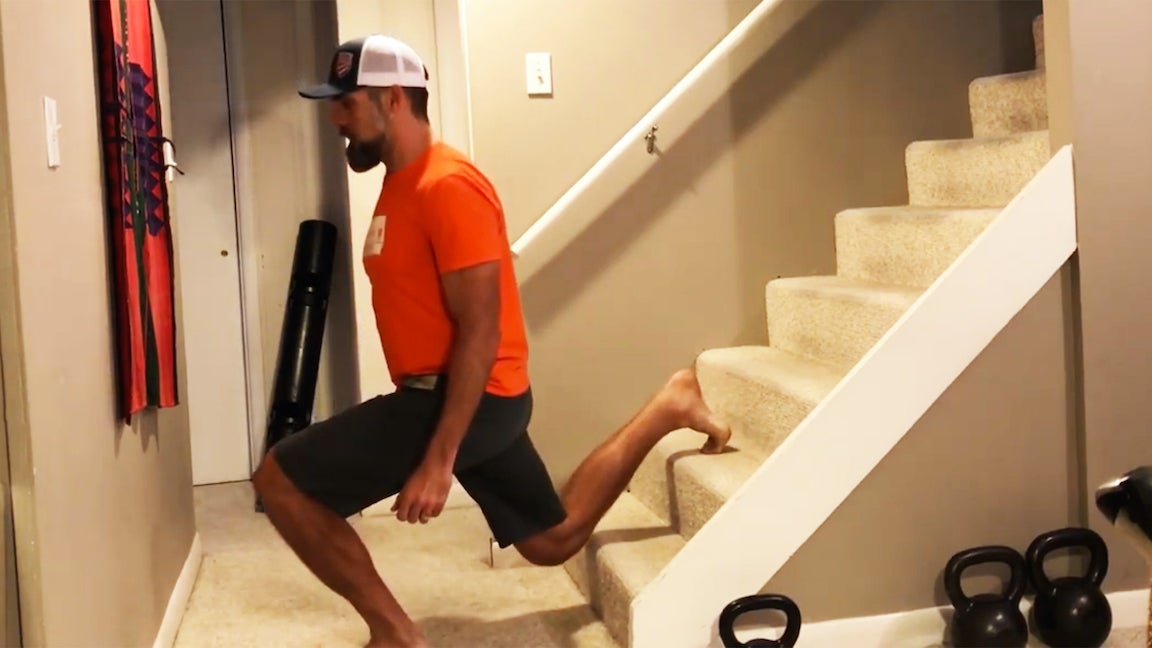
(Photo: Kyle Norman)
If you’re reading this, you probably already know that strength training enhances running performance. You also know by now that most gyms in the country are closed due to COVID-19. In the midst of this bizarre and scary situation, running affords you the opportunity to stay fit while maintaining a sense of normalcy. Despite the obvious inconveniences, the constraints of self-quarantines present some opportunities to get stronger. Here are some strength training exercises you can do right at home.
At-Home Gym Rules
Whether you’re at the gym or in your living room, here are four rules you should always abide by.
1) Always use good technique and control your movement. Don’t let the movement or the weight control you. You will likely lose control with the single-leg exercises, either at the top and/or bottom of the movement. Keep your abs tight and your foot engaged with the ground. Also, keep your range of motion (ROM) short to begin with and your controllable ROM will expand.
2) Never push into pain. If something hurts then shorten the ROM. Move only through the pain-free ROM. You can still get stronger this way. Otherwise, forego the exercise. Now isn’t the best time to be in need of a physical therapist or doctor.
3) While respecting rules one and two, work to exertion. You must work to the point of fatigue—but not utter failure—to get stronger.
4) You have many exercises from which to choose, and you don’t need to do them all every day. Your strategy might be to do 2–4 exercises one day, take 1–2 days off, then do 2–4 others. Continue that alternation pattern until you return back to your original workout. Progress by adding reps and/or weight.
ADVERTISEMENT
13 Exercises
Bridges
Two-leg bridges are easier than one-leg bridges. Each video shows both versions. All of them involve lying face-up with your knees bent. Engage your abs, drive your heels into the ground and push your hips to the ceiling. Contract your glutes at the top. If you feel anything like discomfort in your low-back then you’re not engaging your abs and/or squeezing your glutes. Elevate either your legs or trunk to increase both ROM and the difficulty of the exercise. Repeat until fatigued.
Squat
A full-range squat is good for your mobility, even if you do it without weight. Stand with your feet shoulder width apart, toes pointed out 15-20 degrees. Inhale, brace your abs and hold your breath. Sit down and back as low as you can, ideally with your hips dropping below the height of your knees. Don’t let your knees move forward of your toes. Reverse the motion, and drive up. Exhale, squeeze your quads and glutes, and pull your hips under your ribcage. Repeat to fatigue. You can add weight by loading a backpack, or by holding a suitcase, large stone, log, bucket of sand/water, bag of mulch, etc.
ADVERTISEMENT
Lunge & reach matrix
For this series, you’ll lunge forward, laterally in a couple of different ways, and in rotation. You’ll also be reaching up, down, left/right rotationally, and left/right overhead. This is a comprehensive set of lunges that will enhance any athlete’s movement skill.
Single-leg squat
Every runner should do some sort of single-leg squat. To do this, stand on one leg, inhale, and brace your abs. Squat by bending your knee and hip. Sit down and back while bringing your chest down and forward. You won’t be able to go as deep as a regular squat. Return to standing with your stance leg fully locked, contracting your glutes and quads. Repeat to fatigue.
There are several ways to decrease or adjust the difficulty of this exercise:
- Add stability if you need to by holding lightly to a solid object such as furniture, a rail, or a wall. Use only the amount of help you need and no more. Your sense of balance should be challenged.
- Hold a weighted object or wear a loaded backpack for more challenge.
- Tweak the single-leg squat by moving your non-working leg in various directions and/or driving your arms in various directions. This creates various demands on your balance and puts differing forces on your limbs, joints, and muscles.
- Adjust the pace of the squat. Go faster or slower.
ADVERTISEMENT
Pistol squat
This is a type of single-leg squat using a box or low table to sit down on. This allows you to adjust your range of motion so that it is both a doable and challenging exercise. The height of the box determines the difficulty of the squat, so a surface height that’s just at the edge of your controllable range. Use precise control to sit, not fall, to the bottom. If you can do a butt-to-heel pistol without a box, then give yourself a blue ribbon! (Be sure to post it to social media or it won’t exist.) Repeat until fatigued.
Rear-foot elevated squat
Put one foot up behind you. Your front leg is the working leg. Brace your abs. Descend by bending your front knee and hip then drive back up, contracting your glute and quad. Do this to exertion.
Here are some variations:
- Keep your trunk upright to emphasize the quad of your working leg and to get a stretch in your rear hip flexor and quad.
- Bend forward at your hip to emphasize the glute of your working leg. Both versions are shown in the video. Refer to points 1-4 under “single-leg squat” to adjust the difficulty.
ADVERTISEMENT
Single-leg Romanian Deadlift (RDL)
This is similar to a single-leg squat, but with almost no knee bend. Stand on one leg and brace your abs. Tip your chest forward while pushing your hips back. (Think of pushing a door shut with your butt.) You should feel a stretch in your hamstring and maybe calf. Return to standing with your stance leg fully locked while contracting your glutes and quads. Repeat until fatigued. Again, refer to the four points above to adjust the difficulty.
Hip airplane
This is similar to the Single-leg RDL and it’s great for your glutes and lower-leg. Stand on one leg and tip forward as in the RDL. Stay in that position while you rotate your hips toward the stance leg, feeling a stretch in that glute. Then reverse the motion and rotate your hips away from the stance leg. Repeat until fatigued.
ADVERTISEMENT
Heel raise
You may do this on either two legs or one leg to make it harder. In either case, hold on to something for balance. Stand on a step or lean forward to ensure a full range of motion. Push up onto your toes, lifting your heel(s) while contracting your calf muscles. Descend in control to the ground feeling a slight stretch in your calf. Keep your body tight. The only movement should occur at the ankles. Do this with both straight and bent knees. Either version is effective.
Push-ups
Why do a plank when you can do a pushup? Even though you don’t use much arm strength to run, a true athlete should possess at least a little upper body strength, and the ability to properly execute a push-up will help with your running form. Here’s how:
- Put your pelvis in a posterior tilt and contract your glutes. Think of your pelvis as a bowl of water. Pour the water out the back. You can also visually think of a posterior tilt as pulling your tailbone underneath you, or pulling your belt buckle up to your chin.
- Pull your ribs down and brace your abs. Both the pelvic tilt and braced abs should create a flat low back.
- Retract your head. Think of making a double chin.
- Lower your chest to the ground, or whatever surface your hands are on.
- Push all the way up at the top so that your shoulder blades move forward and you feel a stretch in your upper back.
Look here for more push-up variations.
ADVERTISEMENT
Pull-ups
Reach overhead and grab the bar or whatever surface is available. Start from a full hang. Shrug your shoulders down into your back and pull your chest up to the bar. Descend in a controlled manner and repeat. (Pull-ups are challenging and not everyone can do them, so if you struggle try a “shrug-down” instead.)
If you have no overhead surface to grip then try a table-pull-up. Use a sturdy, well-balanced four-leg table if you have one. Get under the table and grip the tabletop with either an overhand or underhand grip. Tighten your body into a plank and pull your body up toward your hands. Descend while remaining in control. Repeat to exertion. Experiment with straight or bent legs to make the exercise more or less challenging.
ADVERTISEMENT
Dips
Put your hands behind you on a couch, stool, coffee table, or similar surface with your legs out in front of you. Lower yourself to where you feel a stretch and keep your body close to the surface behind you. Push all the way back up and contract your triceps. Repeat to exertion. You can bend your knees to make this easier, or straighten them to make it more difficult. For even more of a challenge, put your feet up on another surface.
Side bridge (AKA side planks)
Lie on your side and prop yourself up on your elbow. Either bend your knees to make this easier, or straighten your legs to make it harder. Lift your hips as high as you can off the ground. Then, staying controlled, return to the ground. You may either hold for a certain amount of time, or perform multiple reps. The video above shows several variations.